
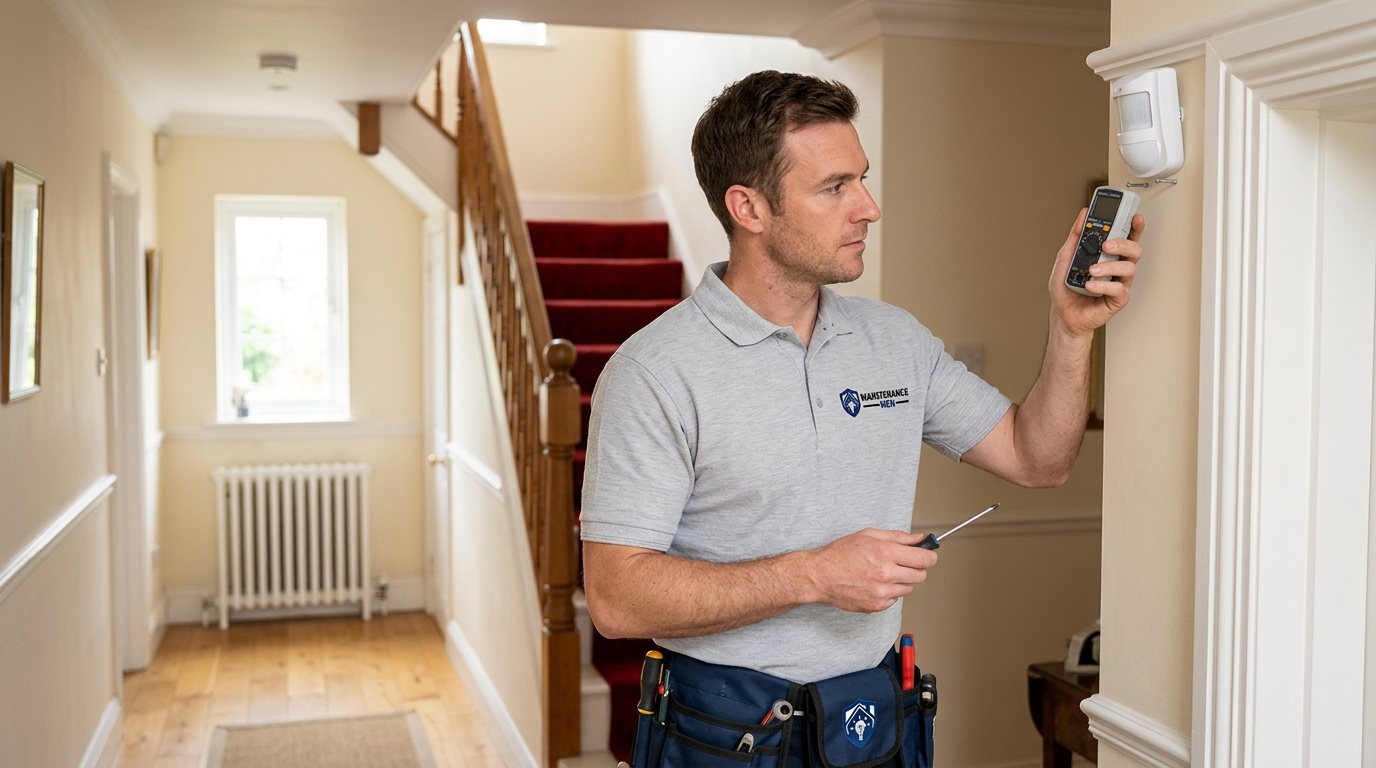
False Motion Alarms Driving You Mad? Let's Find the Real Trigger in West Bromwich
We diagnose what is actually setting your sensor off — pets, sunlight, draughts, placement or batteries — instead of you silencing it and losing the protection.
Booking fee plus hourly labour — the price is confirmed before any work starts.
What this costs
| Booked 14+ days ahead | £25 booking fee £85 per hour |
|---|---|
| Booked within 48 hours | £100 booking fee £65 per hour |
| Same-day call-out | £220 booking fee £45 per hour |
The booking fee secures the visit. Labour is then charged by the hour, so you only pay for the time the job actually takes.
Booking fee £25–£220
£25 + £85/hr booked 14+ days ahead, £100 + £65/hr inside 48 hours, £220 + £45/hr same day. Agreed before we arrive.
Covered under Sensors & Detectors
Security & CCTV › Sensors & Detectors — one of 22 documented jobs in this section.
Same-day false motion sensor alarms
Urgent jobs can often be booked for today. Ask when you book and we will confirm the slot before you pay anything.
15 service areas
Birmingham, Coventry, Dorridge and 12 more across the West Midlands.
When a motion sensor keeps triggering an alarm with nobody in the room, something real is causing it — the sensor is rarely lying without a reason. Insects crawling across the lens, a heater or radiator puffing warm air, sunlight moving across a wall as clouds pass, curtains drifting in a draught, a pet wandering through at floor level, even a spider web catching the light — all of these are classic false-trigger causes for passive infrared sensors, and all of them are fixable. The worst response is to repeatedly silence the alarm or disable the zone, because that removes your detection entirely while the cause carries on unnoticed. Our approach is the opposite: diagnose first, then adjust placement, settings or surroundings so the sensor detects what it should and ignores what it should not.
What actually sets off a false alarm
Passive infrared sensors detect moving heat, so anything that moves heat or looks like it does can fool them. The top causes we see are pets, especially cats on worktops and dogs in rooms the system was not designed to cover; direct sunlight or the reflections from glass doors and conservatory roofs; warm air currents from open fires, radiators and tumble dryer vents; curtains or blinds moving near an open window or draughty door; insects and spiders in or on the lens; and simply a sensor mounted too low, too close to a heat source or pointed at a window. A sensor whose battery is nearly flat can also behave erratically, generating nuisance triggers as its electronics waver. Occasionally the fault is in the equipment itself — a failing sensor or a panel fault — and that needs proper testing rather than adjustment.
How we diagnose it
We begin with the history: which sensor trips, at what times of day, in what weather, and whether pets have access to the area. That pattern is usually very telling — a sensor that trips on sunny afternoons points one way, one that trips at 3am points another. We then inspect the sensor's position, its field of view, its lens for contamination, its mounting and its battery. Where the equipment allows, we check and adjust sensitivity settings and look at whether the sensor type suits the room — for example, a pet-sensitive or curtain-style sensor in a room where the current one keeps tripping. We test after each change, because an adjustment that is not verified is not an adjustment.
The fixes we can make
Many false-alarm problems are solved by repositioning or re-aiming the sensor, changing its mounting height or angle, cleaning the lens, fitting a fresh battery, or adjusting sensitivity and pet-tolerance settings within what the manufacturer supports. Sometimes the right answer is a different type of sensor for that location — for instance a dual-technology unit in a difficult room — and we will quote that honestly as an option rather than pretend a tweak will do. If the sensor itself is faulty, we will say so and quote a replacement separately. Every fix is agreed with you before work starts.
Honest limits
No sensor can be promised never to false-alarm in every condition; what we can do is identify the actual trigger in your home and engineer it out. If a room is genuinely hostile to motion detection — a conservatory in full sun, for example — we will tell you that rather than take money for a fix we do not believe in.
Booking a diagnosis
Get in touch by phone or through the website and describe the pattern: which sensor, roughly when it trips, whether pets or sunlight are involved, and whether you have silenced the zone in the meantime. You pay a booking fee when you book, labour is charged hourly at a rate that depends on how quickly you need the visit, and the full cost is quoted and approved before work begins, with any parts quoted separately.
How the price works
We charge a booking fee to hold your slot, then an hourly rate for the work itself. The fee changes with how soon you need us; the hourly rate changes with the slot you choose. You approve the price before we start, so there is no surprise on the invoice.
Booked 14+ days ahead
£25 booking fee
then £85 per hour of labour
Best value. Book the slot now, pay the smallest booking fee.
Booked within 48 hours
£100 booking fee
then £65 per hour of labour
For jobs that can wait a day or two but not a fortnight.
Same-day call-out
£220 booking fee
then £45 per hour of labour
Urgent problems: standing water, no heat, no power, leaks.
Book the slot
Choose the window that suits you and pay the booking fee. That holds your place in the diary.
We diagnose on site
The engineer confirms the cause and tells you what the job involves and how long it should take.
You approve, we work
Nothing goes ahead until you agree the price. Labour is then charged per hour at your slot rate.
An alarm that keeps going off for no visible reason is exhausting, and the temptation to simply switch the zone off is completely understandable. But a muted sensor is an unprotected home, and almost every false alarm has a genuine physical cause behind it. We find that cause and put it right, so you can have both a quiet house and working detection.
What our customers say about our Security & CCTV service
5 out of 5 from 7 reviews
Would use again
Third time we have used Maintenance Men, and the same experience each time: agreed price, proper explanation, job done in one visit. The hourly rate is fair for the standard of work.
Job: CCTV Installation
Second time we have used them
I had put off sorting this for months because I expected a runaround. Quoted the booking fee plus hourly rate upfront, stuck to it, and actually found the underlying cause rather than just clearing the symptom. Worked neatly and hoovered up afterwards.
Job: Backup Battery Fault
Exactly what was quoted
What I appreciated was being told what was actually wrong before anyone started. Sorted in under 56 minutes and the invoice matched the quote to the penny.
Job: Alarm Repair Service
Book False Motion Sensor Alarms
Tell us what is happening and choose a slot. If you are not sure this is the right job, use the diagnosis panel — it narrows the problem down before you book.
- Booking fee confirmed up front
- Hourly labour, agreed before work starts
- Same-day slots for urgent problems





Questions people ask about false motion sensor alarms
Straight answers to the things customers ask most often before booking.
Should I just turn the zone off until the engineer comes?
Please don't make silencing the alarm a habit or disable the zone permanently — that leaves your home undetected while the cause continues. It is fine to acknowledge an individual alarm, but the aim of our visit is to fix the cause so you don't need to keep muting anything.
What do you check on a false-alarm diagnosis?
We look at which sensor trips and when, inspect its position, height and field of view, clean and check the lens, test the battery, review sensitivity and pet settings, and check for heat sources, draughts and sunlight in its line of sight. Then we test the changes with you.
Can my pets really set off a motion sensor?
Yes — pets moving through a room are a very common cause of false alarms, particularly cats and medium-to-large dogs. Some sensors have pet-tolerant designs and placement matters enormously. We will assess your situation honestly rather than promise that any sensor is completely pet-proof.
Can the false alarms be a sign of something dangerous?
Very rarely a nuisance trigger is actually the sensor flagging something real, such as overheating equipment in its field of view. If an alarm sounds and you ever smell burning or see smoke, treat it as real, get people out and call 999 — then we can investigate the sensor afterwards.
What does a false-alarm diagnosis cost?
You pay a booking fee when you book, and labour is charged hourly at a rate that depends on how soon you need the visit. After diagnosis we quote the full cost of the work and you approve it before we start, with any parts, such as a replacement sensor, quoted separately.
Need false motion sensor alarms sorted in West Bromwich?
Book a slot in the diary and pay only the booking fee up front. We confirm the rest before we start.