
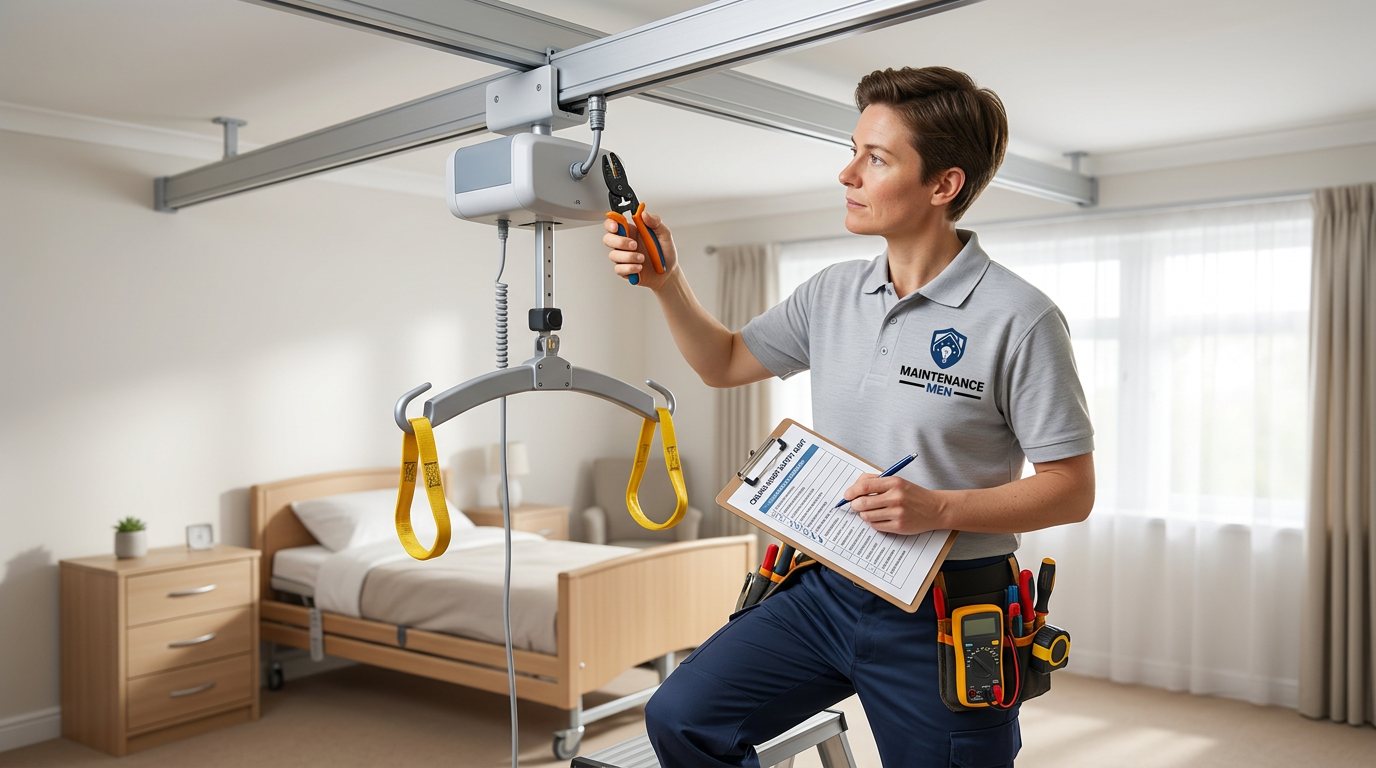
Hoist Moving Slower Than It Used To? We'll Check What's Changed in Wolverhampton
We measure the lift against the manufacturer's stated speed, then check battery condition, track friction and motor wear to see whether something has changed or it was always like this.
Booking fee plus hourly labour — the price is confirmed before any work starts.
What this costs
| Booked 14+ days ahead | £25 booking fee £85 per hour |
|---|---|
| Booked within 48 hours | £100 booking fee £65 per hour |
| Same-day call-out | £220 booking fee £45 per hour |
The booking fee secures the visit. Labour is then charged by the hour, so you only pay for the time the job actually takes.
Booking fee £25–£220
£25 + £85/hr booked 14+ days ahead, £100 + £65/hr inside 48 hours, £220 + £45/hr same day. Agreed before we arrive.
Covered under Hoists & Lifting Equipment
Mobility & Accessibility › Hoists & Lifting Equipment — one of 22 documented jobs in this section.
Same-day slow lifting speed
Urgent jobs can often be booked for today. Ask when you book and we will confirm the slot before you pay anything.
15 service areas
Birmingham, Coventry, Dorridge and 12 more across the West Midlands.
Not every slow hoist is a faulty hoist. Patient hoists are deliberately geared to move slowly and smoothly, and the stated speed in the manual is often lower than people expect.
First, What the Design Says
Check the manual or the data plate for the rated lifting speed. Many ceiling hoists are specified at a modest speed by design, because a slow, controlled lift is easier for the person being moved and gives the carer time to watch for problems. If your unit has always moved at that pace, nothing has changed and nothing needs fixing. If it has clearly slowed from what it used to do, that is a different conversation.
What Makes a Hoist Slow Down
- A battery losing capacity. The motor gets less voltage and turns more slowly, especially under load. This is the most common cause and the easiest to test.
- A charger or dock that is not delivering a full charge, so the hoist starts every lift partly depleted.
- Track friction. Dry or worn trolley rollers, debris on the track, a joint that has shifted, or a track that is no longer running level.
- Motor wear. Worn brushes and a tired motor produce less torque and a lower speed under load.
- Brake drag. A brake that does not fully release adds resistance to every lift.
- Stiff grease in a cold room, which affects mobile hoists more than track units.
- Wrong sling geometry, making the motor work against an awkward angle rather than a straight pull.
- A speed setting changed on units that offer more than one speed, often after a handset replacement or a re-pair.
How We Measure It
We compare what the unit actually does against the manufacturer's specification rather than against memory. That means timing a full lift and lowering under a controlled load, listening to the motor under load and unloaded, and testing the battery under current. We then check the mechanical side: the trolley running free by hand along the whole track, the condition of the rollers and joints, the brake releasing cleanly, and on mobile units the actuator and castors.
Repairs and Realistic Expectations
Battery replacement, charger repair, track cleaning and roller replacement, brake adjustment and control settings are all realistic fixes, and any of them can restore the original speed. Motor or gearbox wear on an older unit may not be economic to repair, and we will say so with the figures in front of you rather than after the work. What we will not do is alter a hoist to run faster than its manufacturer intended. Speed affects how the person being lifted experiences the move, and it is not ours to change on a whim.
Suitability Is Not Ours to Judge
If the concern is that the speed no longer suits the person being lifted — too fast, too slow, unsettling — that is a question about the equipment's suitability for their needs. It belongs with the user, their family and carers, the manufacturer's specification and, where involved, an occupational therapist. We repair and maintain; we do not make clinical judgements or certify equipment as appropriate for an individual.
Safety While It Is Slow
A hoist that is merely slow but otherwise smooth and reliable is usually safe to use, provided the battery is not cutting out under load. A hoist that is slow and also hesitates, stalls or makes a labouring noise is not — take it out of service. Never be tempted to speed a lift along by pushing the trolley or taking the weight of the sling; that puts strain on the fixings and on the person. If it stops with someone in the sling, keep them comfortable and call 999 if they are in pain or distress, and use emergency lowering only as the manufacturer's instructions describe.
Aftercare
After any repair we time the lift again so you can see the difference, test the brake and emergency lowering, and check the charging routine. We will also tell you what normal looks like for your model, so you know what to watch for in future.
Booking
Tell us the make and model, whether the hoist has always been this speed or has slowed recently, and whether it is slower loaded than empty. You pay a booking fee when you book, the hourly labour rate depends on how soon you need the visit, and the full cost is quoted and approved before work starts.
How the price works
We charge a booking fee to hold your slot, then an hourly rate for the work itself. The fee changes with how soon you need us; the hourly rate changes with the slot you choose. You approve the price before we start, so there is no surprise on the invoice.
Booked 14+ days ahead
£25 booking fee
then £85 per hour of labour
Best value. Book the slot now, pay the smallest booking fee.
Booked within 48 hours
£100 booking fee
then £65 per hour of labour
For jobs that can wait a day or two but not a fortnight.
Same-day call-out
£220 booking fee
then £45 per hour of labour
Urgent problems: standing water, no heat, no power, leaks.
Book the slot
Choose the window that suits you and pay the booking fee. That holds your place in the diary.
We diagnose on site
The engineer confirms the cause and tells you what the job involves and how long it should take.
You approve, we work
Nothing goes ahead until you agree the price. Labour is then charged per hour at your slot rate.
Speed is one of those things people notice before they can describe it. A lift that used to take a certain time now takes longer, or the motor sounds like it is working harder to do the same job. Sometimes that is wear and sometimes it is simply how the hoist was designed, and the difference matters — one needs a repair, the other needs reassurance.
What our customers say about our mobility & accessibility service
4.5 out of 5 from 8 reviews
Proper job, no upselling
Turned up in the window they promised, walked me through the options (turns out the old fitting was seized and needed careful removal), then cracked on. Everything was tested before they left. No mess, no drama, no surprise on the bill.
Job: Loose or Faulty Brakes
Fine in the end
The problem is fixed, which is the main thing, and the engineer clearly knew what they were doing. It took a fair bit longer than the estimate on the phone and I had to ask twice for a breakdown of the hours.
Job: Stair Lift Service
Would use again
What I appreciated was being told what was actually wrong before anyone started. Sorted in under 70 minutes and the invoice matched the quote to the penny.
Job: Control Panel Fault
Book Slow Lifting Speed
Tell us what is happening and choose a slot. If you are not sure this is the right job, use the diagnosis panel — it narrows the problem down before you book.
- Booking fee confirmed up front
- Hourly labour, agreed before work starts
- Same-day slots for urgent problems






Questions people ask about slow lifting speed
Straight answers to the things customers ask most often before booking.
Is a slow hoist something I can fix myself?
Charging checks and cleaning the track are reasonable, and if your manual lists a speed setting you can confirm it has not been changed. Anything involving the motor, brake, gearbox or control box is engineer work. Please do not open the unit or adjust the mechanism to try to make it faster.
What will you check?
We time the lift against the manufacturer's stated speed, test the battery under load, check the charger and dock, run the trolley along the track by hand to feel for drag, and check the brake releases properly. On mobile hoists we look at the actuator and castors. That tells us whether this is wear, friction or normal design.
Can you speed it up for us?
Only within what the manufacturer allows, and only if a setting has genuinely been changed. We will not modify a hoist to run faster than its design speed — that affects how safe and comfortable the lift is for the person being moved. If the speed does not suit them, that is a suitability question for the manufacturer and their care team.
It's slower with a person in the sling than when empty. Does that mean it's failing?
Some reduction under load is normal, but a marked difference usually points to a battery that is losing capacity or a motor that is worn. It is worth testing, because a battery that sags under load will eventually cut out mid-lift rather than simply run slowly.
What does the visit cost?
You pay a booking fee when you book, and the hourly labour rate depends on how soon you need the visit. We quote the full cost of the work and you approve it before we start, with any parts identified and quoted separately.
Need slow lifting speed sorted in Wolverhampton?
Book a slot in the diary and pay only the booking fee up front. We confirm the rest before we start.