
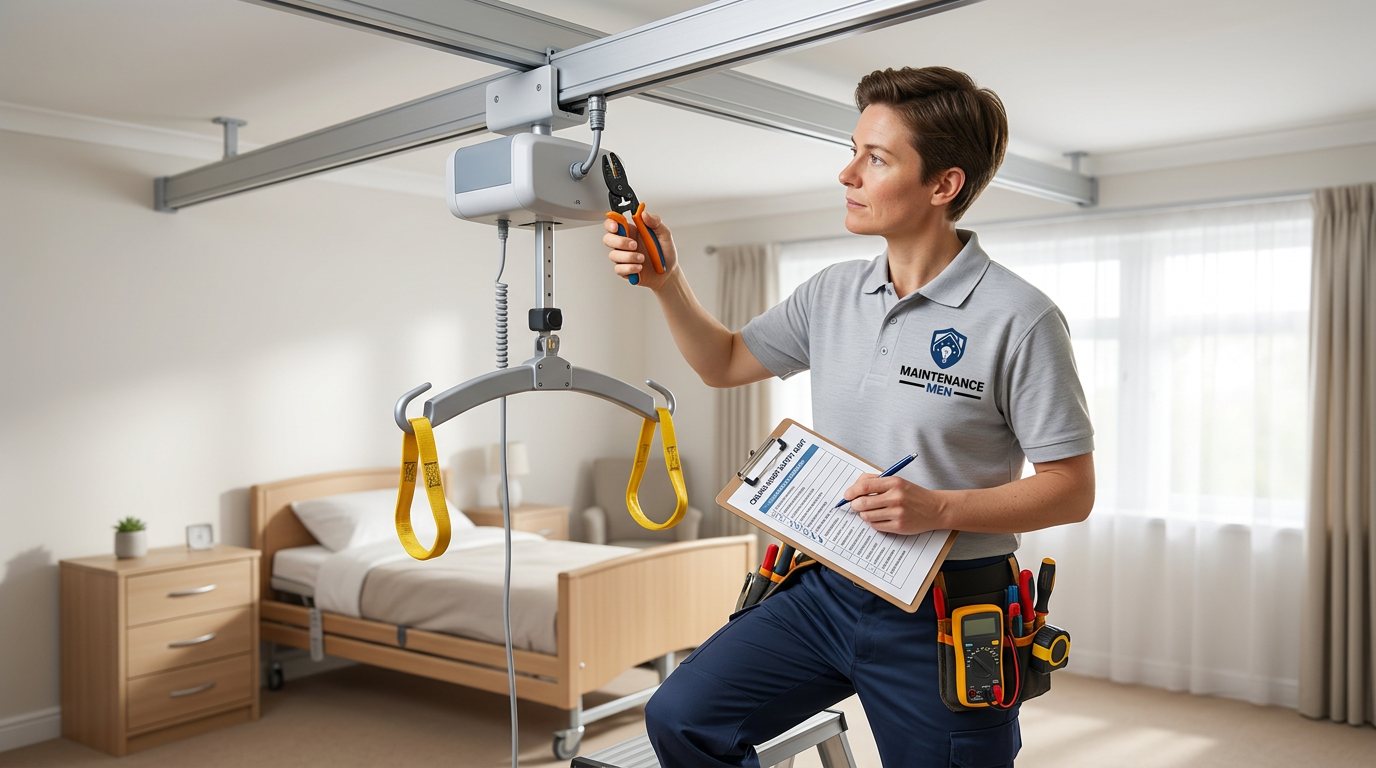
Hoist Tripping Your Electrics? Stop Using It and Let Us Find the Leak in Wolverhampton
We test the charger, cabling, control box and motor for insulation and earth faults, isolate what is faulty and quote the repair before touching anything else.
Booking fee plus hourly labour — the price is confirmed before any work starts.
What this costs
| Booked 14+ days ahead | £25 booking fee £85 per hour |
|---|---|
| Booked within 48 hours | £100 booking fee £65 per hour |
| Same-day call-out | £220 booking fee £45 per hour |
The booking fee secures the visit. Labour is then charged by the hour, so you only pay for the time the job actually takes.
Booking fee £25–£220
£25 + £85/hr booked 14+ days ahead, £100 + £65/hr inside 48 hours, £220 + £45/hr same day. Agreed before we arrive.
Covered under Hoists & Lifting Equipment
Mobility & Accessibility › Hoists & Lifting Equipment — one of 22 documented jobs in this section.
Same-day electrical fault in hoist system
Urgent jobs can often be booked for today. Ask when you book and we will confirm the slot before you pay anything.
15 service areas
Birmingham, Coventry, Dorridge and 12 more across the West Midlands.
Hoists live in bathrooms and wet rooms, which is hard on electrics, and they are used by people who cannot easily get out of the way if something goes wrong. That combination is why we treat electrical faults as a stop-and-call problem.
Why It Matters More Than It Looks
An RCD that trips when the hoist is used is detecting current leaking to earth — through damp, through damaged insulation, through carbon dust in a motor. It is doing its job. Repeatedly resetting it, or swapping the hoist onto an extension lead to get around it, defeats the one device protecting the person using the equipment. A burning smell, a hot plug, a discoloured socket or a buzzing control box are all signs of a fault that is already generating heat. Switch off at the spur or unplug the charger and leave it alone.
What Counts as an Electrical Fault
- The consumer unit or RCD trips when the hoist is charged or operated.
- The unit works only on some days, or only when the weather is dry.
- There is a tingling sensation when touching the track, the motor casing or the handset.
- A burning smell, scorch marks, a melted plug or a warm charger that stays warm when not charging.
- The unit cuts out under load with no mechanical explanation.
- Lights flicker elsewhere in the house when the hoist runs.
Any one of these justifies a proper test rather than an opinion.
Where the Fault Usually Sits
Water ingress is the leading cause in this setting: steam condensing inside a control box, a drip running down a track to the motor, or a wet floor and a charger lead lying in it. Damaged charger leads are next, especially where the cable is pulled across a floor or trapped by a door. Worn motor brushes produce conductive carbon dust inside the motor housing. Damp or corroded track wiring, cracked control box seals, and chargers that have simply aged internally all appear regularly. Occasionally the fault is not the hoist at all but a tired RCD or a socket circuit with its own problem, which is why we test rather than assume.
How We Test It
We isolate the hoist, then test in a deliberate order: visual inspection of the charger, plug, lead and control box for heat damage and water marks; insulation resistance and earth continuity on the unit and its supply lead; a check of the charger's output under load; and an RCD trip test on the circuit, so we know whether the protection itself is working. On the mechanical side we check the motor for brush wear and carbon build-up, and the track wiring for corrosion at the joints. Only when we know which item is leaking current do we discuss replacement.
Repairs We Can Make
Replacing a charger, a supply lead, a handset cable, a control box or a motor is within our scope, using manufacturer-approved parts. Where water has got in, we clean, dry and reseal properly rather than just drying it out and hoping. If the fault is in the fixed wiring — a damaged spur, a socket circuit issue, a lack of proper earthing — we will explain what needs doing and carry out the electrical work we are competent for, isolating the circuit while we do it. If the fixed installation needs a larger alteration, we will say so and quote it as a separate piece of work rather than improvise.
Limits You Should Know
We cannot certify a hoist as electrically safe for a user's medical needs, and we do not make clinical judgements about who should use it. We also cannot promise a repair will not recur if the room stays steamy and the unit is not ventilated — we will tell you what would help. Parts availability is checked, never assumed, and no repair time is promised before diagnosis.
What to Do Tonight
Switch it off at the spur, unplug the charger, and do not use the hoist. If the person needs moving, use alternative arrangements rather than a unit with a known electrical fault. If anything is hot, scorched or smoking, isolate the circuit at the consumer unit and call us; if there is fire or smoke you cannot control, leave the property and call 999.
Booking
Tell us what trips, when it trips, whether anything smells or feels warm, and the make and model of the hoist and charger. You pay a booking fee when you book, labour is charged hourly at a rate that depends on how soon you need us, and the full cost is quoted and approved before work starts.
How the price works
We charge a booking fee to hold your slot, then an hourly rate for the work itself. The fee changes with how soon you need us; the hourly rate changes with the slot you choose. You approve the price before we start, so there is no surprise on the invoice.
Booked 14+ days ahead
£25 booking fee
then £85 per hour of labour
Best value. Book the slot now, pay the smallest booking fee.
Booked within 48 hours
£100 booking fee
then £65 per hour of labour
For jobs that can wait a day or two but not a fortnight.
Same-day call-out
£220 booking fee
then £45 per hour of labour
Urgent problems: standing water, no heat, no power, leaks.
Book the slot
Choose the window that suits you and pay the booking fee. That holds your place in the diary.
We diagnose on site
The engineer confirms the cause and tells you what the job involves and how long it should take.
You approve, we work
Nothing goes ahead until you agree the price. Labour is then charged per hour at your slot rate.
An electrical fault on a hoist is the one category of problem where the right response is to stop immediately, and we would rather you rang us with a hoist that is switched off than carried on with one that keeps tripping the board. A tripping RCD means current is going somewhere it should not, and a burning smell means something is already overheating. Neither improves with use.
What our customers say about our mobility & accessibility service
4.5 out of 5 from 8 reviews
Proper job, no upselling
Turned up in the window they promised, walked me through the options (turns out the old fitting was seized and needed careful removal), then cracked on. Everything was tested before they left. No mess, no drama, no surprise on the bill.
Job: Loose or Faulty Brakes
Fine in the end
The problem is fixed, which is the main thing, and the engineer clearly knew what they were doing. It took a fair bit longer than the estimate on the phone and I had to ask twice for a breakdown of the hours.
Job: Stair Lift Service
Would use again
What I appreciated was being told what was actually wrong before anyone started. Sorted in under 70 minutes and the invoice matched the quote to the penny.
Job: Control Panel Fault
Book Electrical Fault in Hoist System
Tell us what is happening and choose a slot. If you are not sure this is the right job, use the diagnosis panel — it narrows the problem down before you book.
- Booking fee confirmed up front
- Hourly labour, agreed before work starts
- Same-day slots for urgent problems






Questions people ask about electrical fault in hoist system
Straight answers to the things customers ask most often before booking.
The RCD only trips now and then. Can I keep using it until it gets worse?
No — an occasional trip is an early warning, not a small problem, and the next event could happen with someone in the sling. Please switch it off at the spur and leave it until it has been tested. Intermittent earth faults in a steamy room tend to become permanent quite quickly.
What will you do on the visit?
We isolate the unit and inspect the charger, plug, lead and control box for heat and water damage, then test insulation resistance and earth continuity, check the charger output under load and test the RCD on the circuit. We also look at motor brushes and track wiring. That identifies the leak before anything is replaced.
Is it safe for me to reset the trip and try again?
Resetting once to see whether it was a one-off is understandable, but repeated resetting is not. If it trips again, stop and call us. Never run the hoist from an extension lead or a different socket to get around a trip — that removes the protection designed to keep the user safe.
Could the fault be the house wiring rather than the hoist?
Yes, and that is one reason we test rather than assume. A tired RCD, a damaged spur or a socket circuit fault can all look like a hoist fault. We test the circuit as well as the equipment, and we tell you which side of the plug the problem sits on.
What does it cost?
You pay a booking fee when you book, and the hourly labour rate depends on how soon you need the visit. The full cost of the work is quoted and approved before we start, and any parts, such as a charger or control box, are quoted separately.
Need electrical fault in hoist system sorted in Wolverhampton?
Book a slot in the diary and pay only the booking fee up front. We confirm the rest before we start.