
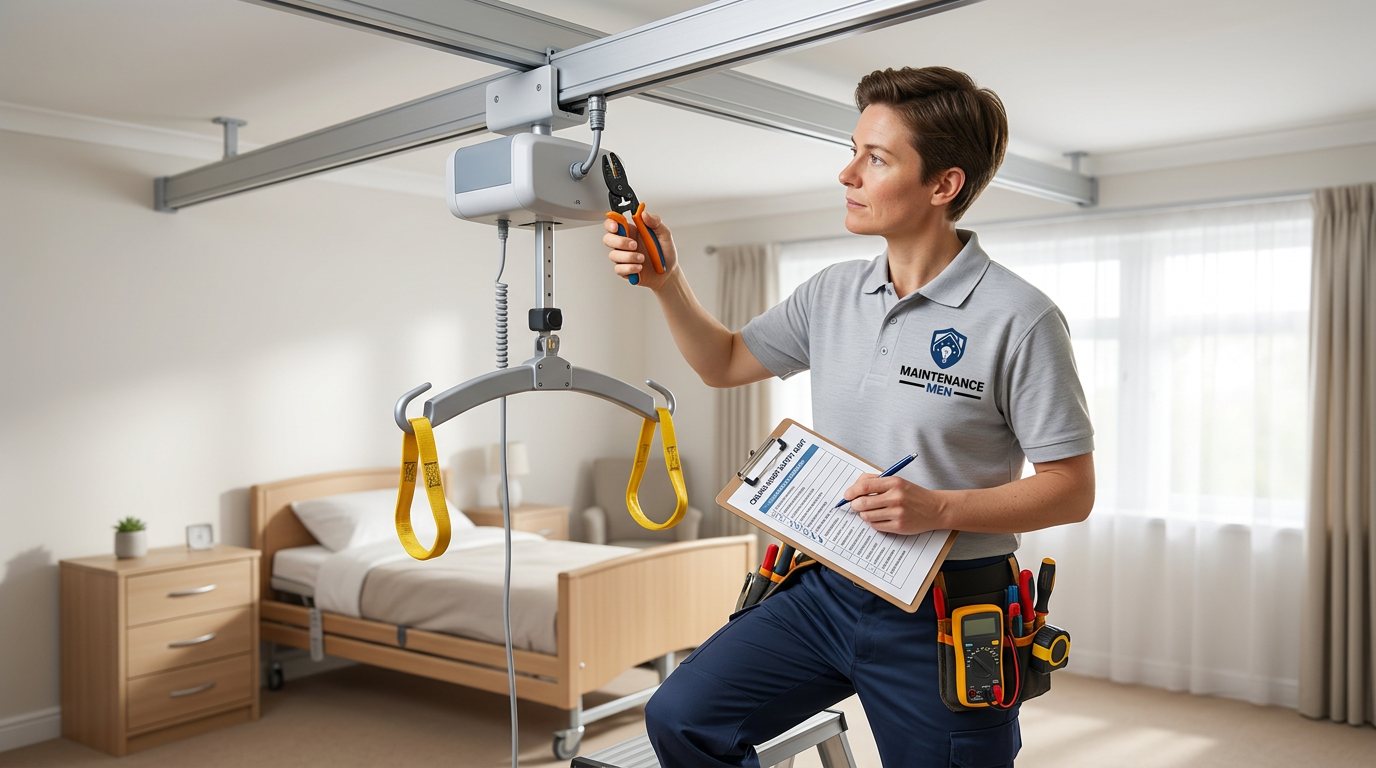
Overload Warning Sounding Wrongly? We'll Test the Load Sensing Properly in Warwick
We check the load cell or current sensing, its wiring and the control settings to establish whether the warning is a false alarm or a genuine overload being reported.
Booking fee plus hourly labour — the price is confirmed before any work starts.
What this costs
| Booked 14+ days ahead | £25 booking fee £85 per hour |
|---|---|
| Booked within 48 hours | £100 booking fee £65 per hour |
| Same-day call-out | £220 booking fee £45 per hour |
The booking fee secures the visit. Labour is then charged by the hour, so you only pay for the time the job actually takes.
Booking fee £25–£220
£25 + £85/hr booked 14+ days ahead, £100 + £65/hr inside 48 hours, £220 + £45/hr same day. Agreed before we arrive.
Covered under Hoists & Lifting Equipment
Mobility & Accessibility › Hoists & Lifting Equipment — one of 22 documented jobs in this section.
Same-day weight limit warning issue
Urgent jobs can often be booked for today. Ask when you book and we will confirm the slot before you pay anything.
15 service areas
Birmingham, Coventry, Dorridge and 12 more across the West Midlands.
Load warning systems are safety devices, and a safety device that cries wolf is on its way to being ignored. The diagnosis has two halves: is the load genuinely over the limit, and is the sensing telling the truth?
How Hoists Detect Load
There are two common approaches. Some hoists use a load cell or strain gauge in the spreader bar or the lifting point, which measures actual force. Others infer load from motor current — the harder the motor works, the higher the current, and the control box treats a sustained high current as an overload. Current-based systems are simpler but easier to mislead: a stiff track, a cold room, a dragging brake or a tired battery can all make the motor work harder than the load alone would justify, and the warning sounds without anything being too heavy.
What the Symptoms Tell Us
- Warning sounds with nothing in the sling. Usually a sensing or calibration fault, or a control setting that has changed.
- Warning sounds only at one point on the track. Suggests mechanical drag rather than load — a joint, a roller or an obstruction.
- Warning sounds with a particular person but not others. Worth checking the rated capacity honestly, including the sling and spreader bar. It may be correct.
- No warning at all, even with a heavy load. The more serious fault, because the protection has stopped working.
- Warning sounds and the hoist refuses to lift. The unit is doing what it was designed to do; the question is whether the trigger is real.
How We Test
We establish the rated capacity from the data plate and add up what is actually being lifted, including the sling and any accessories, because people routinely forget those. We then test the unit under a controlled load within capacity, watching for a warning that should not occur, and check the battery under load and the track for drag, since both can trigger current-based systems falsely. If the unit has a load cell, we inspect it and its wiring in the spreader bar for damage, and check the connection to the control box. We do not recalibrate a load sensing system unless the manufacturer's procedure supports it — a wrongly calibrated safety device is worse than one that is obviously broken.
Repairs and Limits
Damaged load cell wiring, a failed spreader bar sensor, a control box setting that has reverted, a battery that cannot deliver current without sagging, and mechanical drag on the track are all fixable. Where the sensing is inside a sealed spreader bar, the usual remedy is replacement of the bar rather than repair, and we will quote that honestly. What we will not do is disable the warning, raise the threshold to stop it annoying you, or fit a non-approved sensor. And we cannot tell you whether a given hoist is suitable for a particular person — weight limits and equipment choice belong with the user, their family and carers, and the manufacturer's specification.
If the Warning Sounds Mid-Lift
Lower the person if it is safe and comfortable to do so, following the manufacturer's instructions, and do not continue the lift by overriding anything. If they are suspended and cannot be lowered, keep them calm and comfortable and call 999 if they are in pain or distress. Never add a second person to take the weight or push the trolley to get past a warning.
Keeping It Honest
Have the load warning checked at every service rather than only when it misbehaves, keep the sling and spreader bar free of damage, and record the rated capacity somewhere visible so everyone using the hoist knows the real limit. If the same warning keeps appearing with the same person, that is worth a proper conversation about equipment rather than another repair.
Booking
Tell us the make and model, what the warning does and when, what is normally being lifted, and whether the unit refuses to lift or merely beeps. You pay a booking fee when you book, labour is charged hourly at a rate that depends on how soon you need the visit, and the full cost is quoted and approved before work starts.
How the price works
We charge a booking fee to hold your slot, then an hourly rate for the work itself. The fee changes with how soon you need us; the hourly rate changes with the slot you choose. You approve the price before we start, so there is no surprise on the invoice.
Booked 14+ days ahead
£25 booking fee
then £85 per hour of labour
Best value. Book the slot now, pay the smallest booking fee.
Booked within 48 hours
£100 booking fee
then £65 per hour of labour
For jobs that can wait a day or two but not a fortnight.
Same-day call-out
£220 booking fee
then £45 per hour of labour
Urgent problems: standing water, no heat, no power, leaks.
Book the slot
Choose the window that suits you and pay the booking fee. That holds your place in the diary.
We diagnose on site
The engineer confirms the cause and tells you what the job involves and how long it should take.
You approve, we work
Nothing goes ahead until you agree the price. Labour is then charged per hour at your slot rate.
A weight limit warning that sounds when it should not is tempting to ignore — and that is exactly why it needs attention. The same device that is annoying you today is the one that will warn you when a lift is genuinely too heavy. We would rather establish whether the warning is false or correct than have you learn to dismiss it.
What our customers say about our mobility & accessibility service
4.5 out of 5 from 8 reviews
Proper job, no upselling
Turned up in the window they promised, walked me through the options (turns out the old fitting was seized and needed careful removal), then cracked on. Everything was tested before they left. No mess, no drama, no surprise on the bill.
Job: Loose or Faulty Brakes
Fine in the end
The problem is fixed, which is the main thing, and the engineer clearly knew what they were doing. It took a fair bit longer than the estimate on the phone and I had to ask twice for a breakdown of the hours.
Job: Stair Lift Service
Would use again
What I appreciated was being told what was actually wrong before anyone started. Sorted in under 70 minutes and the invoice matched the quote to the penny.
Job: Control Panel Fault
Book Weight Limit Warning Issue
Tell us what is happening and choose a slot. If you are not sure this is the right job, use the diagnosis panel — it narrows the problem down before you book.
- Booking fee confirmed up front
- Hourly labour, agreed before work starts
- Same-day slots for urgent problems


Questions people ask about weight limit warning issue
Straight answers to the things customers ask most often before booking.
Can I just turn the warning off?
No, and we will not do it either. That warning is the only thing standing between a marginal lift and a structural or mechanical failure. If it is sounding falsely we will find and fix the cause; silencing it would leave the hoist unprotected.
What will you check?
We confirm the rated capacity and what is actually being lifted including the sling, test under a controlled load within capacity, check the battery under current, look for drag on the track and brake, and inspect the load cell or spreader bar wiring if the unit uses one. That separates a false alarm from a real overload.
The warning sounds but the hoist still lifts. Is that safe?
Not really. A warning that can be ignored is a warning that will eventually be ignored at the wrong moment. Please stop using the hoist until it has been checked, especially if the same lift used to work without a warning.
It only warns for one particular person. Does that mean they're too heavy?
It might, and it is worth checking honestly including the sling and any accessories in the total. If the combined weight is at or above the rated capacity, the equipment is not suitable for that lift and no repair will change that — we will say so plainly rather than adjust the warning.
What does it cost?
You pay a booking fee when you book, and the hourly labour rate depends on how soon you need the visit. The full cost of the work is quoted and approved before we start, with any parts such as a spreader bar quoted separately.
Need weight limit warning issue sorted in Warwick?
Book a slot in the diary and pay only the booking fee up front. We confirm the rest before we start.