
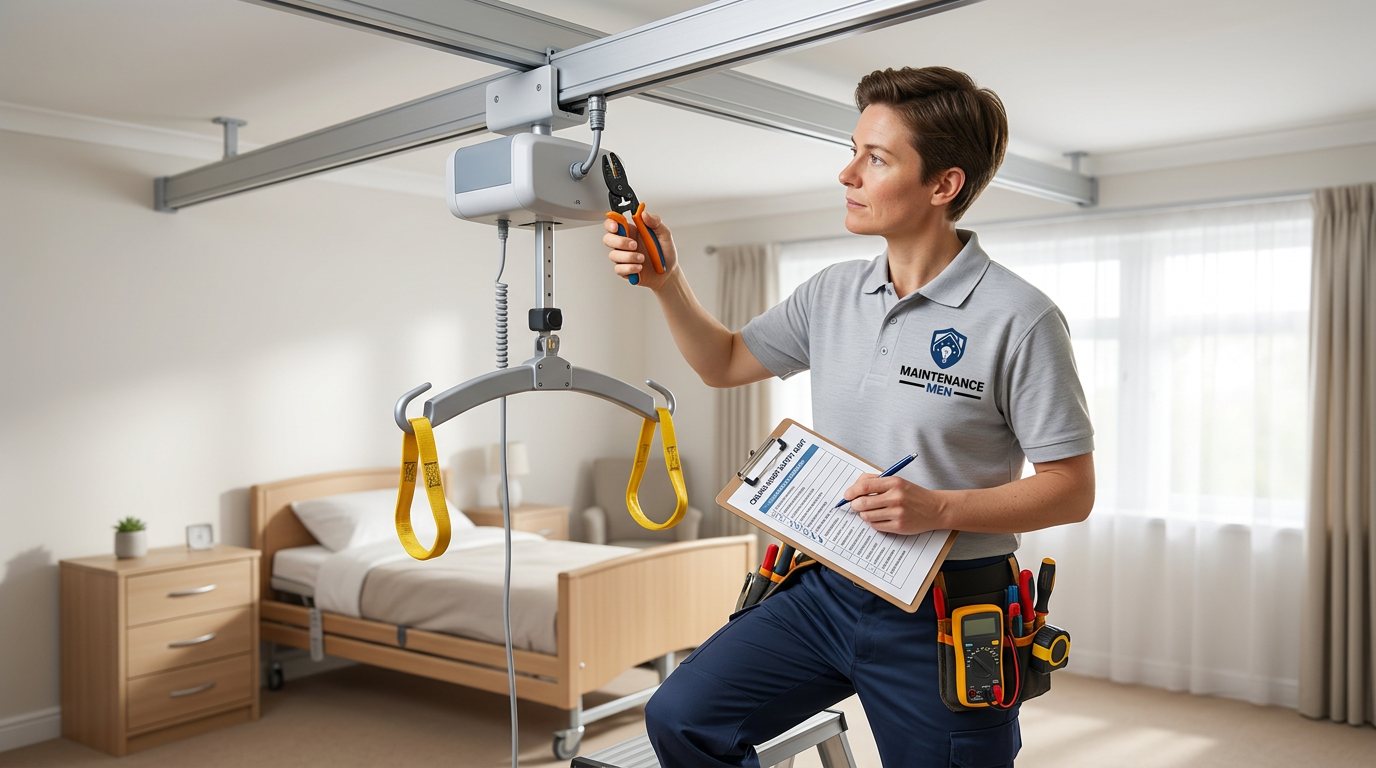
Hoist Battery Not Holding Charge? We'll Test It Properly and Replace It in Warwick
We measure the battery under load, check the charger and dock, and confirm whether the battery, the charging circuit or the control box is at fault.
Booking fee plus hourly labour — the price is confirmed before any work starts.
What this costs
| Booked 14+ days ahead | £25 booking fee £85 per hour |
|---|---|
| Booked within 48 hours | £100 booking fee £65 per hour |
| Same-day call-out | £220 booking fee £45 per hour |
The booking fee secures the visit. Labour is then charged by the hour, so you only pay for the time the job actually takes.
Booking fee £25–£220
£25 + £85/hr booked 14+ days ahead, £100 + £65/hr inside 48 hours, £220 + £45/hr same day. Agreed before we arrive.
Covered under Hoists & Lifting Equipment
Mobility & Accessibility › Hoists & Lifting Equipment — one of 22 documented jobs in this section.
Same-day battery backup failure
Urgent jobs can often be booked for today. Ask when you book and we will confirm the slot before you pay anything.
15 service areas
Birmingham, Coventry, Dorridge and 12 more across the West Midlands.
Battery faults account for a large share of hoist call-outs, and they are among the most straightforward to put right — provided the diagnosis is done properly rather than assumed.
What a Failing Battery Looks Like
A battery that is on its way out will still run the handset and often still lift an empty carry bar. Under the load of a person it sags, the control box sees low voltage and shuts down, and the lift stops. Other signs: fewer lifts per charge than you used to get, a charge indicator that never quite reaches full, a battery that becomes warm during charging, a unit that only works reliably just after charging, and a charger that shows green almost immediately. If the charger finishes suspiciously fast, the battery is usually the reason.
Why Batteries Fail Early
These are sealed lead-acid or lithium packs living in a warm, steamy room, and they are asked to deliver high current in short bursts. Leaving a hoist off its charger for days or weeks is the single biggest cause — the cells sulphate and lose capacity permanently. Frequent short top-ups rather than full cycles, a charger that has drifted out of specification, a battery left flat over a holiday, and simple age all contribute. On ceiling hoists charged through a dock, poor contact means the battery is chronically undercharged even though it appears to be on charge.
Testing Rather Than Guessing
We measure the battery's open-circuit voltage, then its voltage under a real load, because the difference between those two figures is the diagnosis. A pack that reads healthy at rest and collapses under current is worn out, whatever its age suggests. We check the charger's output against the manufacturer's specification, inspect and clean the dock contacts, confirm the charge indicator circuit is telling the truth, and check the battery terminals and connector for corrosion. Only then do we discuss replacement.
Replacement and What It Involves
Batteries are a consumable and we fit manufacturer-approved packs rather than generic equivalents, because the charging profile and the connector have to match. Fitting is usually quick; the important part is confirming afterwards that the new pack charges fully, holds its voltage under load and gives the expected number of lifts. If the real fault turns out to be the charger or the control box's charging circuit, replacing the battery alone would have wasted your money, which is why we test first.
A Word on Backup Batteries
Some hoists carry a small backup battery to power emergency lowering or to hold the control system's memory when the main pack is disconnected. If that backup has failed, emergency lowering may not work when you need it — a fault you cannot see until the day it matters. We test it as part of the visit and replace it if it will not hold.
Charging Habits That Make Batteries Last
Put the hoist on charge after every period of use rather than waiting for the indicator to drop. Keep the charger connected when the unit is idle. Keep the dock contacts clean and make sure the trolley parks fully home. Avoid leaving the unit in a hot cupboard or in direct sun. If the hoist is used several times a day, expect the battery to be replaced more often — that is normal wear, not a fault.
Safety and Scope
Do not open a battery pack, bypass a charger, or fit a pack of a different voltage or chemistry because it happens to fit the connector. Do not use a hoist whose battery is cutting out under load, even if it works when empty — the failure will happen with someone in the sling. We cannot advise whether a particular hoist or its battery capacity suits a user's needs; that is a matter for the user, their family and carers, and the manufacturer's specifications. If someone is suspended and the unit has cut out, keep them calm and comfortable and call 999 if they are in pain or distress; emergency lowering is only for someone confident they can do it exactly as the manufacturer instructs.
Booking
Tell us the make and model, how old the battery is, how many lifts you get per charge and whether the charge light behaves normally. You pay a booking fee when you book, labour is charged hourly at a rate that depends on how soon you need us, and the full cost is quoted and approved before work begins, with the battery quoted separately.
How the price works
We charge a booking fee to hold your slot, then an hourly rate for the work itself. The fee changes with how soon you need us; the hourly rate changes with the slot you choose. You approve the price before we start, so there is no surprise on the invoice.
Booked 14+ days ahead
£25 booking fee
then £85 per hour of labour
Best value. Book the slot now, pay the smallest booking fee.
Booked within 48 hours
£100 booking fee
then £65 per hour of labour
For jobs that can wait a day or two but not a fortnight.
Same-day call-out
£220 booking fee
then £45 per hour of labour
Urgent problems: standing water, no heat, no power, leaks.
Book the slot
Choose the window that suits you and pay the booking fee. That holds your place in the diary.
We diagnose on site
The engineer confirms the cause and tells you what the job involves and how long it should take.
You approve, we work
Nothing goes ahead until you agree the price. Labour is then charged per hour at your slot rate.
A hoist battery rarely fails dramatically. It fades — the unit does fewer lifts between charges, the climb gets slower, the indicator drops from full to half in one lift, and eventually it stops partway. Because the decline is gradual, people adapt around it for weeks without realising the battery is the reason. Testing it under load takes minutes and settles the question.
What our customers say about our mobility & accessibility service
4.5 out of 5 from 8 reviews
Proper job, no upselling
Turned up in the window they promised, walked me through the options (turns out the old fitting was seized and needed careful removal), then cracked on. Everything was tested before they left. No mess, no drama, no surprise on the bill.
Job: Loose or Faulty Brakes
Fine in the end
The problem is fixed, which is the main thing, and the engineer clearly knew what they were doing. It took a fair bit longer than the estimate on the phone and I had to ask twice for a breakdown of the hours.
Job: Stair Lift Service
Would use again
What I appreciated was being told what was actually wrong before anyone started. Sorted in under 70 minutes and the invoice matched the quote to the penny.
Job: Control Panel Fault
Book Battery Backup Failure
Tell us what is happening and choose a slot. If you are not sure this is the right job, use the diagnosis panel — it narrows the problem down before you book.
- Booking fee confirmed up front
- Hourly labour, agreed before work starts
- Same-day slots for urgent problems




Questions people ask about battery backup failure
Straight answers to the things customers ask most often before booking.
Can I just order a battery online and fit it myself?
Replacing a battery is one of the few hoist tasks the user manual often permits, so if your manual shows how and the manufacturer supplies the correct pack, that is reasonable. Do not fit a different voltage or chemistry, and do not open the old pack. If the new battery does not solve it, the fault is in the charger or control box and needs testing.
How do you tell a tired battery from a faulty charger?
By measuring both. We check the charger's output against the manufacturer's specification and measure the battery at rest and under load. A battery that reads fine off load and collapses under current is worn out; a battery that never receives the right charging voltage is being starved by the charger. The two faults look identical from the outside.
Is it dangerous to keep using a hoist that cuts out on low battery?
Yes. A cut-out under load means the lift can stop with someone suspended, which is exactly the situation you want to avoid. Take it out of service until the battery has been tested and replaced.
How often should a hoist battery be replaced?
There is no fixed interval — it depends on how many lifts a day the hoist does, how faithfully it is returned to its charger, and the room it lives in. We will not invent a schedule; we test capacity and tell you what condition the pack is actually in.
What does it cost?
You pay a booking fee when you book, and the hourly labour rate depends on how soon you need the visit. The full cost of the work is quoted and approved before we start, with the replacement battery quoted separately so you can see the parts cost clearly.
Need battery backup failure sorted in Warwick?
Book a slot in the diary and pay only the booking fee up front. We confirm the rest before we start.