
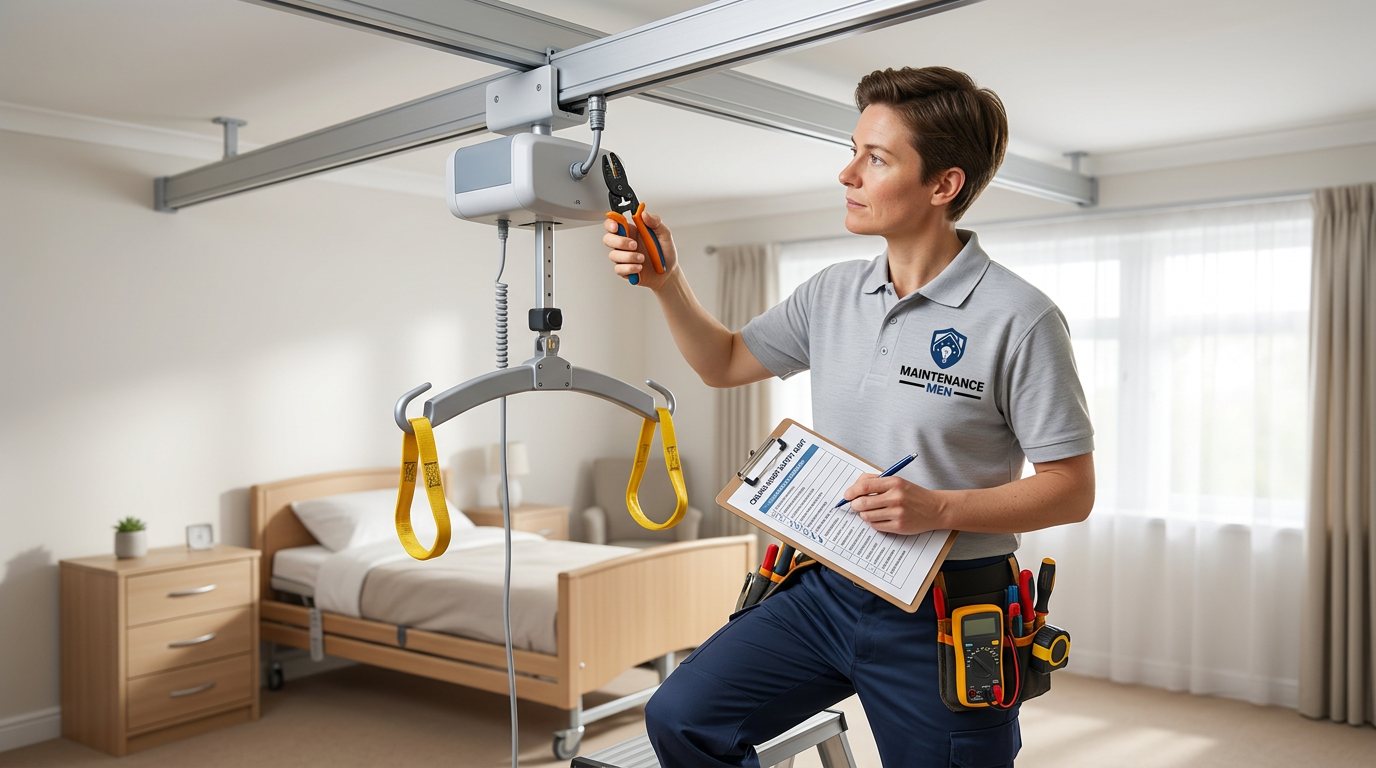
Hoist Juddering or Lurching? We'll Smooth Out the Movement Safely in Warwick
We inspect the track joints, trolley rollers, brake and fixings to find why the lift is no longer running evenly, and repair what is actually causing it.
Booking fee plus hourly labour — the price is confirmed before any work starts.
What this costs
| Booked 14+ days ahead | £25 booking fee £85 per hour |
|---|---|
| Booked within 48 hours | £100 booking fee £65 per hour |
| Same-day call-out | £220 booking fee £45 per hour |
The booking fee secures the visit. Labour is then charged by the hour, so you only pay for the time the job actually takes.
Booking fee £25–£220
£25 + £85/hr booked 14+ days ahead, £100 + £65/hr inside 48 hours, £220 + £45/hr same day. Agreed before we arrive.
Covered under Hoists & Lifting Equipment
Mobility & Accessibility › Hoists & Lifting Equipment — one of 22 documented jobs in this section.
Same-day jerky hoist movement
Urgent jobs can often be booked for today. Ask when you book and we will confirm the slot before you pay anything.
15 service areas
Birmingham, Coventry, Dorridge and 12 more across the West Midlands.
Jerky movement is a symptom with a short list of causes, and most of them are visible from underneath the track with the unit switched off.
What Jerking Feels Like
People describe it differently: a shudder that runs through the whole lift, a grab and release as the trolley passes a particular point, a lurch at the start of the lift before it settles, or a vibration that gets worse the higher the load. Where in the travel it happens is the most valuable clue you can give us. A judder at one point on the track suggests a joint or an obstruction. A judder throughout suggests the trolley, the brake or the power supply. A judder only under load points towards the motor, brake or battery.
Mechanical Causes
- Misaligned track joints. Track sections joined with a bracket that has shifted by a millimetre will catch the rollers on every pass. This is common and easy to overlook.
- Debris on the track. Grit, a dropped screw, dried plaster dust or a sling clip left on the rail will produce a grab at a fixed point.
- Worn trolley rollers or bearings. Flat spots and play in the rollers make the trolley rumble and catch.
- A brake that is not releasing cleanly, so each lift begins with a snatch.
- Loose fixings. A bracket that has worked slightly loose lets the track flex, and the movement shows up as a judder under load. This one matters structurally, not just for comfort.
- A track that is no longer level, so the trolley is climbing a gradient it was never set up for.
- Sling asymmetry. A sling attached unevenly loads one side of the spreader bar more than the other and can make the lift pull to one side.
Electrical and Drive Causes
A battery that is losing capacity delivers an uneven voltage under load, and the motor responds with uneven torque. Worn motor brushes produce a similar effect, particularly at low speed. On mobile hoists, a worn actuator can judder as it extends, and stiff or damaged castors make the whole unit lurch when it is moved. A control box with a failing relay can also produce an on-off stutter rather than a smooth drive.
How We Investigate
We run the trolley along the whole track by hand with the unit off, which tells us immediately whether the resistance is mechanical. We inspect each joint, the rollers, the end stops and the fixings, and we check the track for level and alignment. Then we test under a controlled load, listening to the motor and watching the trolley, and test the battery under current. On mobile units we check the actuator travel, the leg spread and the castors.
What We Repair
Realigning and re-securing track joints, replacing worn rollers and bearings, cleaning the track properly, adjusting or replacing a dragging brake, replacing motor brushes where the manufacturer supports it, replacing batteries, and re-securing fixings where the structure can take them. Where the fixings cannot be made sound because the ceiling or wall is unsuitable, we will say so and explain what a proper fixing would involve rather than tightening something that will work loose again.
What We Do Not Do
We do not adjust a hoist to compensate for a structural problem, and we do not modify a track's geometry to make a lift feel smoother. We cannot certify equipment as suitable for a particular person's needs — that rests with the user, their family and carers and the manufacturer's specifications. And we never work on a unit with a load suspended from it.
Safety Until We Arrive
If the hoist lurches, grabs or drops suddenly, stop using it. Jerking loads the fixings and the sling far more than a smooth lift does, and the person being moved has no way to steady themselves. Do not lubricate the track with household products, do not tighten brackets yourself unless the manual explicitly covers it, and do not continue a lift that has started to judder. If someone is suspended and the unit will not move, keep them comfortable and call 999 if they are in pain or distress.
After the Repair
We run the unit through its full travel under load, confirm the movement is even from end to end, check the brake, test the emergency stop and lowering, and re-check the fixings. We will show you what the track should sound and feel like so you can spot a return early.
Booking
Tell us the make and model, where in the travel the judder happens, whether it is worse under load, and whether anything has been changed recently — a new sling, a track extension, a room redecorated. You pay a booking fee when you book, labour is hourly at a rate that depends on how soon you need the visit, and the full cost is quoted and approved before work starts.
How the price works
We charge a booking fee to hold your slot, then an hourly rate for the work itself. The fee changes with how soon you need us; the hourly rate changes with the slot you choose. You approve the price before we start, so there is no surprise on the invoice.
Booked 14+ days ahead
£25 booking fee
then £85 per hour of labour
Best value. Book the slot now, pay the smallest booking fee.
Booked within 48 hours
£100 booking fee
then £65 per hour of labour
For jobs that can wait a day or two but not a fortnight.
Same-day call-out
£220 booking fee
then £45 per hour of labour
Urgent problems: standing water, no heat, no power, leaks.
Book the slot
Choose the window that suits you and pay the booking fee. That holds your place in the diary.
We diagnose on site
The engineer confirms the cause and tells you what the job involves and how long it should take.
You approve, we work
Nothing goes ahead until you agree the price. Labour is then charged per hour at your slot rate.
A hoist that shudders, grabs or lurches is unpleasant for the person being lifted and unsettling for whoever is operating it. It is also a useful warning, because uneven movement almost always has a mechanical cause that gets worse with use. The good news is that the usual culprits — track joints, rollers, a dragging brake — are things we can see and test rather than guess at.
What our customers say about our mobility & accessibility service
4.5 out of 5 from 8 reviews
Proper job, no upselling
Turned up in the window they promised, walked me through the options (turns out the old fitting was seized and needed careful removal), then cracked on. Everything was tested before they left. No mess, no drama, no surprise on the bill.
Job: Loose or Faulty Brakes
Fine in the end
The problem is fixed, which is the main thing, and the engineer clearly knew what they were doing. It took a fair bit longer than the estimate on the phone and I had to ask twice for a breakdown of the hours.
Job: Stair Lift Service
Would use again
What I appreciated was being told what was actually wrong before anyone started. Sorted in under 70 minutes and the invoice matched the quote to the penny.
Job: Control Panel Fault
Book Jerky Hoist Movement
Tell us what is happening and choose a slot. If you are not sure this is the right job, use the diagnosis panel — it narrows the problem down before you book.
- Booking fee confirmed up front
- Hourly labour, agreed before work starts
- Same-day slots for urgent problems


Questions people ask about jerky hoist movement
Straight answers to the things customers ask most often before booking.
Can I just oil the track to stop the juddering?
Please don't. Household lubricants attract dust and grit, which makes the problem worse, and some tracks and trolley rollers are designed to run dry or need a specific lubricant. A judder is a symptom of alignment, wear or a loose fixing, and lubricating it hides the cause rather than fixing it.
What will you look at?
We run the trolley by hand with the power off to feel where the resistance is, inspect every track joint, the rollers, the end stops and the fixings, check the track is level, then test under a controlled load and check the battery under current. On a mobile hoist we check the actuator, leg spread and castors.
Is juddering dangerous or just uncomfortable?
Both. It is uncomfortable for the person being lifted, and it puts repeated shock loads through the sling, the spreader bar and the ceiling fixings — the very parts that hold the weight. That is why we treat a lurch or a sudden grab as a reason to stop using the hoist until it is checked.
The judder only happens at one spot on the track. What does that tell you?
That it is almost certainly mechanical and local: a misaligned joint, a burr, debris, or a roller catching. Those are usually straightforward to correct, and knowing the exact position saves a lot of time, so point it out to us when we arrive.
What will the repair cost?
You pay a booking fee when you book, and the hourly labour rate depends on how soon you need the visit. The full cost of the work is quoted and approved before we start, with any parts such as rollers or brackets quoted separately.
Need jerky hoist movement sorted in Warwick?
Book a slot in the diary and pay only the booking fee up front. We confirm the rest before we start.