
Drain Draining Slowly? Deal With It Before It Blocks in Warwick
We clear the partial restriction now, check the run while it is accessible, and tell you whether anything suggests it will come back.
Booking fee plus hourly labour — the price is confirmed before any work starts.
What this costs
| Booked 14+ days ahead | £25 booking fee £85 per hour |
|---|---|
| Booked within 48 hours | £100 booking fee £65 per hour |
| Same-day call-out | £220 booking fee £45 per hour |
The booking fee secures the visit. Labour is then charged by the hour, so you only pay for the time the job actually takes.
Booking fee £25–£220
£25 + £85/hr booked 14+ days ahead, £100 + £65/hr inside 48 hours, £220 + £45/hr same day. Agreed before we arrive.
Covered under Blocked Drains
Drainage › Blocked Drains — one of 14 documented jobs in this section.
Same-day partial drain blockage
Urgent jobs can often be booked for today. Ask when you book and we will confirm the slot before you pay anything.
15 service areas
Birmingham, Coventry, Dorridge and 12 more across the West Midlands.
Partial blockages are the easiest drainage problem to fix and the easiest to ignore. Water still goes away, so nothing seems urgent, but the pipe is already carrying less than it should, and what is slowing it down is still accumulating.
The early signs worth acting on
Water that sits in a basin or a bath for a few seconds longer than it used to. A toilet that flushes less decisively. A gurgle from a trap when another fitting is used. A drain outside that takes longer to clear after rain. A faint smell from a plughole. None of these is a crisis, and all of them are the same message: the pipe is restricted and the restriction is growing.
The most common causes are a build-up of fat and food in a kitchen waste, hair and soap in a bathroom trap, silt and leaves in an outside gully, and a soft obstruction — paper, wipes, a build-up of scale in an old pipe — that has not yet sealed the bore. Roots and a dropped pipe cause the same symptom but do not clear for long, which is why we check rather than assume.
What we do on the visit
We ask which fittings are slow and whether the slowness is constant or comes and goes. Then we test each one and watch the flow, which usually identifies whether the restriction is local to a fitting or shared on a branch. Local slowness on one basin is a trap; several slow fittings on the same side of the house is the branch; everything slow, including outside, is the main run.
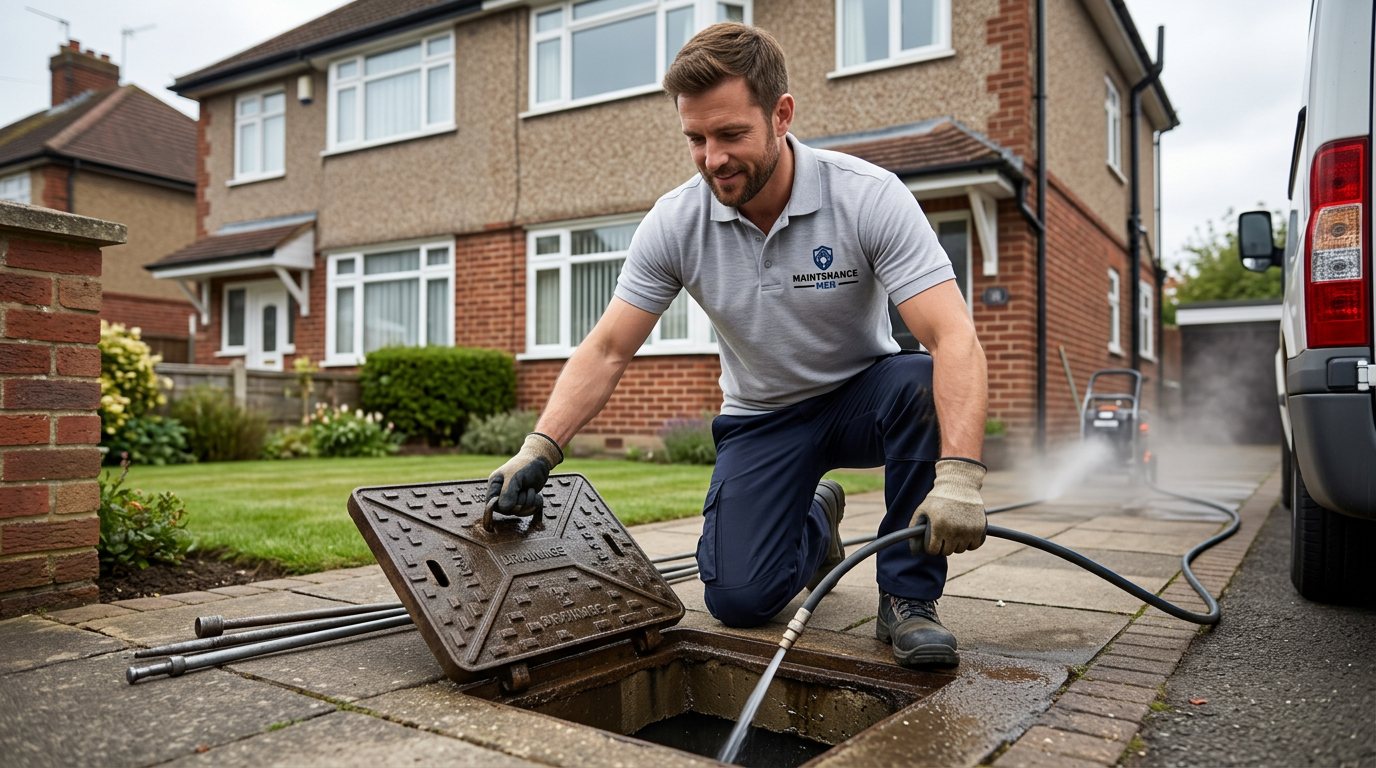
Clearing is then a matter of the right method for the pipe. A trap is opened and cleaned. A short branch is rodded. An outside gully is emptied. A longer or greasy run responds better to jetting, which scours the walls rather than punching a hole through the middle of the obstruction. We flush through afterwards and confirm the flow is genuinely restored, not merely improved.
Why the method matters
A clearance that only opens a channel leaves most of the restriction in place, and it closes again quickly. This is why we do not simply plunge and leave. On a fat-blocked kitchen run in particular, the difference between a hole and a properly cleaned pipe is the difference between a fortnight and a couple of years.
It also matters that the pipe is not damaged in the process. A high-pressure jet in the wrong hands on an old clay or a thin plastic run can do real harm, so the pressure and the nozzle are chosen to suit the pipe we are working on, not the biggest setting available.
What we tell you afterwards
If the run clears and stays clear, that is a maintenance problem solved. If it clears and immediately starts to slow again, or if the water runs away and then rises in another fitting, there is something structural going on and we will say so. A camera survey is the way to establish that, and any repair follows from it as a separate quote.
We will also tell you honestly if the pattern suggests it will recur — a shallow fall, a long flat run, a kitchen waste with no gradient — because knowing that lets you plan maintenance rather than being surprised.
Simple things that keep it clear
Do not put fat, oil or food scraps down the sink; wipe pans into the bin instead. Use a hair catch in the bath and basin. Clear gully gratings before winter and after leaf fall. Run water in unused traps weekly. Avoid wipes entirely, even the ones labelled flushable, because they do not break down the way paper does.
Before we arrive, do not pour caustic chemicals down a drain that is still draining. They pass through too quickly to work on the restriction and can damage seals and traps. If you have used any, tell us so we can take the right precautions.
To book, tell us the postcode, which fittings are slow and whether the slowness is getting worse. A clear description of the pattern usually means we arrive with the right equipment the first time.
How the price works
We charge a booking fee to hold your slot, then an hourly rate for the work itself. The fee changes with how soon you need us; the hourly rate changes with the slot you choose. You approve the price before we start, so there is no surprise on the invoice.
Booked 14+ days ahead
£25 booking fee
then £85 per hour of labour
Best value. Book the slot now, pay the smallest booking fee.
Booked within 48 hours
£100 booking fee
then £65 per hour of labour
For jobs that can wait a day or two but not a fortnight.
Same-day call-out
£220 booking fee
then £45 per hour of labour
Urgent problems: standing water, no heat, no power, leaks.
Book the slot
Choose the window that suits you and pay the booking fee. That holds your place in the diary.
We diagnose on site
The engineer confirms the cause and tells you what the job involves and how long it should take.
You approve, we work
Nothing goes ahead until you agree the price. Labour is then charged per hour at your slot rate.
A drain that drains, just not as fast as it used to, is at the stage where a short visit does the most good. Left alone, the restriction closes over weeks or months until water is standing. Clearing it now is quicker, cleaner and usually cheaper than waiting for the backup.
What our customers say about our drainage service
4.2 out of 5 from 5 reviews
Fast, tidy and friendly
Turned up in the window they promised, walked me through the options (turns out the part had to be sourced locally), then cracked on. Everything was tested before they left. No mess, no drama, no surprise on the bill.
Job: Standing Water in Shower Tray
Happy overall
Good job overall. Turned up about 15 minutes after the window started, but rang to say so, and the work itself was tidy and well explained. Price was as quoted.
Job: Partial Soil Stack Blockage
Fixed it, but took longer than expected
The problem is fixed, which is the main thing, and the engineer clearly knew what they were doing. It took a fair bit longer than the estimate on the phone and I had to ask twice for a breakdown of the hours.
Job: Surface Water Drain Maintenance
Book Partial Drain Blockage
Tell us what is happening and choose a slot. If you are not sure this is the right job, use the diagnosis panel — it narrows the problem down before you book.
- Booking fee confirmed up front
- Hourly labour, agreed before work starts
- Same-day slots for urgent problems



Questions people ask about partial drain blockage
Straight answers to the things customers ask most often before booking.
Is it worth booking for a slow drain?
Yes, if it has been getting slower over weeks. A partial restriction is quicker and cleaner to clear than a full blockage, and leaving it risks a backup at an inconvenient moment. If it has only just started and clears on its own, it may simply be a trap that needs cleaning.
How do you find where the restriction is?
By testing each fitting and watching the flow. One slow basin points to its own trap; several slow fittings on one side of the house point to a branch; everything slow including outside points to the main run. We check before choosing a method.
Is a slow drain a health risk?
Not immediately, but waste sitting in a pipe produces smells and can corrode the pipe and its seals over time, and a partial blockage can close completely without warning. It is a maintenance issue best dealt with early.
Why does it come back after being cleared?
Usually because only a channel was opened rather than the pipe being properly scoured, or because there is an underlying cause such as a shallow fall, a long flat run or root intrusion. A camera survey establishes which, and any repair is quoted separately.
What does it cost?
You pay a booking fee when you book, and labour is charged hourly at a rate that depends on how soon you need the visit. The full cost of the work is quoted before we start, parts quoted separately, so the full cost is approved before any tools come out. A camera survey or repair, if needed, is quoted separately once we know what we are dealing with.
Need partial drain blockage sorted in Warwick?
Book a slot in the diary and pay only the booking fee up front. We confirm the rest before we start.