
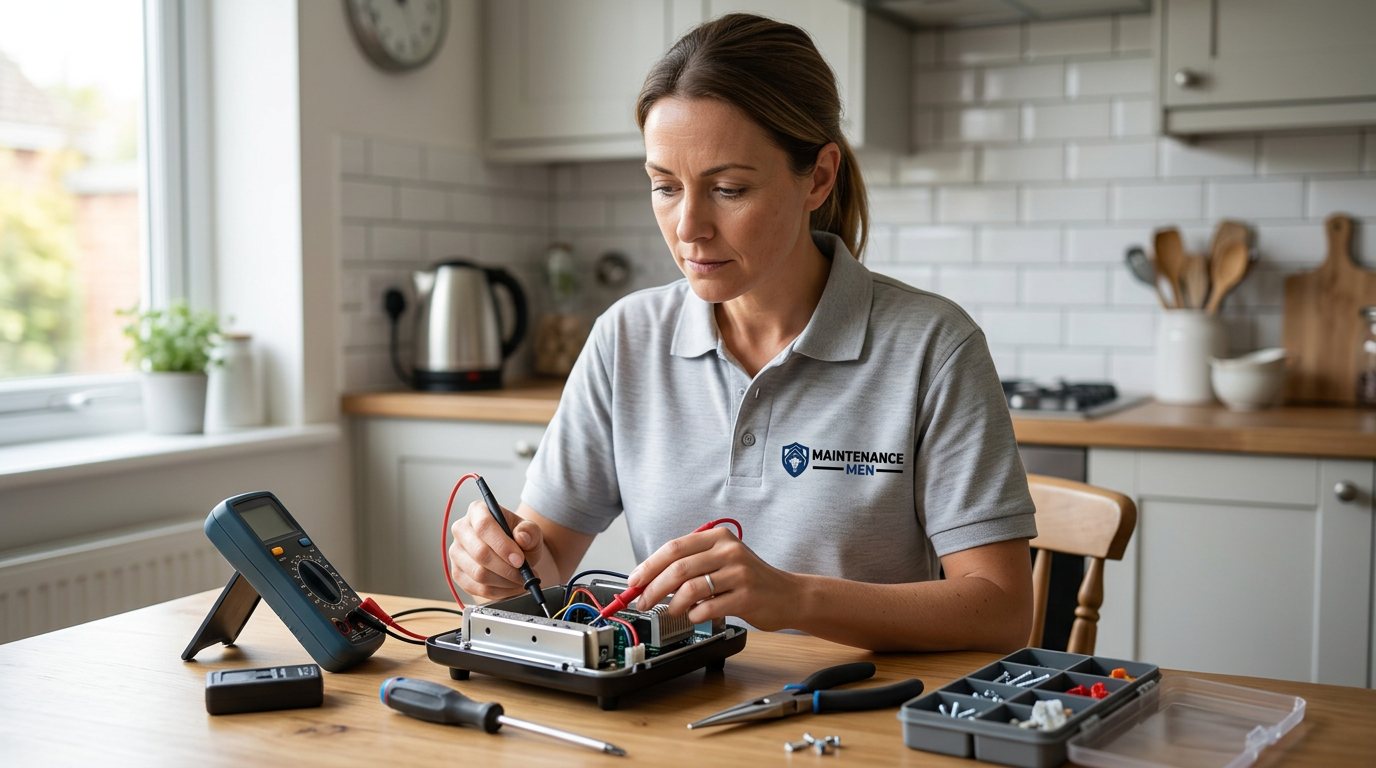
Kettle not boiling? We test the element and the switch in Warwick
A short visit confirms whether scale, the element, the switch or the base connector is stopping your kettle from boiling.
Booking fee plus hourly labour — the price is confirmed before any work starts.
What this costs
| Booked 14+ days ahead | £25 booking fee £85 per hour |
|---|---|
| Booked within 48 hours | £100 booking fee £65 per hour |
| Same-day call-out | £220 booking fee £45 per hour |
The booking fee secures the visit. Labour is then charged by the hour, so you only pay for the time the job actually takes.
Booking fee £25–£220
£25 + £85/hr booked 14+ days ahead, £100 + £65/hr inside 48 hours, £220 + £45/hr same day. Agreed before we arrive.
Covered under Small Appliances
Home Appliances › Small Appliances — one of 20 documented jobs in this section.
Same-day kettle not boiling
Urgent jobs can often be booked for today. Ask when you book and we will confirm the slot before you pay anything.
15 service areas
Birmingham, Coventry, Dorridge and 12 more across the West Midlands.
The kettle is the most-used appliance in many kitchens, so when it stops boiling the household notices immediately. Its simplicity works in your favour. The heating element, the switch, the boil-dry cut-out and the cordless base connector are the only real candidates, and each fails in a recognisable way. A short visit is usually enough to say which one it is.
The four things that stop a kettle boiling
First, scale. West Midlands water is hard in many areas, and limescale insulates the element from the water it is supposed to heat. A scaled kettle takes longer and longer to boil, then eventually seems to stop making progress at all. Second, the element itself, which can fail open circuit — no heat at all — or develop a partial failure that draws current without heating properly. Third, the switch: the latching mechanism wears, or the contacts burn back, so the kettle will not stay on or will not come on at all. Fourth, the base connector: the concentric contacts at the bottom of the jug and in the base lose spring tension or become furred, and the kettle gets intermittent or no power.
Why a boil-dry cut-out matters
Most kettles have a boil-dry protector, a small thermal device that cuts the element if it is switched on with too little water. Once it operates, it may reset when the kettle cools, or it may be a one-shot device. If your kettle stopped after being switched on empty, that is very likely the explanation, and it is also a reminder that the protector has done its job. Testing it is part of the visit, but we also check whether the protector operated because of a genuine dry switch-on or because the element is overheating for another reason.
What the visit covers
The kettle is unplugged and emptied. We inspect the element for scale and for signs of failure, test its continuity and insulation, operate the switch to check it latches and that the contacts are sound, examine the base connector contacts on both the jug and the base, and test the boil-dry cut-out. Where the fault is scale, descaling is often the whole repair; where it is the element or the switch, the part is identified and quoted. We also check the flex and plug, since a damaged cord is easy to overlook.
Descaling without damaging anything
Descaling a kettle is genuinely a user-level job if done properly: unplug, let it cool, use a proprietary descaler or a diluted citric acid solution following the maker's instructions, boil, rinse thoroughly and repeat if needed. What matters is not overfilling, not leaving the solution in for longer than instructed, and never immersing the base or the electrical connector. Aggressive descaling with undiluted acid can attack seals and metal, so the instructions on the packet are worth reading rather than improvising.
Repair or replace
Kettles are inexpensive, and that shapes the decision. A switch or a base connector is a modest part and a reasonable repair on a good kettle. An element in a mid-range stainless or glass kettle is worth replacing if the part is available. On a budget kettle where the element is bonded into the body and the part is unavailable, replacement is the honest answer. We will not push a repair that costs more than the appliance.
Safety notes
Never fill above the maximum mark, never switch on with the lid open, and never operate a kettle on a wet base. If the base or plug shows scorch marks, or the kettle trips the RCD, stop using it: that is an earth fault and needs testing rather than descaling. Unplug before cleaning or descaling and keep water out of the electrical connector.
Booking
Book online with the kettle make and model, and say whether it heats at all, heats slowly, or will not stay switched on. The booking fee is paid when you book, and the hourly labour rate depends on how soon you need the visit. The full cost is quoted and approved before work begins, with any parts identified and quoted separately.
How the price works
We charge a booking fee to hold your slot, then an hourly rate for the work itself. The fee changes with how soon you need us; the hourly rate changes with the slot you choose. You approve the price before we start, so there is no surprise on the invoice.
Booked 14+ days ahead
£25 booking fee
then £85 per hour of labour
Best value. Book the slot now, pay the smallest booking fee.
Booked within 48 hours
£100 booking fee
then £65 per hour of labour
For jobs that can wait a day or two but not a fortnight.
Same-day call-out
£220 booking fee
then £45 per hour of labour
Urgent problems: standing water, no heat, no power, leaks.
Book the slot
Choose the window that suits you and pay the booking fee. That holds your place in the diary.
We diagnose on site
The engineer confirms the cause and tells you what the job involves and how long it should take.
You approve, we work
Nothing goes ahead until you agree the price. Labour is then charged per hour at your slot rate.
A kettle is one of the simplest appliances in the house, which is why a failure is usually easy to pin down: scale on the element, a failed element, a switch that no longer latches or a base connector that has lost contact. Our visit tests those in order and tells you whether it is worth repairing or replacing.
What our customers say about our home appliances service
4.8 out of 5 from 14 reviews
Exactly what was quoted
What I appreciated was being told what was actually wrong before anyone started. Sorted in under 27 minutes and the invoice matched the quote to the penny.
Job: Tumble Dryer Not Starting Cycle
Good job, slightly late
Solid work. Hourly rate feels fair for the amount of work involved and everything was tested before they left. Would book again.
Job: Toaster Not Working
No mess left behind
Really straightforward. It had been bothering us for weeks; diagnosed properly, fixed the same visit, and the price was exactly what was explained when booking. Can not fault it.
Job: Microwave Button Repair
Book Kettle Not Boiling
Tell us what is happening and choose a slot. If you are not sure this is the right job, use the diagnosis panel — it narrows the problem down before you book.
- Booking fee confirmed up front
- Hourly labour, agreed before work starts
- Same-day slots for urgent problems







Questions people ask about kettle not boiling
Straight answers to the things customers ask most often before booking.
Can I try descaling it before booking?
Yes, and it is worth doing if the kettle is slow rather than completely dead. Use a proper descaler as directed, rinse thoroughly and keep water out of the base connector. If nothing changes, the element or switch is the more likely cause.
What is checked on the visit?
The element for scale, continuity and insulation failure, the switch for latching and contact condition, the base connector contacts on both parts, the boil-dry cut-out, and the plug and flex. The kettle is emptied and unplugged before any of it.
Is a scaled kettle dangerous?
Not usually, but heavy scale makes the element run hotter than designed, which shortens its life and can distort the base. It also makes the kettle slower and less efficient, so it is worth descaling.
My kettle boils but switches off before it is properly hot. Why?
That usually points to a scaled element overheating locally, or a failing steam sensor or switch. Both are testable, and neither should be worked around by holding the switch down.
What does it cost?
The booking fee is paid when you book, and the hourly labour rate depends on how soon you need the visit. We confirm the full cost and you approve it before work starts; any parts are identified and quoted separately.
Need kettle not boiling sorted in Warwick?
Book a slot in the diary and pay only the booking fee up front. We confirm the rest before we start.