
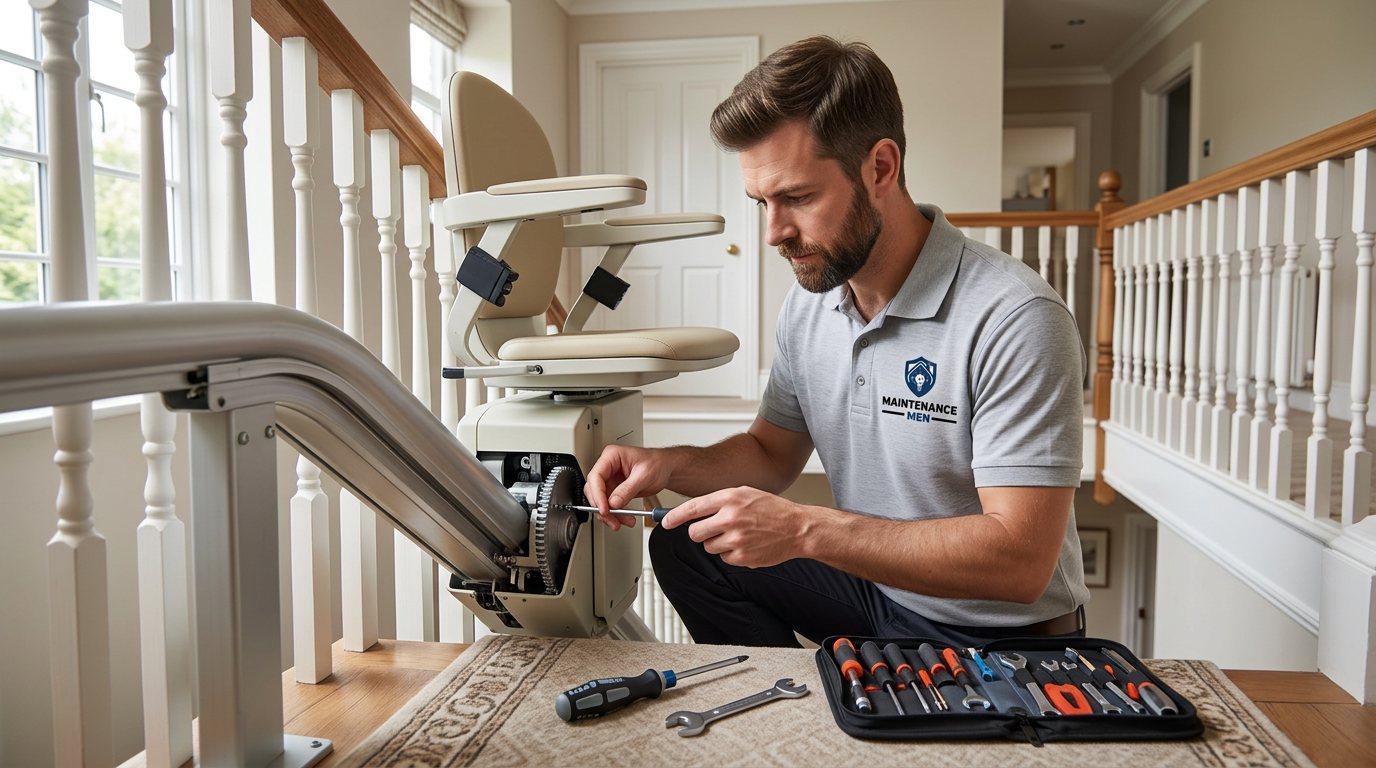
Stair Lift Cutting Out Intermittently? We'll Find the Cause in Smethwick
We trace intermittent power loss through batteries, contacts, wiring and connections until the real cause is proven, then quote the repair.
Booking fee plus hourly labour — the price is confirmed before any work starts.
What this costs
| Booked 14+ days ahead | £25 booking fee £85 per hour |
|---|---|
| Booked within 48 hours | £100 booking fee £65 per hour |
| Same-day call-out | £220 booking fee £45 per hour |
The booking fee secures the visit. Labour is then charged by the hour, so you only pay for the time the job actually takes.
Booking fee £25–£220
£25 + £85/hr booked 14+ days ahead, £100 + £65/hr inside 48 hours, £220 + £45/hr same day. Agreed before we arrive.
Covered under Stair Lifts
Mobility & Accessibility › Stair Lifts — one of 24 documented jobs in this section.
Same-day intermittent power loss
Urgent jobs can often be booked for today. Ask when you book and we will confirm the slot before you pay anything.
15 service areas
Birmingham, Coventry, Dorridge and 12 more across the West Midlands.
Intermittent power loss is the most frustrating stair lift fault there is: the lift behaves perfectly while you are demonstrating it to someone, then stops the moment you actually need it. It is also the fault most likely to be dismissed as a quirk — and the one most likely to leave someone stranded on the stairs eventually. The good news is that intermittent faults almost always have a physical cause, and patient testing finds it.
Where intermittent power loss comes from
The leading suspects, in rough order of likelihood: batteries that have aged enough to sag under load but still pass a quick glance at a voltmeter; charging contacts that connect cleanly when the carriage sits one way and poorly when it sits another; loose or corroded connectors in the wiring loom that open and close with vibration and temperature; a joystick, button or key switch with a worn internal contact; and, less often, a drive component that binds only at one spot on the rail, or a control board with a failing solder joint. Each of these produces power loss that comes and goes, which is why the symptom — not the guess — has to drive the diagnosis.
Why it matters to fix it promptly
A lift that loses power unpredictably is a lift that can stop mid-journey with someone aboard. Beyond the obvious distress, every uncontrolled stop stresses the drive and the batteries, and the underlying fault usually worsens. If the lift has ever tripped your electrics, smelled of burning, or behaved erratically — jerking, reversing direction, or beeping without reason — stop using it until it has been checked.
What helps before we arrive
Keep a simple note for a week: what the lift did, roughly when, where on the stairs it happened, and whether it was the first journey of the day or a later one. Patterns matter — a fault that appears only at the top of the stairs points to a limit switch or contact spot, while one that appears after several journeys points to batteries or heat. Also note anything that changed recently, such as a power cut, a deep-clean of the rail, or a new carpet fitting that might foul the rail. This genuinely shortens the diagnosis.
How we test for an intermittent fault
We start with the charging chain — batteries load-tested, charger output measured, contacts inspected and exercised through their seating position. Then we work through the loom: every connector checked, cleaned and re-seated, wiring inspected where it flexes as the carriage travels. We test the controls with the seat and footplate sensors confirmed good, and we run the lift through repeated full travel cycles under realistic load, watching voltage and listening for binding. Where a fault hides from a static test, repeated dynamic testing usually drags it out. We then quote the repair in full for your approval — and we will not declare the fault fixed until the lift has completed reliable cycles after the repair.
Safety and stuck-lift advice
If the lift has cut out with someone seated, keep them safe, comfortable and calm; call 999 if they are in pain or distress. Use a manual release only strictly per the manufacturer's instructions, and only if a confident person can follow the steps safely — never climb under, push or force a suspended lift. Once a lift has shown intermittent behaviour, treat every journey with a little caution until the repair is done.
Aftercare
After the repair, park on the charge points reliably and mention any repeat of the symptom immediately — a properly diagnosed fault should not return, and a prompt report lets us act while the trail is fresh. An annual service also catches loosening connectors and tired batteries before they become intermittent faults.
Booking
Tell us the make and model and share any notes you have kept about when the fault appears. You pay a booking fee when you book, labour is charged hourly at a rate that depends on how soon you need us, and the full cost is quoted and approved before work starts, with parts quoted separately.
How the price works
We charge a booking fee to hold your slot, then an hourly rate for the work itself. The fee changes with how soon you need us; the hourly rate changes with the slot you choose. You approve the price before we start, so there is no surprise on the invoice.
Booked 14+ days ahead
£25 booking fee
then £85 per hour of labour
Best value. Book the slot now, pay the smallest booking fee.
Booked within 48 hours
£100 booking fee
then £65 per hour of labour
For jobs that can wait a day or two but not a fortnight.
Same-day call-out
£220 booking fee
then £45 per hour of labour
Urgent problems: standing water, no heat, no power, leaks.
Book the slot
Choose the window that suits you and pay the booking fee. That holds your place in the diary.
We diagnose on site
The engineer confirms the cause and tells you what the job involves and how long it should take.
You approve, we work
Nothing goes ahead until you agree the price. Labour is then charged per hour at your slot rate.
A lift that works one day and dies the next — or stops halfway and restarts an hour later — is harder to pin down than a lift that has failed outright. Intermittent faults are a diagnosis challenge we take seriously, and this page explains how we approach them methodically rather than by guesswork.
What our customers say about our mobility & accessibility service
4.5 out of 5 from 8 reviews
Proper job, no upselling
Turned up in the window they promised, walked me through the options (turns out the old fitting was seized and needed careful removal), then cracked on. Everything was tested before they left. No mess, no drama, no surprise on the bill.
Job: Loose or Faulty Brakes
Fine in the end
The problem is fixed, which is the main thing, and the engineer clearly knew what they were doing. It took a fair bit longer than the estimate on the phone and I had to ask twice for a breakdown of the hours.
Job: Stair Lift Service
Would use again
What I appreciated was being told what was actually wrong before anyone started. Sorted in under 70 minutes and the invoice matched the quote to the penny.
Job: Control Panel Fault
Book Intermittent Power Loss
Tell us what is happening and choose a slot. If you are not sure this is the right job, use the diagnosis panel — it narrows the problem down before you book.
- Booking fee confirmed up front
- Hourly labour, agreed before work starts
- Same-day slots for urgent problems






Questions people ask about intermittent power loss
Straight answers to the things customers ask most often before booking.
Should I keep using the lift between now and the repair?
If the cut-outs are happening with nobody aboard and the lift behaves normally otherwise, careful short journeys may be reasonable — but treat the lift as unreliable until it is fixed. If it jerks, reverses, trips the electrics or smells of burning, stop using it. If it stops with someone aboard, keep them safe and call 999 if they are in distress.
How do you diagnose a fault that only happens sometimes?
Methodically. We load-test the batteries, measure charger output, exercise the charging contacts through their seating, check and re-seat every connector, test the controls and sensors, then run repeated full travel cycles under realistic load while monitoring the supply. Intermittent faults are found by repetition and observation, not by swapping parts.
Is there anything I can safely try myself?
Keep the notes described on this page, make sure the lift parks fully on its charge points, and check that nothing has been recently fitted near the rail. Beyond that, testing batteries, connectors and controls is engineer work — dismantling anything voids the point of a careful diagnosis.
Why does the fault seem worse on some days?
Temperature, humidity and how many journeys the lift has done that day all affect tired batteries and marginal contacts, which is why intermittent faults cluster on cold mornings or busy afternoons. That pattern is genuinely useful diagnostic information, so do mention it when you book.
How is an intermittent-fault visit charged?
You pay a booking fee when you book, and labour is charged at an hourly rate that depends on how soon you need us. Once the cause is found we quote the full cost of the repair for your approval before work starts, and parts are quoted separately.
Need intermittent power loss sorted in Smethwick?
Book a slot in the diary and pay only the booking fee up front. We confirm the rest before we start.