
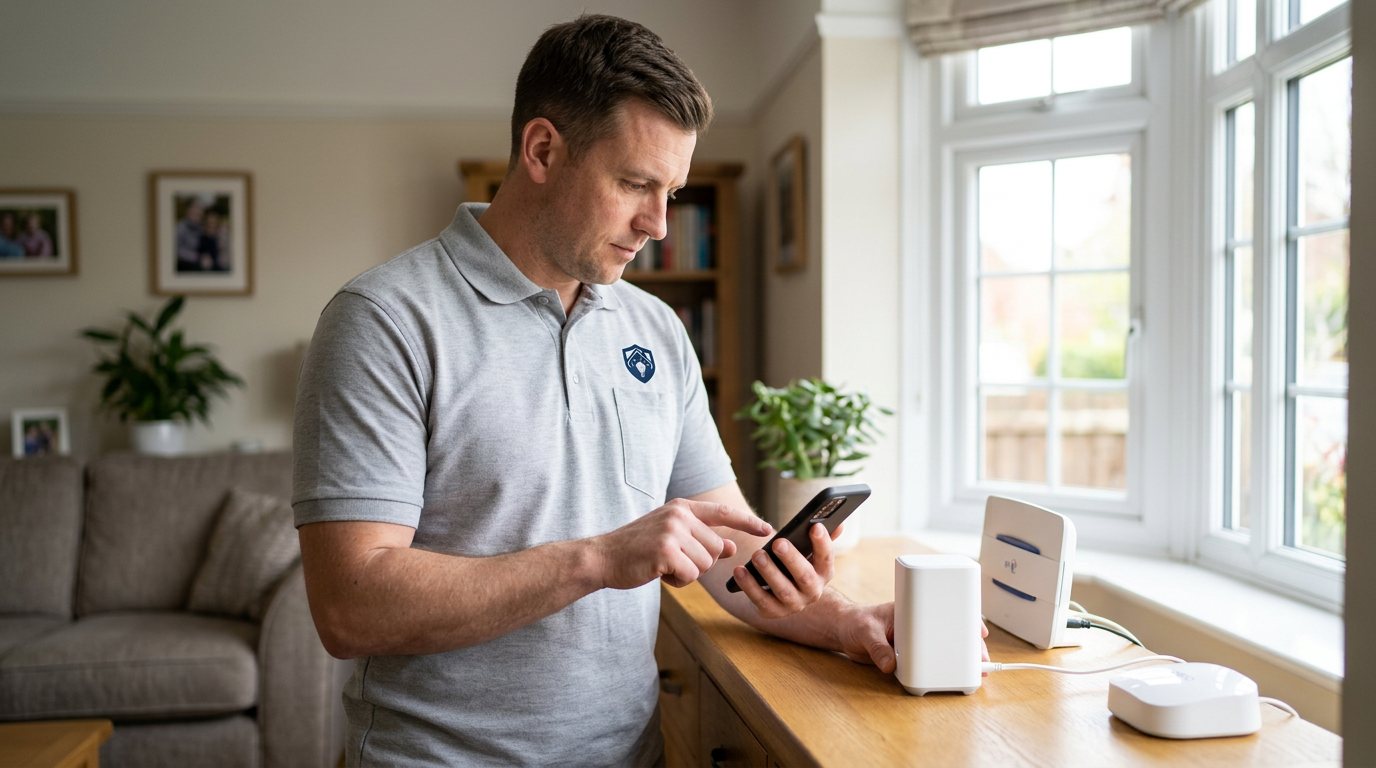
False Security Alerts? We'll Stop the Crying Wolf in Shirley
We diagnose why sensors trigger wrongly — placement, pets, sensitivity, batteries — so alerts mean something again.
Booking fee plus hourly labour — the price is confirmed before any work starts.
What this costs
| Booked 14+ days ahead | £25 booking fee £85 per hour |
|---|---|
| Booked within 48 hours | £100 booking fee £65 per hour |
| Same-day call-out | £220 booking fee £45 per hour |
The booking fee secures the visit. Labour is then charged by the hour, so you only pay for the time the job actually takes.
Booking fee £25–£220
£25 + £85/hr booked 14+ days ahead, £100 + £65/hr inside 48 hours, £220 + £45/hr same day. Agreed before we arrive.
Covered under Smart Security
Security & CCTV › Smart Security — one of 20 documented jobs in this section.
Same-day false smart alerts
Urgent jobs can often be booked for today. Ask when you book and we will confirm the slot before you pay anything.
15 service areas
Birmingham, Coventry, Dorridge and 12 more across the West Midlands.
A false alert is a sensor reporting something that is not what it was installed to detect. Motion detectors responding to pets or heat, contact sensors reporting doors that have not opened, cameras flagging shadows and headlights — each type has its own failure modes, and each failure mode has a cause that can usually be found and fixed. The goal of the visit is not just to stop the alerts but to make sure the ones that remain are trustworthy again.
Why sensors trigger falsely
Motion sensors are the most frequent offenders, and the causes are physical: a sensor pointed at a radiator, a window with changing sunlight, a curtain moving in a draught, or a hallway a cat crosses at night. Pets deserve special mention — many sensors have pet-resistant modes and mounting heights, but they must be chosen and positioned correctly, and an ordinary sensor at the wrong height will report every cat as an intruder. Contact sensors false-report when their two halves drift out of alignment, when magnetic mounts loosen, or when batteries sag. Cameras false-alert on anything their motion detection treats as movement — trees, rain, light changes — unless detection zones and sensitivity are configured properly.
How we diagnose it
We start with the pattern: which sensor, what time of day, how often. Patterns are informative — a hallway sensor that fires at dusk points at sunlight, one that fires overnight points at a pet or a draught. We then check each suspect sensor's mounting, alignment, battery and sensitivity settings, and we test deliberately: walk the sensor's field, and if relevant, let the pet do the same. Where settings are wrong, we correct them; where placement is wrong, we reposition the sensor rather than numbing its sensitivity, because a desensitised sensor is its own security risk.
The tempting wrong fix
The instinctive response to false alerts is to turn sensitivity down, disable the sensor, or mute notifications — and all three weaken your security to solve an annoyance. We will not recommend disabling sensors or stripping alert settings as a fix. The honest approach is to find what the sensor is actually responding to and address that, so the sensor keeps doing its job and stops doing someone else's.
Honest limits
Some environmental causes — a very draughty room, direct low sun, a busy road reflected in a window — may mean a sensor's position can never be fully reliable, and moving it or changing its type is the real answer. We will say so plainly rather than selling adjustments that will not hold. We also cannot guarantee that a manufacturer's detection algorithm will never misfire; we can configure it sensibly and honestly within its limits.
Aftercare
After the fix, keep a brief log of any false alerts for a fortnight: which sensor, what time, what was happening. If a pattern persists, tell us — it points at a residual cause worth another look rather than a system you have to tolerate.
Booking
Book through the Maintenance Men website or by phone, and tell us which sensors are false-triggering, how often, and whether you have pets. If you can recall the times of day the false alerts arrive, that alone often narrows the cause considerably.
Making alerts trustworthy again
The real goal of a false-alarm repair is not silence; it is trust. When alerts stop crying wolf, you start reading them again, and the system does the job you installed it for. That is why we resist the shortcut of desensitising sensors to the point of uselessness — a motion detector that ignores genuine movement is not a fix, it is a different fault. After our visit, expect the system to be quiet about the things that do not matter and prompt about the things that do. If it is not, tell us, because that means a cause is still hiding.
How the price works
We charge a booking fee to hold your slot, then an hourly rate for the work itself. The fee changes with how soon you need us; the hourly rate changes with the slot you choose. You approve the price before we start, so there is no surprise on the invoice.
Booked 14+ days ahead
£25 booking fee
then £85 per hour of labour
Best value. Book the slot now, pay the smallest booking fee.
Booked within 48 hours
£100 booking fee
then £65 per hour of labour
For jobs that can wait a day or two but not a fortnight.
Same-day call-out
£220 booking fee
then £45 per hour of labour
Urgent problems: standing water, no heat, no power, leaks.
Book the slot
Choose the window that suits you and pay the booking fee. That holds your place in the diary.
We diagnose on site
The engineer confirms the cause and tells you what the job involves and how long it should take.
You approve, we work
Nothing goes ahead until you agree the price. Labour is then charged per hour at your slot rate.
False alerts erode a security system faster than almost any other fault: after the tenth pointless notification, you stop looking, and then a real alert gets ignored too. False triggers are not random bad luck — they have causes, and the causes are diagnosable. Pets, sensor placement, sensitivity settings, failing batteries and environmental triggers like sunlight and draughts all produce false alerts, and each leaves a pattern we can read.
What our customers say about our Security & CCTV service
5 out of 5 from 7 reviews
Would use again
Third time we have used Maintenance Men, and the same experience each time: agreed price, proper explanation, job done in one visit. The hourly rate is fair for the standard of work.
Job: CCTV Installation
Second time we have used them
I had put off sorting this for months because I expected a runaround. Quoted the booking fee plus hourly rate upfront, stuck to it, and actually found the underlying cause rather than just clearing the symptom. Worked neatly and hoovered up afterwards.
Job: Backup Battery Fault
Exactly what was quoted
What I appreciated was being told what was actually wrong before anyone started. Sorted in under 56 minutes and the invoice matched the quote to the penny.
Job: Alarm Repair Service
Book False Smart Alerts
Tell us what is happening and choose a slot. If you are not sure this is the right job, use the diagnosis panel — it narrows the problem down before you book.
- Booking fee confirmed up front
- Hourly labour, agreed before work starts
- Same-day slots for urgent problems





Questions people ask about false smart alerts
Straight answers to the things customers ask most often before booking.
Could my pet really be triggering the alarm?
Very possibly, and it is one of the most common causes. Many motion sensors have pet-resistant modes and recommended mounting heights, but they have to be set up correctly. We test with your pet's actual movement patterns rather than guessing from the manual.
How do you find what is causing false alerts?
We look at the pattern — which sensor, what time of day, how often — then check that sensor's mounting, alignment, battery and sensitivity, and test it deliberately by walking its field of view. Patterns plus testing usually identify the cause quickly.
Is it safe to just turn the sensor off until it behaves?
We would advise against it. A disabled sensor is a permanent gap in your coverage, and silencing notifications trains you to ignore alerts generally. The better route is to find what the sensor is responding to and fix that, so it keeps protecting you.
My camera flags every car that passes — can that be fixed?
Usually, yes. Cameras detect change rather than intruders, so passing headlights, trees and rain all count as motion unless detection zones and sensitivity are configured. Setting the camera to ignore the road and focus on your property is a configuration task we do regularly.
What does fixing false alerts cost?
You pay a booking fee when you book, and labour is charged hourly at a rate that depends on how soon you need the visit. The full cost of the work is quoted and approved by you before we start, with any parts quoted separately.
Need false smart alerts sorted in Shirley?
Book a slot in the diary and pay only the booking fee up front. We confirm the rest before we start.