
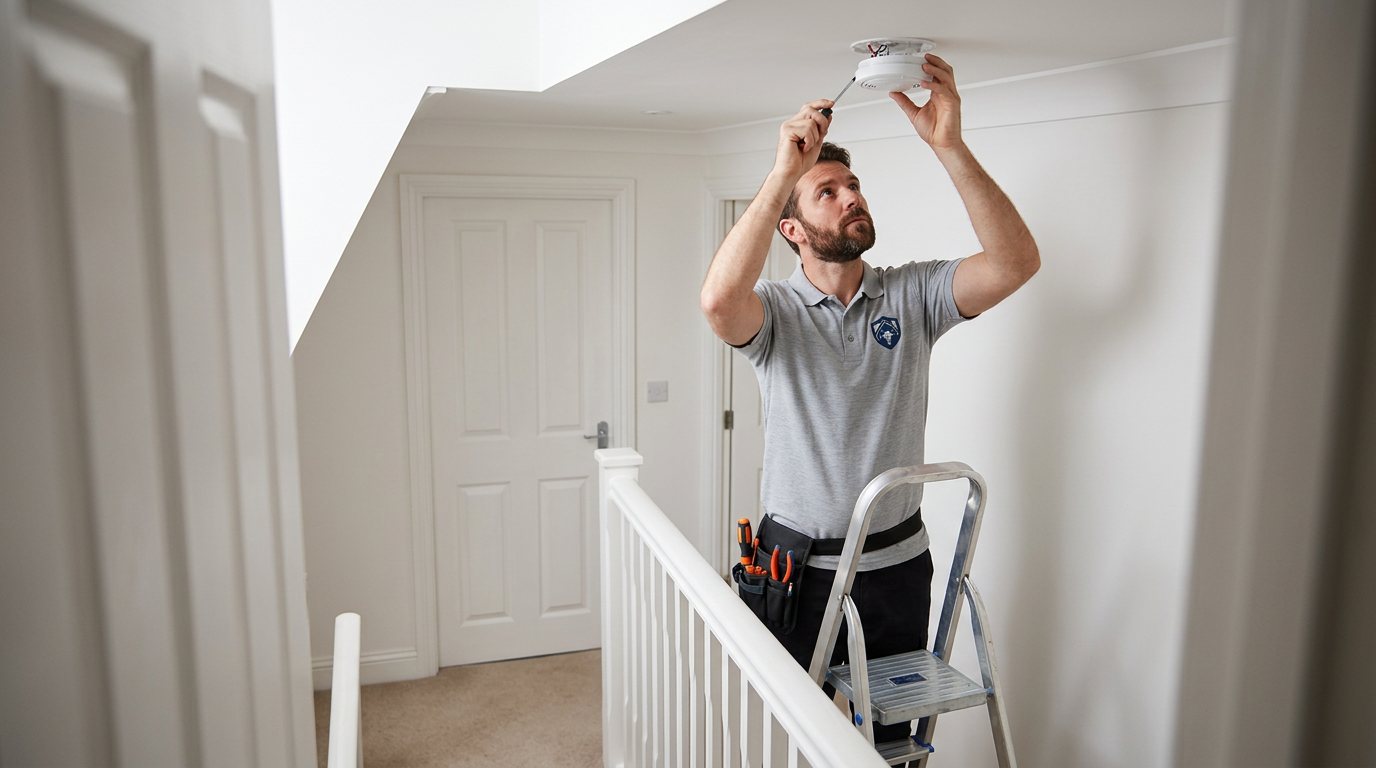
An Intermittent Smoke Alarm Is a Warning — Let's Fix It Properly
We trace why your alarm works one day and fails the next, then repair the connection or component behind the unreliability.
Booking fee plus hourly labour — the price is confirmed before any work starts.
What this costs
| Booked 14+ days ahead | £25 booking fee £85 per hour |
|---|---|
| Booked within 48 hours | £100 booking fee £65 per hour |
| Same-day call-out | £220 booking fee £45 per hour |
The booking fee secures the visit. Labour is then charged by the hour, so you only pay for the time the job actually takes.
Booking fee £25–£220
£25 + £85/hr booked 14+ days ahead, £100 + £65/hr inside 48 hours, £220 + £45/hr same day. Agreed before we arrive.
Covered under Safety Systems
Electrical › Safety Systems — one of 20 documented jobs in this section.
Same-day intermittent smoke alarm
Urgent jobs can often be booked for today. Ask when you book and we will confirm the slot before you pay anything.
15 service areas
Birmingham, Coventry, Dorridge and 12 more across the West Midlands.
The Alarm You Can't Rely On
An intermittent smoke alarm is a strange kind of fault. Some weeks the test button chirps happily and the light blinks as it should; other weeks nothing happens until you press again, or the alarm comes and goes for no reason you can see. It's easy to shrug at, because the alarm clearly works sometimes — but that's precisely the problem. A fire doesn't check whether your alarm is having a good day, and an unreliable alarm is unreliable at exactly the wrong moment.
The upside is that intermittency is a clue. Components rarely fail on and off; connections and contacts do. So the fault is nearly always physical and findable.
Why an Alarm Behaves Unpredictably
The classic culprit is the connection between the alarm and its mounting plate. Smoke alarms are deliberately designed to unclip for battery changes and decorating, and over the years the contacts on that plate can lose their spring, corrode or pick up a film of dust. The result is an alarm that works when the contacts happen to touch and dies when they don't — often nudged in and out of life by vibrations from doors, traffic or the loft above.
Battery problems behave the same way. A backup battery that's nearly flat, or sitting in a tired spring contact, can hold the alarm alive one hour and dark the next. On older alarms the same story plays out inside the sensor: as it approaches the end of its service life, its readings wander, and the alarm may test fine one month and struggle the next.
Finally, an alarm that flickers in and out while others in the house stay solid may point to its supply — a junction behind the ceiling, or a segment of interlink wiring that only makes contact when the building is warm or still.
What Unreliability Really Costs
It's tempting to trust the alarm because it passed the last test. But the whole point of a smoke alarm is that it works on the one night out of thousands when it's needed. An intermittent unit gives you a protection level you can't measure, and that uncertainty is its own hazard — you'll either test obsessively or stop trusting the system altogether.
If the alarm is interlinked with others, an unreliable unit can also drag on the system: a marginal connection may chatter, trigger nuisance alerts or fail to pass a real activation along to the rest of the house.
How We Diagnose an Intermittent Fault
We start by getting the alarm to fail in front of us. That means testing it repeatedly, checking the LED, and — where the alarm is mains-powered — measuring the supply at the mounting plate rather than guessing from the floor. The engineer will unclip the unit and inspect the plate contacts, the battery compartment and the terminals behind it, looking for the corrosion, dust or fatigue that causes on-and-off behaviour.
Where the alarm is part of an interlinked set, we test the whole chain, because an intermittent link wire can make a perfectly healthy alarm appear faulty — or the reverse. By the end of the diagnosis you should have a plain-English answer: whether the fault is the contacts, the battery arrangement, the unit itself or the wiring, and what it will take to put right.
How We Fix It
Most intermittent faults are cured by cleaning and re-making the connection: refreshing the plate contacts, replacing the battery clips or springs, re-terminating the conductors behind the plate with a proper connection rather than a hopeful twist. Where a battery is marginal, we fit a fresh one of the correct type rather than the nearest lookalike.
If the alarm's own electronics are the cause — age-related sensor drift, internal damage, an expired unit — we'll say so and fit a correct replacement, mains-powered and interlinked to match the rest of your system. The test afterwards is simple and satisfying: the alarm should answer instantly, every time, with no coaxing.
After the Repair
We'll show you what we changed and why, and give you the short testing routine that keeps an eye on the connection going forward. If your home's alarms are getting old together, we'll tell you honestly which units are nearing the end of their lives so you can plan replacements on your terms instead of discovering them one silent morning at a time.
When to Call Us
Book if your alarm needs several presses before it responds, if its light flickers or disappears, if it has ever been dead and then come back on its own, or if it behaves differently after the heating or the loft has been disturbed. Intermittent faults are much easier to pin down when the alarm is still partly alive, so don't wait for it to fail completely.
Book Your Smoke Alarm Repair Today
An alarm you can't predict is an alarm you can't trust, and tracing the fault is usually a straightforward job for someone with the right tester and a head torch. Call Maintenance Men or book online — we often have same-day slots for alarm faults — and we'll make your smoke alarm boring again, in the best possible way: the same reliable chirp, every time.
How the price works
We charge a booking fee to hold your slot, then an hourly rate for the work itself. The fee changes with how soon you need us; the hourly rate changes with the slot you choose. You approve the price before we start, so there is no surprise on the invoice.
Booked 14+ days ahead
£25 booking fee
then £85 per hour of labour
Best value. Book the slot now, pay the smallest booking fee.
Booked within 48 hours
£100 booking fee
then £65 per hour of labour
For jobs that can wait a day or two but not a fortnight.
Same-day call-out
£220 booking fee
then £45 per hour of labour
Urgent problems: standing water, no heat, no power, leaks.
Book the slot
Choose the window that suits you and pay the booking fee. That holds your place in the diary.
We diagnose on site
The engineer confirms the cause and tells you what the job involves and how long it should take.
You approve, we work
Nothing goes ahead until you agree the price. Labour is then charged per hour at your slot rate.
A smoke alarm that only half works is almost more worrying than one that's dead, because you never know which version of the alarm you'll have on the night it matters. Intermittent faults usually come down to a loose connection, a tired battery contact or a sensor on its way out. We find the reason for the unpredictability and remove it, so the alarm behaves the same way every single time you test it.
What our customers say about our electrical service
4.6 out of 5 from 11 reviews
Does what it says on the tin
No complaints about the work itself — clear explanation, sensible advice, fair price. Booking online was easy enough once I found the right job page.
Job: Smoke Alarm Replacement
Fixed it, but took longer than expected
Work itself was fine and tidy. Communication beforehand was patchy — I did not get the confirmation message and had to ring to check the slot. Would still use again.
Job: Flickering Outdoor Lights
Turned up when they said
Third time we have used Maintenance Men, and the same experience each time: agreed price, proper explanation, job done in one visit. The hourly rate is fair for the standard of work.
Job: Appliance Causing Power Trip
Book Intermittent Smoke Alarm
Tell us what is happening and choose a slot. If you are not sure this is the right job, use the diagnosis panel — it narrows the problem down before you book.
- Booking fee confirmed up front
- Hourly labour, agreed before work starts
- Same-day slots for urgent problems








Questions people ask about intermittent smoke alarm
Straight answers to the things customers ask most often before booking.
Why does my smoke alarm work sometimes and not others?
Almost always a physical connection issue: worn or dusty contacts on the mounting plate, a tired battery in a loose clip, or a marginal terminal behind the unit. Intermittent behaviour is rarely the sensor itself — that tends to fail gradually rather than on and off — so it's usually very fixable once we can see the contacts.
Could I just clean the contacts myself?
You can carefully unclip the alarm, check the battery is seated firmly and give the contacts a light clean — that sometimes revives it. But if the fault returns, or the alarm is wired into the mains, stop and call us: what looks like a dirty contact can be a loose terminal in a live ceiling fitting, which isn't a DIY job.
Is it safe to keep using an unreliable alarm while I wait?
Partially working protection is better than none, but treat it as a stopgap: test it daily, don't rely on it overnight, and consider a basic battery alarm from a supermarket as a temporary backstop in the same room. The real fix shouldn't wait long, because intermittent faults usually end in complete failure.
What does an intermittent fault cost to sort out?
You pay a booking fee when you book, and the engineer's time is charged hourly at a rate that depends on how soon you need us. We agree the full cost with you before we start work, so you'll know exactly what the fix involves before anything is touched.
Will you replace the alarm even if it still half-works?
Only if the diagnosis points at the unit itself. If the fault is in the contacts, the battery clips or the wiring, repairing the connection is usually the better answer and keeps your original alarm in service. If the unit has expired or its electronics are unreliable, we'll recommend a correct like-for-like replacement and explain why.
Need intermittent smoke alarm sorted?
Book a slot in the diary and pay only the booking fee up front. We confirm the rest before we start.