
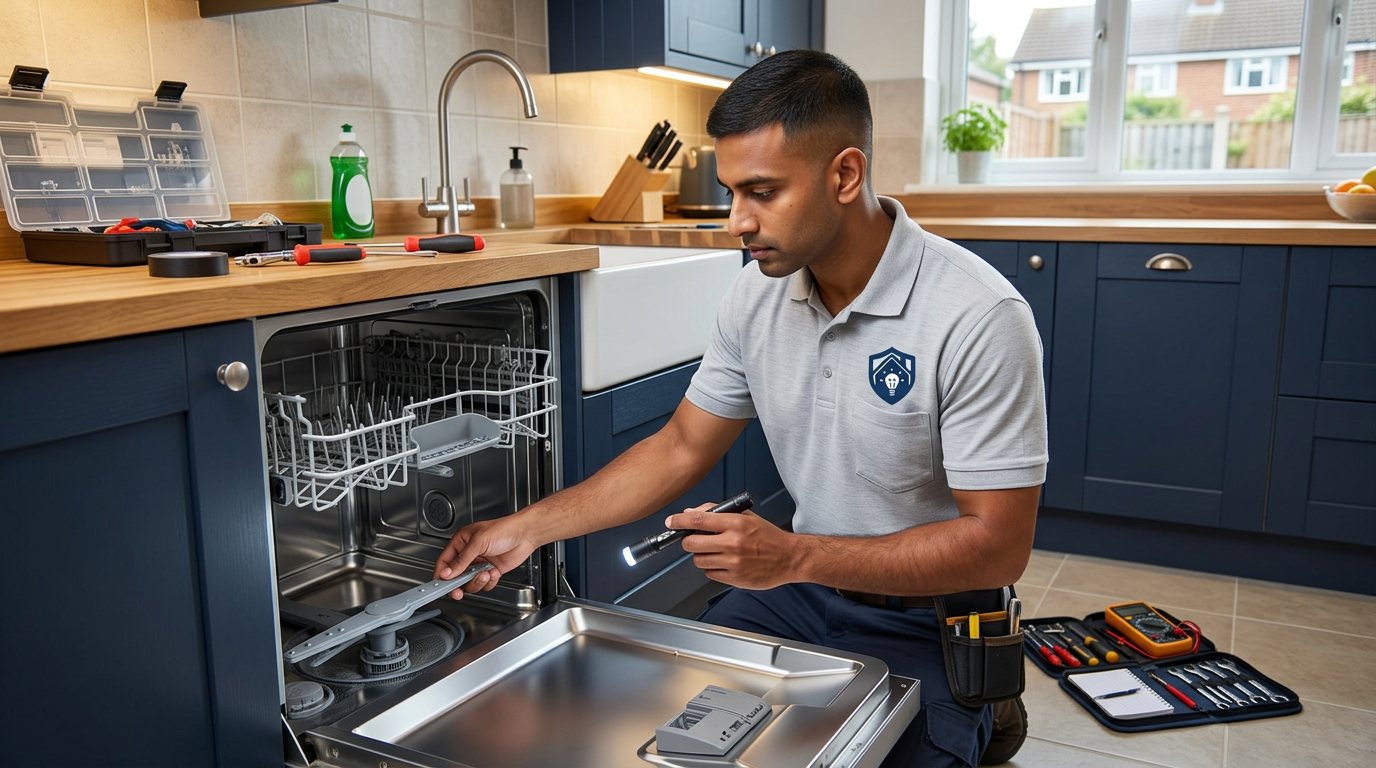
Dishwasher Dead on the Panel? We Trace the Supply First in Edgbaston
We check the socket, fuse, door interlock and control supply to establish whether the machine has lost power or failed internally, then quote before any repair.
Booking fee plus hourly labour — the price is confirmed before any work starts.
What this costs
| Booked 14+ days ahead | £25 booking fee £85 per hour |
|---|---|
| Booked within 48 hours | £100 booking fee £65 per hour |
| Same-day call-out | £220 booking fee £45 per hour |
The booking fee secures the visit. Labour is then charged by the hour, so you only pay for the time the job actually takes.
Booking fee £25–£220
£25 + £85/hr booked 14+ days ahead, £100 + £65/hr inside 48 hours, £220 + £45/hr same day. Agreed before we arrive.
Covered under Dishwasher
Home Appliances › Dishwasher — one of 24 documented jobs in this section.
Same-day dishwasher not turning on
Urgent jobs can often be booked for today. Ask when you book and we will confirm the slot before you pay anything.
15 service areas
Birmingham, Coventry, Dorridge and 12 more across the West Midlands.
A dishwasher with a blank panel and no response to any button feels like a major failure. In practice the fault is often upstream of the machine entirely: a tripped circuit, a blown fuse in the plug, a socket that has been switched off at the spur, or a door that is not registering as closed. Because those causes are cheap to rule out and internal causes are not, the sensible order of work is supply first, appliance second.
What "not turning on" actually covers
Homeowners use the same phrase for several different states, and they lead in different directions:
- completely dead, no lights, no sound, no display
- display lit but no button responds
- lights flash and the machine does nothing further
- the machine starts, runs briefly and shuts down
The first is usually supply or the main board's power stage. The second points at the control panel or its ribbon connection. The third is often an error state the machine is trying to tell you about. The fourth is a protection shutdown, commonly water in the base tray. Knowing which one you have changes the diagnosis before a screwdriver comes out.
Before we arrive
There are a few checks worth doing, because they are safe and they save time. Confirm the socket or fused spur is switched on. If the machine is plugged into a socket behind a neighbouring cupboard, make sure nothing has been knocked. Check whether the circuit breaker for the kitchen sockets has tripped, and whether it trips again immediately when reset. If it trips again, stop resetting it and tell us, because a breaker that will not hold indicates a fault that needs isolating rather than repeated attempts.
Do not open the appliance, remove the plinth, or start swapping fuses for higher-rated ones. A fuse that blows repeatedly is reporting a fault, not causing one.
How the diagnosis runs
We begin with a voltage check at the point of connection, which separates a dead supply from a dead appliance in a couple of minutes. If supply is present, the next step is the door interlock, because a machine that does not believe its door is shut will not energise anything and can look completely dead. From there we check the internal fuse or thermal cut-out where the model has one, the mains filter, and the low-voltage supply on the control board.
Many modern dishwashers use a switch-mode supply on the board. When that fails, the symptom is exactly this: nothing at all, with no error code. On those models the decision is usually board-level repair or replacement rather than component-level work, and we will tell you which is realistic for your machine.
Repair, replacement and parts
Once we know the failed item, we quote it. Some parts are generic and readily available; some are model-specific and need ordering, which means a return visit. We will be straight with you about availability and lead time rather than implying everything is on the van. Where a board is obsolete or the cost approaches the value of the machine, we will say so and let you decide, rather than pushing a repair that does not make sense.
Water and power isolation
If there is any sign of water at the base of the machine, in the plinth area, or around the plug, do not use the machine. Isolate the socket at the switch if it is safe to reach, or the circuit at the consumer unit if it is not, and leave it off. If water and electricity have already met, do not touch the appliance; isolate at the consumer unit and call us. We isolate power and water at the start of work as a matter of routine where the job requires it, and only where it can be done safely.
Aftercare
After a repair we run a short cycle to confirm the machine powers up, fills, heats and drains as it should, and that no error returns. If a board has been replaced, your programme settings may have reset to factory defaults, so expect to set the clock and preferred cycle again. Keep the manual with the model number to hand for future parts enquiries.
When to stop and call
Stop and book if the machine is dead, if the breaker will not hold, if you can smell burning, or if there is water where the electrics sit. Those are not faults to live with. Have the brand, model number, and a note of exactly what happens when you press power ready for the visit, and we can get to the likely cause quickly.
To arrange a visit, book online with those details and the booking fee is taken at the time of booking. The hourly labour rate depends on how soon you need us, and the full cost is quoted and approved by you before any work starts.
How the price works
We charge a booking fee to hold your slot, then an hourly rate for the work itself. The fee changes with how soon you need us; the hourly rate changes with the slot you choose. You approve the price before we start, so there is no surprise on the invoice.
Booked 14+ days ahead
£25 booking fee
then £85 per hour of labour
Best value. Book the slot now, pay the smallest booking fee.
Booked within 48 hours
£100 booking fee
then £65 per hour of labour
For jobs that can wait a day or two but not a fortnight.
Same-day call-out
£220 booking fee
then £45 per hour of labour
Urgent problems: standing water, no heat, no power, leaks.
Book the slot
Choose the window that suits you and pay the booking fee. That holds your place in the diary.
We diagnose on site
The engineer confirms the cause and tells you what the job involves and how long it should take.
You approve, we work
Nothing goes ahead until you agree the price. Labour is then charged per hour at your slot rate.
A dishwasher that will not power up at all is usually a supply problem before it is an appliance problem, and that is the quickest thing to establish. It is also the point where people start pressing buttons repeatedly or resetting the breaker, which tells you nothing. Our visit starts at the plug and works inward, so you get a clear answer rather than a guess about the board.
What our customers say about our home appliances service
4.8 out of 5 from 14 reviews
Exactly what was quoted
What I appreciated was being told what was actually wrong before anyone started. Sorted in under 27 minutes and the invoice matched the quote to the penny.
Job: Tumble Dryer Not Starting Cycle
Good job, slightly late
Solid work. Hourly rate feels fair for the amount of work involved and everything was tested before they left. Would book again.
Job: Toaster Not Working
No mess left behind
Really straightforward. It had been bothering us for weeks; diagnosed properly, fixed the same visit, and the price was exactly what was explained when booking. Can not fault it.
Job: Microwave Button Repair
Book Dishwasher Not Turning On
Tell us what is happening and choose a slot. If you are not sure this is the right job, use the diagnosis panel — it narrows the problem down before you book.
- Booking fee confirmed up front
- Hourly labour, agreed before work starts
- Same-day slots for urgent problems








Questions people ask about dishwasher not turning on
Straight answers to the things customers ask most often before booking.
Can I just check the fuse and plug myself?
Yes, that is reasonable and worth doing. Check the socket or spur is switched on and look at the plug fuse if the plug is accessible without disturbing the wiring. Do not fit a fuse of a higher rating, and do not open the appliance itself.
What will you actually test on the visit?
We check for voltage at the point of connection, test the door interlock, inspect the internal fuse or thermal cut-out where fitted, and check the control board's low-voltage supply. That sequence separates a supply fault from an appliance fault before any parts are discussed.
The breaker trips when I reset it. Is that safe?
No, stop resetting it. A breaker that trips again straight away is reporting a fault that should be isolated and diagnosed, not repeatedly energised. Leave it off and tell us when you book so we can plan for an isolation-first visit.
Is it worth repairing a dead dishwasher?
That depends on what has failed and the age of the machine. A fuse, interlock or filter is usually straightforward. A main board on an older machine may cost enough that replacement is the better value, and we will give you that comparison honestly rather than defaulting to a repair.
How is the price worked out?
The booking fee is paid when you book. The hourly labour rate depends on how soon you need the visit, so a same-day or next-day slot differs from one later in the week. The full cost is quoted and you approve it before work begins, and any parts needed are identified and quoted separately.
Need dishwasher not turning on sorted in Edgbaston?
Book a slot in the diary and pay only the booking fee up front. We confirm the rest before we start.