
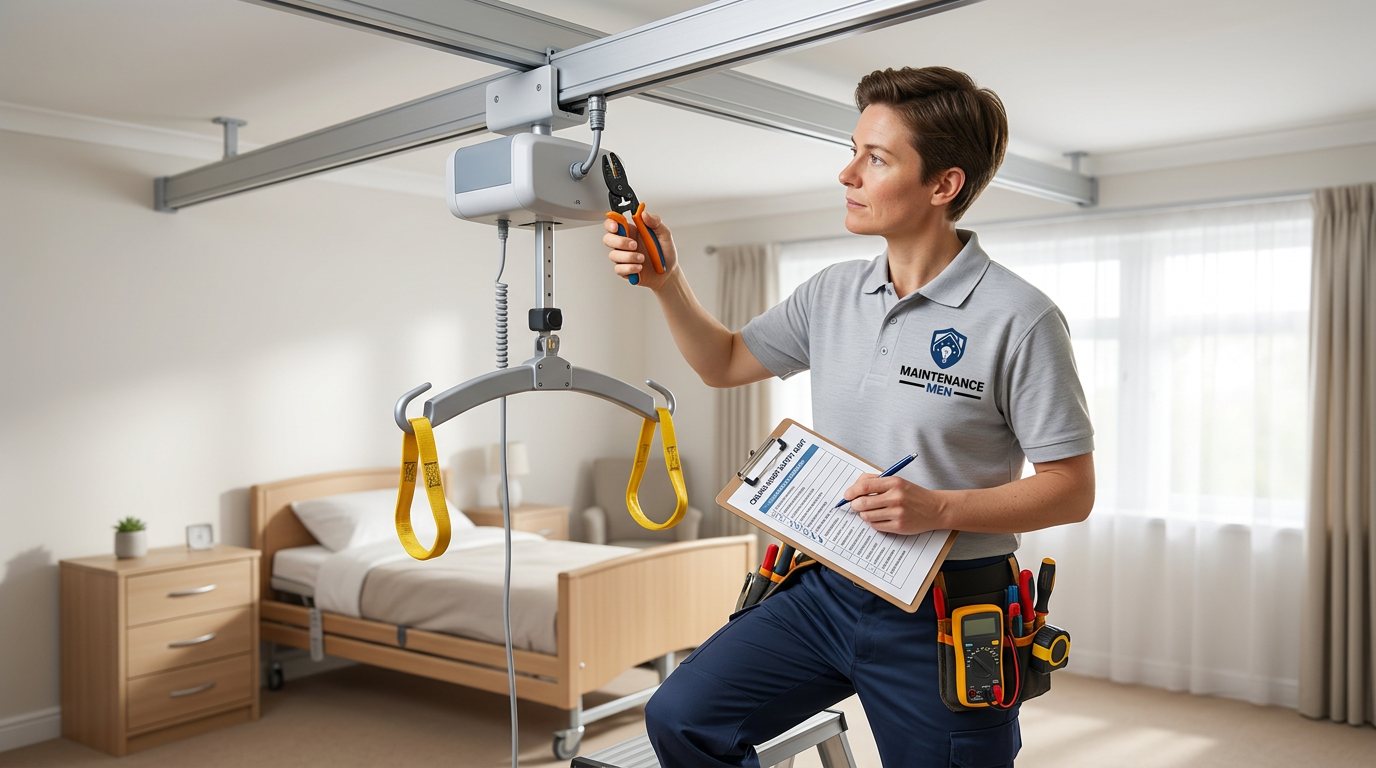
Hoist Track Feeling Loose? We'll Assess the Fixings and the Ceiling in Birmingham
We check the brackets, the substrate and the track alignment, and we tell you honestly when a fixing point cannot safely carry the load it is being asked to hold.
Booking fee plus hourly labour — the price is confirmed before any work starts.
What this costs
| Booked 14+ days ahead | £25 booking fee £85 per hour |
|---|---|
| Booked within 48 hours | £100 booking fee £65 per hour |
| Same-day call-out | £220 booking fee £45 per hour |
The booking fee secures the visit. Labour is then charged by the hour, so you only pay for the time the job actually takes.
Booking fee £25–£220
£25 + £85/hr booked 14+ days ahead, £100 + £65/hr inside 48 hours, £220 + £45/hr same day. Agreed before we arrive.
Covered under Hoists & Lifting Equipment
Mobility & Accessibility › Hoists & Lifting Equipment — one of 22 documented jobs in this section.
Same-day loose track fitting
Urgent jobs can often be booked for today. Ask when you book and we will confirm the slot before you pay anything.
15 service areas
Birmingham, Coventry, Dorridge and 12 more across the West Midlands.
Track fixings fail for reasons that a tightened bolt does not solve. Getting this right is about the substrate as much as the hardware.
The Warning Signs
A track that rocks when the trolley passes. Brackets that have visibly moved, leaving a mark where they used to sit. Screws that turn without tightening. Cracks or staining in the plaster around a fixing. A creak or a knock with every pass. A gap opening between the track and the ceiling. Any of these means the hoist should come out of use until it has been looked at, because the load path to the structure is in question.
Why Fixings Come Loose
Ceiling track hoists are usually fixed into joists, into a spreader or beam, or through a structural ceiling. Common failures include brackets fixed into plasterboard alone rather than into timber; fixings that have been tightened into joist ends or into timber that has split; resin anchors that were not installed correctly or have been loaded before curing; vibration gradually loosening bolts that were never fitted with the right washers; a track extended or re-sited without the fixings being upgraded; and condensation or a long-term leak softening the timber a bracket is fixed to.
How We Assess It
We inspect every fixing point rather than the one that is obviously moving. That means checking the brackets and their bolts, confirming what the fixing is actually embedded in, probing the timber for soundness where it is accessible, looking for cracks and water staining in the surrounding structure, and checking the track for straightness, level and joint alignment. We test the track by hand with the hoist empty to feel for movement, and we look at whether the load is spread across enough points for the track's span. Then we tell you what we found in plain terms.
What We Can Put Right
Replacing fixings with the correct type and size for the substrate, adding brackets where a span is under-supported, adding a spreader plate to distribute load across joists, re-aligning a track that has shifted, and renewing bolts, washers and brackets that have corroded. Every repair is followed by a check that the track runs straight, is level, and does not move under a controlled load within its rated capacity.
When We Say No
If the ceiling cannot safely take the load — a plasterboard ceiling with no suitable structure, joists that are rotten or undersized, a wall that is not sound — we will not fit a heavier bolt and hope. We will explain what would be required, which might be a spreader beam, a different track position, or a structural solution from a builder or structural engineer. That is not us being difficult; it is the only honest answer when someone's weight will hang from it. We also cannot certify the installation as suitable for a particular person's needs or confirm its compliance with any clinical or care specification — that rests with the user, their family and carers, and the manufacturer's specification.
Safety Until It Is Fixed
Stop using the hoist. A track that moves under load is a fixing problem that will not improve with use, and the failure mode is not gradual. Do not tighten brackets yourself unless the manual explicitly covers it, do not add your own brackets, and do not hang anything else from the track. If someone is mid-lift and the track has moved, lower them if it is safe and comfortable to do so per the manufacturer's instructions; if they are suspended and cannot be lowered, keep them comfortable and call 999 if they are in pain or distress.
Aftercare
We will show you what to look for — movement, marks around brackets, new cracks — and recommend a check interval that reflects how heavily the hoist is used. Fixings are worth inspecting at every service, not only when something feels wrong.
Booking
Tell us the make and model, where the movement is, whether it is one bracket or the whole track, and anything that has changed recently — a new track section, a redecoration, a leak. You pay a booking fee when you book, labour is hourly at a rate that depends on how soon you need the visit, and the full cost is quoted and approved before work starts.
How the price works
We charge a booking fee to hold your slot, then an hourly rate for the work itself. The fee changes with how soon you need us; the hourly rate changes with the slot you choose. You approve the price before we start, so there is no surprise on the invoice.
Booked 14+ days ahead
£25 booking fee
then £85 per hour of labour
Best value. Book the slot now, pay the smallest booking fee.
Booked within 48 hours
£100 booking fee
then £65 per hour of labour
For jobs that can wait a day or two but not a fortnight.
Same-day call-out
£220 booking fee
then £45 per hour of labour
Urgent problems: standing water, no heat, no power, leaks.
Book the slot
Choose the window that suits you and pay the booking fee. That holds your place in the diary.
We diagnose on site
The engineer confirms the cause and tells you what the job involves and how long it should take.
You approve, we work
Nothing goes ahead until you agree the price. Labour is then charged per hour at your slot rate.
A ceiling track that moves, creaks or sags is holding a person's weight through a handful of bolts, so a loose fitting deserves attention rather than a quick tighten. The fixing is only ever as strong as what is behind it, and the important question is not whether the bracket is loose but why. We answer that before we put a spanner on anything.
What our customers say about our mobility & accessibility service
4.5 out of 5 from 8 reviews
Proper job, no upselling
Turned up in the window they promised, walked me through the options (turns out the old fitting was seized and needed careful removal), then cracked on. Everything was tested before they left. No mess, no drama, no surprise on the bill.
Job: Loose or Faulty Brakes
Fine in the end
The problem is fixed, which is the main thing, and the engineer clearly knew what they were doing. It took a fair bit longer than the estimate on the phone and I had to ask twice for a breakdown of the hours.
Job: Stair Lift Service
Would use again
What I appreciated was being told what was actually wrong before anyone started. Sorted in under 70 minutes and the invoice matched the quote to the penny.
Job: Control Panel Fault
Book Loose Track Fitting
Tell us what is happening and choose a slot. If you are not sure this is the right job, use the diagnosis panel — it narrows the problem down before you book.
- Booking fee confirmed up front
- Hourly labour, agreed before work starts
- Same-day slots for urgent problems





Questions people ask about loose track fitting
Straight answers to the things customers ask most often before booking.
Can I just tighten the bracket bolts myself?
If a bolt is visibly loose and your manual shows the correct fixing, tightening it is reasonable — but it usually comes loose for a reason, and tightening a fixing that has pulled out of plasterboard or split timber makes things worse. If it loosens again, stop and have it assessed properly.
What will you check?
Every fixing point, not just the loose one: the brackets and bolts, what they are embedded in, the soundness of the timber, cracks and water staining around the fixings, and the track's straightness and level. Then we test for movement with the hoist empty and explain what we found.
What if the ceiling isn't strong enough?
Then we will say so rather than fit a bigger bolt. Options include a spreader plate across joists, additional brackets, a different track position, or a structural solution from a builder or structural engineer. A hoist track carries a person, so this is not a place for an optimistic fix.
The track creaks but doesn't seem to move. Is that a problem?
It can be. A creak with every pass often means a bracket is flexing or a joint is working, and both get worse. It is worth a look before it becomes visible movement, because a fixing that is slowly pulling out is much easier to correct early.
What will it cost?
You pay a booking fee when you book, and the hourly labour rate depends on how soon you need the visit. After the assessment we quote the full cost of the work and you approve it before we start, with brackets, fixings or any structural work quoted separately.
Need loose track fitting sorted in Birmingham?
Book a slot in the diary and pay only the booking fee up front. We confirm the rest before we start.