
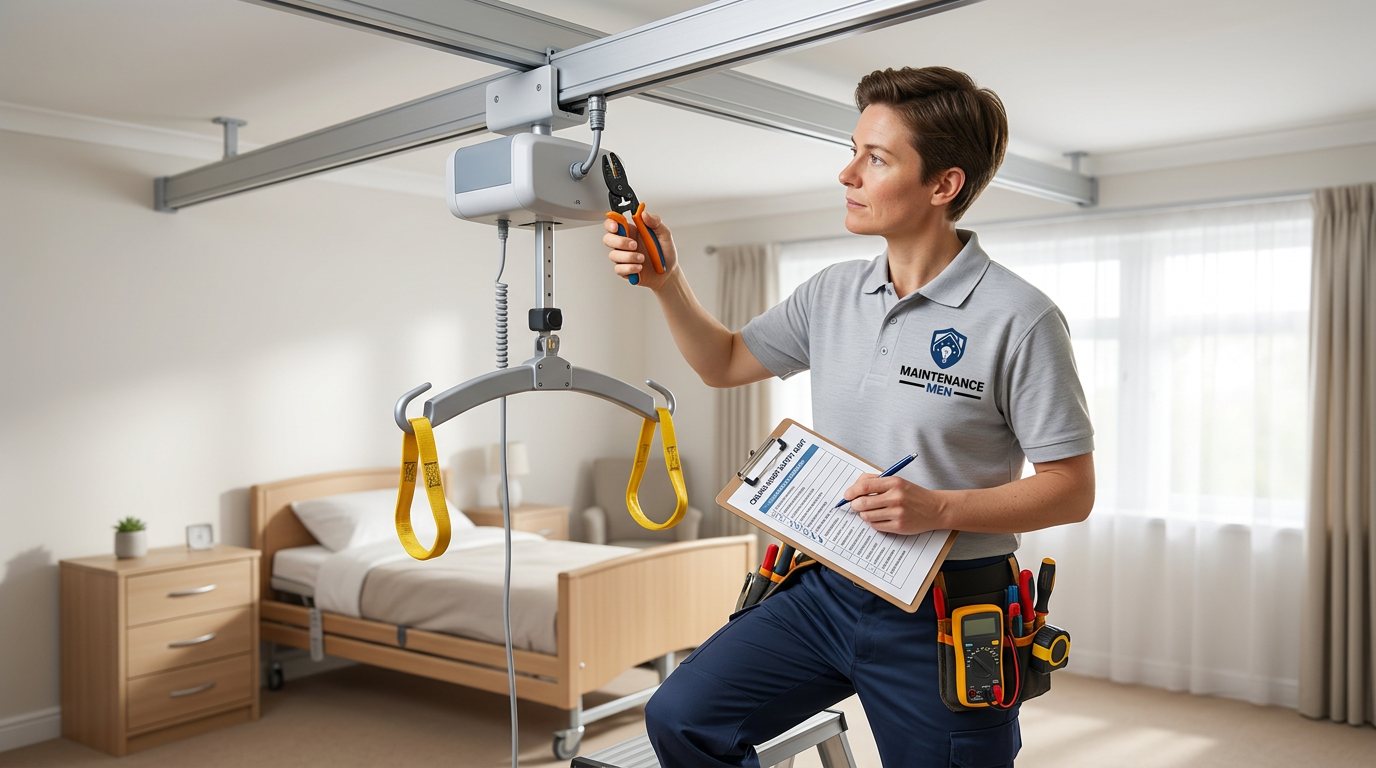
Hoist No Longer Needed? We'll Remove It Cleanly and Make Good the Room in Birmingham
We isolate and dismantle the system, take down the track and fixings, make the ceiling and walls good, and tell you who the equipment should go back to.
Booking fee plus hourly labour — the price is confirmed before any work starts.
What this costs
| Booked 14+ days ahead | £25 booking fee £85 per hour |
|---|---|
| Booked within 48 hours | £100 booking fee £65 per hour |
| Same-day call-out | £220 booking fee £45 per hour |
The booking fee secures the visit. Labour is then charged by the hour, so you only pay for the time the job actually takes.
Booking fee £25–£220
£25 + £85/hr booked 14+ days ahead, £100 + £65/hr inside 48 hours, £220 + £45/hr same day. Agreed before we arrive.
Covered under Hoists & Lifting Equipment
Mobility & Accessibility › Hoists & Lifting Equipment — one of 22 documented jobs in this section.
Same-day hoist removal
Urgent jobs can often be booked for today. Ask when you book and we will confirm the slot before you pay anything.
15 service areas
Birmingham, Coventry, Dorridge and 12 more across the West Midlands.
A removal is a decommissioning job: isolate, dismantle, take down, make good, and hand back or dispose of the equipment properly.
Before Anything Comes Down
Establish who owns the hoist. Equipment supplied through social care, a council, a housing association or a care provider is often on loan and must be collected by them — disposing of it yourself can leave you liable for its value. If it was bought privately, it is yours to sell, donate or scrap. If it is being replaced by a new system, the new one is usually commissioned before or alongside the removal so there is minimal gap. If the hoist is still in use by anyone, it stays in service until the replacement is ready.
Making It Safe
The electrical supply to the charger or the fused spur is isolated first, at the circuit, and confirmed dead before anything is disconnected. The hoist is then lowered and the load removed — nobody dismantles a system with anything hanging from it. The battery is removed and disposed of properly, because these packs should not go into household waste. Only then is the track taken down.
Taking Down the Track
Track sections come apart at their joints. The motor unit and trolley come off the rail. Then the brackets and fixings are removed, and this is where a good removal differs from a rushed one: the fixings come out cleanly rather than being snapped off or left proud, and the holes are filled and finished so the ceiling does not look like a colander. Long runs with many brackets take longer than people expect, and a track fixed into joists through a plastered ceiling may need careful patching afterwards.
Making Good
We fill fixing holes, patch plaster where the track has marked the ceiling, and touch in with paint where we can match it reasonably. We do not claim to be decorators, and on a large ceiling with many fixings a full repaint may be the sensible finish — we will tell you honestly which it is rather than promising an invisible repair. Any cable left in the wall is made safe and, where it is no longer used, disconnected at the source rather than left live behind plaster.
Removal and Disposal
We take the track, brackets and fixings away. Batteries go for proper disposal. Where equipment is being returned to a provider, we can leave it in a condition for collection and tell you what they typically expect. We do not promise to dispose of slings or other soft items as clinical waste — if that is needed, we will say so and point you to the right route rather than guess.
If Part of the System Stays
Sometimes a track stays for a future installation, or a charger spur remains useful. We will tell you what is safe to leave and what must be isolated, and label anything that remains so nobody later mistakes it for live equipment. If a track is to stay but unused, it should not be left where someone might try to hang from it.
About the Decision Itself
We remove equipment; we do not advise on whether someone should stop using a hoist, or on what should replace it. Those are conversations for the user, their family and carers, and the professionals involved in their care. If you are unsure whether a removal is the right step, that is worth settling before you book, and we are happy to work to whatever decision has been made.
Safety
Never attempt to take down a track yourself. It is fixed into structure, it is heavy, it may be above a bathroom or stairwell, and the fixings can release suddenly. Do not cut cables without isolating the circuit, and do not leave a battery or charger accessible for children or anyone who might try to use the remains.
Booking
Tell us the make and model, whether the equipment is owned or on loan, how long the track run is, and whether a replacement is being fitted. You pay a booking fee when you book, labour is hourly at a rate that depends on how soon you need the visit, and the full cost is quoted and approved before work starts — larger removals are quoted after a look at the run.
How the price works
We charge a booking fee to hold your slot, then an hourly rate for the work itself. The fee changes with how soon you need us; the hourly rate changes with the slot you choose. You approve the price before we start, so there is no surprise on the invoice.
Booked 14+ days ahead
£25 booking fee
then £85 per hour of labour
Best value. Book the slot now, pay the smallest booking fee.
Booked within 48 hours
£100 booking fee
then £65 per hour of labour
For jobs that can wait a day or two but not a fortnight.
Same-day call-out
£220 booking fee
then £45 per hour of labour
Urgent problems: standing water, no heat, no power, leaks.
Book the slot
Choose the window that suits you and pay the booking fee. That holds your place in the diary.
We diagnose on site
The engineer confirms the cause and tells you what the job involves and how long it should take.
You approve, we work
Nothing goes ahead until you agree the price. Labour is then charged per hour at your slot rate.
Removing a hoist is often an emotional job as much as a practical one, and it deserves to be done tidily rather than left as a row of holes and a dangling cable. There is also a practical question that catches people out: much of this equipment is on loan from a council or care provider and has to be returned, not scrapped. We will help you establish that before anything comes down.
What our customers say about our mobility & accessibility service
4.5 out of 5 from 8 reviews
Proper job, no upselling
Turned up in the window they promised, walked me through the options (turns out the old fitting was seized and needed careful removal), then cracked on. Everything was tested before they left. No mess, no drama, no surprise on the bill.
Job: Loose or Faulty Brakes
Fine in the end
The problem is fixed, which is the main thing, and the engineer clearly knew what they were doing. It took a fair bit longer than the estimate on the phone and I had to ask twice for a breakdown of the hours.
Job: Stair Lift Service
Would use again
What I appreciated was being told what was actually wrong before anyone started. Sorted in under 70 minutes and the invoice matched the quote to the penny.
Job: Control Panel Fault
Book Hoist Removal
Tell us what is happening and choose a slot. If you are not sure this is the right job, use the diagnosis panel — it narrows the problem down before you book.
- Booking fee confirmed up front
- Hourly labour, agreed before work starts
- Same-day slots for urgent problems



Questions people ask about hoist removal
Straight answers to the things customers ask most often before booking.
The hoist was supplied by the council. Can you just take it away?
Please check with them first. Loaned equipment often has to be collected by the organisation that supplied it, and disposing of it yourself can leave you liable for its value. Once you know it is yours to remove, we can take it down and dispose of it properly.
Will you leave the ceiling looking like it did before?
We remove fixings cleanly, fill the holes and patch the plaster, and touch in paint where we can get a reasonable match. On a ceiling with a long track and many brackets a full repaint is often the honest answer, and we will tell you which applies before we start rather than after.
Is it safe to leave the old track up and just disconnect the hoist?
It can be, provided the electrical supply is properly isolated and the track is sound and clearly out of use. An unused track that someone might try to hang from, or a live charger spur left behind plaster, is not acceptable — we isolate and label anything that stays.
What happens to the battery and the old parts?
The battery is removed and disposed of properly rather than put in household waste, and the track, brackets and fixings are taken away. Soft items such as slings may need a different disposal route, and we will tell you if that applies rather than guess.
What does a removal cost?
You pay a booking fee when you book, and the hourly labour rate depends on how soon you need the visit. The full cost of the work is quoted and approved before we start, and a long track run or extensive making good is quoted after we have seen it.
Need hoist removal sorted in Birmingham?
Book a slot in the diary and pay only the booking fee up front. We confirm the rest before we start.