
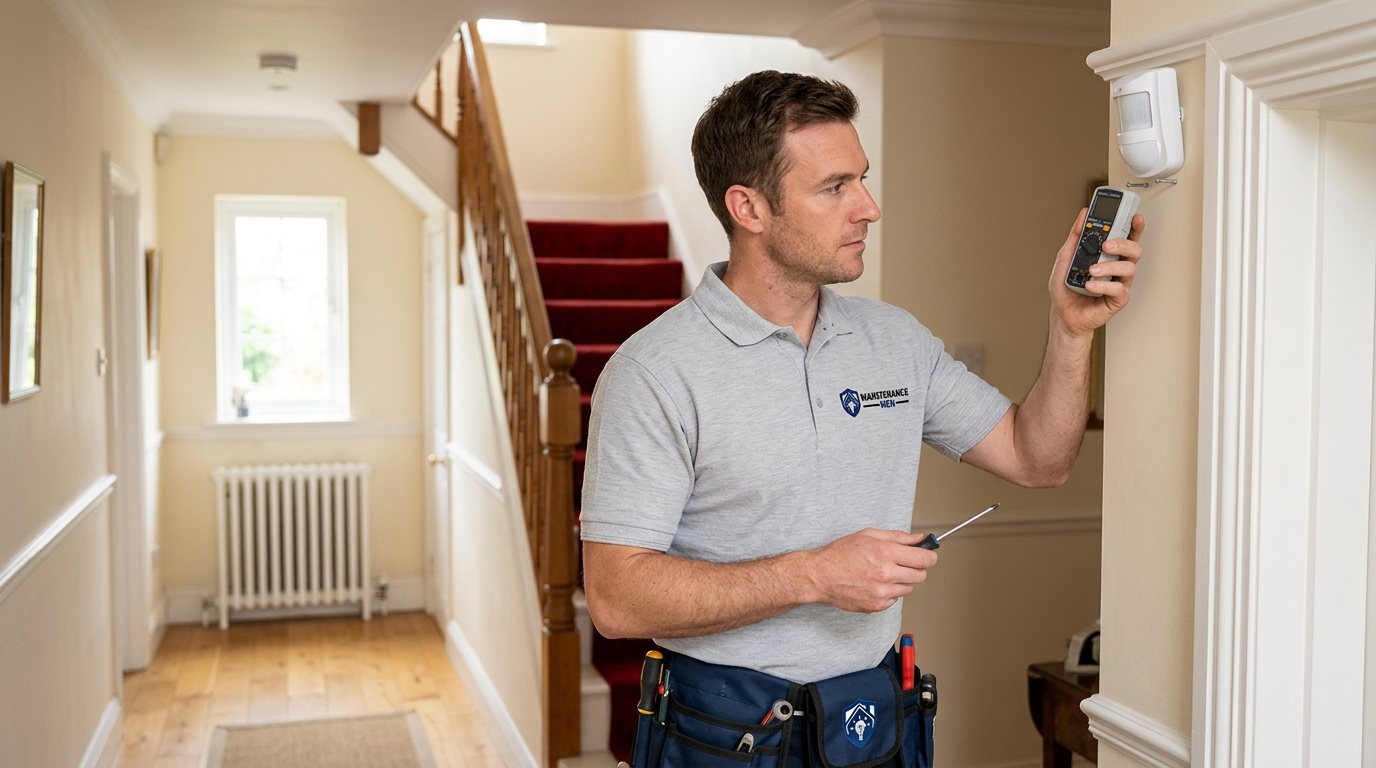
Motion Sensor Dead? We'll Trace It Back to a Fixable Cause in Wolverhampton
We test the sensor, its battery or supply, its position and its link to the panel, and give you a clear diagnosis and quote before any repair begins.
Booking fee plus hourly labour — the price is confirmed before any work starts.
What this costs
| Booked 14+ days ahead | £25 booking fee £85 per hour |
|---|---|
| Booked within 48 hours | £100 booking fee £65 per hour |
| Same-day call-out | £220 booking fee £45 per hour |
The booking fee secures the visit. Labour is then charged by the hour, so you only pay for the time the job actually takes.
Booking fee £25–£220
£25 + £85/hr booked 14+ days ahead, £100 + £65/hr inside 48 hours, £220 + £45/hr same day. Agreed before we arrive.
Covered under Sensors & Detectors
Security & CCTV › Sensors & Detectors — one of 22 documented jobs in this section.
Same-day motion sensor not working
Urgent jobs can often be booked for today. Ask when you book and we will confirm the slot before you pay anything.
15 service areas
Birmingham, Coventry, Dorridge and 12 more across the West Midlands.
A motion sensor that no longer reacts when you walk past it is one of those faults that is easy to put off and hard to ignore. It might not have tripped for weeks, or it might be a single zone on your alarm panel showing as missing or faulty every time you try to set the system. Either way, the sensor is not doing its job, and the honest answer is that several different problems all look identical from the outside. Batteries die, sensors drift on their brackets, radio links drop, tamper switches stick and internal electronics fail. The purpose of our visit is to work out which one you have, rather than swapping parts until something happens to work.
Why a motion sensor stops responding
On a battery-powered sensor, a flat or corroded battery is the single most common cause, and a battery that is nearly flat often behaves oddly first — the sensor may trigger late, intermittently or not at all before it dies completely. Corrosion on the battery contacts can interrupt the circuit even with a fresh battery fitted. On wired sensors, a loose connection at the panel or a damaged cable run can take the zone down. Physical causes are just as common: a sensor that has been knocked out of alignment by a door slamming or a ladder leaning against the wall may no longer cover the area it was aimed at, so it looks dead when it is actually just looking in the wrong direction. On wireless systems, a sensor that has lost its pairing with the hub or panel will sit silent no matter how much movement it sees. And sometimes the sensor's own electronics have simply reached the end of their life.
How we diagnose it
We start by putting the sensor into a walk test so we can see exactly what the panel reports as you move through the room. From there we check the obvious things first: battery condition, contact cleanliness, the tamper switch, and whether the sensor's field of view still covers the space it was installed to protect. On wireless units we check the signal strength between the sensor and the panel and, where the equipment supports it, re-pair the sensor properly rather than just power-cycling it and hoping. On wired units we test the wiring continuity and the connections at the panel end. If the sensor turns out to have internal electronics damage or end-of-life symptoms, we will tell you plainly that a replacement is the realistic option, and we will not sell you a repair that will not last.
Your options once we know the cause
Most fixes are straightforward. A battery replacement, a bracket re-aligned and re-fixed, a contact cleaned or a wireless link re-established are all sensible visits in themselves. If a sensor needs replacing, we match the type to the panel you already have — mixing incompatible brands rarely ends well — and we quote the replacement parts separately so you can see exactly what you are paying for before deciding. If we find the fault is elsewhere in the system, such as the panel or a wiring run, we will tell you what that involves and what it is likely to cost before you commit to anything. You approve the full cost before any work starts, so there are no surprises.
What we cannot promise
We diagnose and repair honestly, but we do not claim any sensor will detect movement in every condition — no detector does. Mounting position, room layout, pets and even strong sunlight all influence how a sensor behaves, and if we think the sensor's placement is part of the problem, we will say so rather than simply replace the unit and leave you with the same fault in a new box.
Booking your visit
Call or use the website to arrange a visit, and tell us the make of your alarm system, whether the sensors are wired or wireless, and exactly how the fault shows itself — no trips at all, intermittent, or an error on the panel. That detail genuinely speeds up diagnosis. You pay a booking fee when you book, labour is charged hourly at a rate that depends on how soon you need the visit, and the full cost is quoted and approved before work starts, with any parts quoted separately.
How the price works
We charge a booking fee to hold your slot, then an hourly rate for the work itself. The fee changes with how soon you need us; the hourly rate changes with the slot you choose. You approve the price before we start, so there is no surprise on the invoice.
Booked 14+ days ahead
£25 booking fee
then £85 per hour of labour
Best value. Book the slot now, pay the smallest booking fee.
Booked within 48 hours
£100 booking fee
then £65 per hour of labour
For jobs that can wait a day or two but not a fortnight.
Same-day call-out
£220 booking fee
then £45 per hour of labour
Urgent problems: standing water, no heat, no power, leaks.
Book the slot
Choose the window that suits you and pay the booking fee. That holds your place in the diary.
We diagnose on site
The engineer confirms the cause and tells you what the job involves and how long it should take.
You approve, we work
Nothing goes ahead until you agree the price. Labour is then charged per hour at your slot rate.
A motion sensor that has stopped responding leaves a gap in your home's protection that you can feel every time you walk past it. The fault is usually one of a small number of causes, and guessing at it often makes things worse. Our visit is about proving which cause applies to your sensor and explaining what it will take to put right.
What our customers say about our Security & CCTV service
5 out of 5 from 7 reviews
Would use again
Third time we have used Maintenance Men, and the same experience each time: agreed price, proper explanation, job done in one visit. The hourly rate is fair for the standard of work.
Job: CCTV Installation
Second time we have used them
I had put off sorting this for months because I expected a runaround. Quoted the booking fee plus hourly rate upfront, stuck to it, and actually found the underlying cause rather than just clearing the symptom. Worked neatly and hoovered up afterwards.
Job: Backup Battery Fault
Exactly what was quoted
What I appreciated was being told what was actually wrong before anyone started. Sorted in under 56 minutes and the invoice matched the quote to the penny.
Job: Alarm Repair Service
Book Motion Sensor Not Working
Tell us what is happening and choose a slot. If you are not sure this is the right job, use the diagnosis panel — it narrows the problem down before you book.
- Booking fee confirmed up front
- Hourly labour, agreed before work starts
- Same-day slots for urgent problems




Questions people ask about motion sensor not working
Straight answers to the things customers ask most often before booking.
Can I fix a dead motion sensor myself?
If the sensor is battery-powered, changing the battery is reasonable DIY territory, and many manuals describe how to do it safely. Beyond that — re-pairing a wireless sensor, opening a wired unit or testing wiring — it is best left to an engineer, because a sensor half-dismantled can generate tamper faults and mask the real problem.
What do you actually check during the visit?
We run a walk test, check the battery and contacts, verify the tamper switch, confirm the sensor still covers the right area, and test the link to the panel or hub. On wired units we also test the cabling. By the end you get a plain-language diagnosis of the actual cause.
Will you just disable the zone if the sensor is faulty?
No — we do not silence or bypass a faulty sensor as a permanent solution, because that leaves a hole in your cover. Our job is to diagnose the cause and repair or replace the sensor so the zone is properly protected again.
Why does my sensor work sometimes and not others?
Intermittent faults usually point to a dying battery, a marginal radio link or a loose connection rather than a dead sensor. These are worth diagnosing promptly, because a sensor that is only half-working gives unreliable cover, and the underlying cause tends to get worse rather than better.
How is the work priced?
You pay a booking fee when you book, and labour is charged hourly at a rate that depends on how soon you need us to attend. Once we have diagnosed the fault, the full cost of the work is quoted and approved before anything starts, and any replacement parts are quoted separately so you know exactly what you are approving.
Need motion sensor not working sorted in Wolverhampton?
Book a slot in the diary and pay only the booking fee up front. We confirm the rest before we start.