
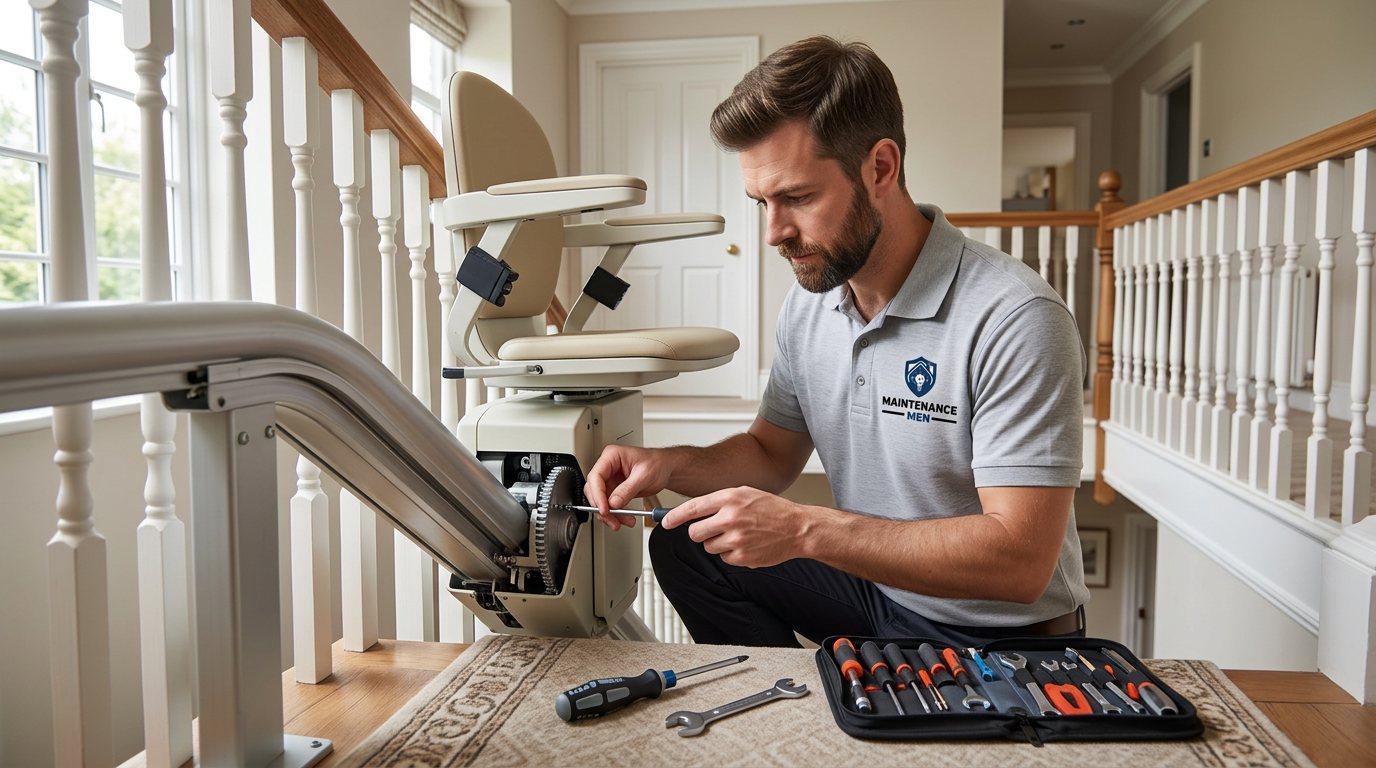
Flat Stair Lift Batteries Replaced Quickly and Safely in Wolverhampton
We load-test your lift's batteries, replace them with manufacturer-approved parts if worn, and quote everything for your approval first.
Booking fee plus hourly labour — the price is confirmed before any work starts.
What this costs
| Booked 14+ days ahead | £25 booking fee £85 per hour |
|---|---|
| Booked within 48 hours | £100 booking fee £65 per hour |
| Same-day call-out | £220 booking fee £45 per hour |
The booking fee secures the visit. Labour is then charged by the hour, so you only pay for the time the job actually takes.
Booking fee £25–£220
£25 + £85/hr booked 14+ days ahead, £100 + £65/hr inside 48 hours, £220 + £45/hr same day. Agreed before we arrive.
Covered under Stair Lifts
Mobility & Accessibility › Stair Lifts — one of 24 documented jobs in this section.
Same-day battery failure
Urgent jobs can often be booked for today. Ask when you book and we will confirm the slot before you pay anything.
15 service areas
Birmingham, Coventry, Dorridge and 12 more across the West Midlands.
Nearly every stair lift fitted in the last couple of decades runs on a pair of rechargeable batteries carried on the lift carriage itself. It is a good design — no trailing cable, no live rail, and the lift keeps working through a power cut — but it makes the batteries the heart of the machine, and like all batteries they wear out. Recognising the signs early saves you from being stranded halfway up the stairs.
The signs of failing stair lift batteries
The classic pattern is a lift that works fine for the first journey of the day and then slows, complains or stops later on. Other signs include: needing to park the lift for hours before it will complete a trip; a low-battery beep that appears earlier and earlier; journeys that become noticeably slower as the batteries drain; a lift that is completely dead in the morning despite showing a charge light when parked; and, in some systems, a fault code pointing at battery voltage. If the batteries have failed outright, the lift will not move at all, although the seat and footplate functions may still respond.
Why batteries fail
Stair lift batteries age whether or not the lift is used daily — time, temperature and charge cycling all take their toll, and a lift parked slightly off its charge points accelerates the decline by leaving the batteries partly discharged. Very occasional deep discharge, a failed charger quietly under-charging for months, or simply reaching the end of their service life are the usual stories. There is no diagnostic shortcut: healthy-looking batteries can sag badly under the load of a loaded lift on a flight of stairs, which is why proper load testing matters.
What our battery visit covers
We measure the resting voltage of each battery, load-test them to see how they behave when the lift actually draws current, and check the charger and charging contacts to make sure a fresh set will not be quietly ruined by the same fault that killed the old ones. If replacement is needed we fit manufacturer-approved batteries of the correct type, secure and connect them properly, and confirm the charging indicator behaves correctly. Old batteries are taken away for responsible recycling. If testing shows the batteries are healthy and something else — a charger, contact or wiring fault — is the real cause, we will tell you and quote that instead. All costs are quoted and approved before work starts, with parts quoted separately.
A note on DIY replacement
Some manufacturers make their batteries a genuinely user-serviceable part, with a step-by-step procedure in the manual — if that applies to your model and you feel confident, following the manual exactly is reasonable. But many lifts require covers to be removed, connectors to be released and the correct battery type to be fitted; getting any of that wrong risks a lift that fails mid-journey. If your manual does not describe battery replacement as a user task, or if the batteries are swollen, hot or leaking, book an engineer.
Safety reminders
If the batteries have died with someone on the lift, keep them safe, comfortable and calm — call 999 if they are in pain or distress. Manual release is only for someone confident, strictly per the manufacturer's instructions; never climb under, push or force a suspended lift. Do not use a lift that has behaved erratically, tripped the electrics or smelled of burning until it has been checked.
Keeping the new set healthy
Park the lift squarely on its charge points every time, let it charge between journeys where practical, and ask us to check battery health at the annual service. Batteries replaced before they fail completely keep the lift dependable and avoid the midnight dead-lift surprise.
Booking
Contact us with the make and model, how the symptoms have developed and roughly how old the lift is. You pay a booking fee when you book, the hourly labour rate depends on how soon you need us, and the full cost is quoted and approved before work begins, with parts quoted separately.
How the price works
We charge a booking fee to hold your slot, then an hourly rate for the work itself. The fee changes with how soon you need us; the hourly rate changes with the slot you choose. You approve the price before we start, so there is no surprise on the invoice.
Booked 14+ days ahead
£25 booking fee
then £85 per hour of labour
Best value. Book the slot now, pay the smallest booking fee.
Booked within 48 hours
£100 booking fee
then £65 per hour of labour
For jobs that can wait a day or two but not a fortnight.
Same-day call-out
£220 booking fee
then £45 per hour of labour
Urgent problems: standing water, no heat, no power, leaks.
Book the slot
Choose the window that suits you and pay the booking fee. That holds your place in the diary.
We diagnose on site
The engineer confirms the cause and tells you what the job involves and how long it should take.
You approve, we work
Nothing goes ahead until you agree the price. Labour is then charged per hour at your slot rate.
Batteries are the most commonly replaced part on any stair lift, and a failing pack rarely gives much warning beyond shorter journeys and a lift that is dead by morning. Our visit tells you definitively whether the batteries are the problem — and whether anything else is hiding behind them.
What our customers say about our mobility & accessibility service
4.5 out of 5 from 8 reviews
Proper job, no upselling
Turned up in the window they promised, walked me through the options (turns out the old fitting was seized and needed careful removal), then cracked on. Everything was tested before they left. No mess, no drama, no surprise on the bill.
Job: Loose or Faulty Brakes
Fine in the end
The problem is fixed, which is the main thing, and the engineer clearly knew what they were doing. It took a fair bit longer than the estimate on the phone and I had to ask twice for a breakdown of the hours.
Job: Stair Lift Service
Would use again
What I appreciated was being told what was actually wrong before anyone started. Sorted in under 70 minutes and the invoice matched the quote to the penny.
Job: Control Panel Fault
Book Battery Failure
Tell us what is happening and choose a slot. If you are not sure this is the right job, use the diagnosis panel — it narrows the problem down before you book.
- Booking fee confirmed up front
- Hourly labour, agreed before work starts
- Same-day slots for urgent problems



Questions people ask about battery failure
Straight answers to the things customers ask most often before booking.
How long do stair lift batteries normally last?
It varies with the model, usage pattern and how reliably the lift parks on its charge points, but batteries are treated by every manufacturer as a consumable part with a finite service life. If your lift is slowing or going flat overnight, age is the most likely reason — a load test will confirm it.
Is changing the batteries a DIY job?
Only if your manufacturer's manual describes it as a user task and you are confident following it exactly, using the correct battery type. Otherwise, or if the batteries are swollen or leaking, leave it to us. We never advise opening drive units or working on anything beyond what the manual supports.
Can worn batteries make the lift stop with someone on it?
Yes — a battery that sags under load can stop the lift anywhere on the rail. If that happens, make the person safe, comfortable and calm, call 999 if they are in distress, and attempt a manual release only strictly per the manufacturer's instructions by a confident person. Never push or force the lift.
Will you check the charger as well as the batteries?
Yes, always. Fitting new batteries to a lift whose charger or charging contacts are faulty would destroy the new set too, so we test the whole charging chain — charger output, contacts and seating — before and after replacing anything. That is part of the quoted work, not an extra.
What does battery replacement cost?
You pay a booking fee when you book, and labour is charged hourly at a rate that depends on how soon you need the visit. The full cost, including fitting, is quoted and approved before we start, and the batteries themselves are quoted separately as parts.
Need battery failure sorted in Wolverhampton?
Book a slot in the diary and pay only the booking fee up front. We confirm the rest before we start.