
Radiator Leaking? We Stop It at the Valve, Joint or Panel in West Bromwich
Damp patches under a radiator, a crusted valve, or water only when the heating runs — we trace the joint and fix it properly.
Booking fee plus hourly labour — the price is confirmed before any work starts.
What this costs
| Booked 14+ days ahead | £25 booking fee £85 per hour |
|---|---|
| Booked within 48 hours | £100 booking fee £65 per hour |
| Same-day call-out | £220 booking fee £45 per hour |
The booking fee secures the visit. Labour is then charged by the hour, so you only pay for the time the job actually takes.
Booking fee £25–£220
£25 + £85/hr booked 14+ days ahead, £100 + £65/hr inside 48 hours, £220 + £45/hr same day. Agreed before we arrive.
Covered under Leaks
Plumbing › Leaks — one of 17 documented jobs in this section.
Same-day radiator leak repair
Urgent jobs can often be booked for today. Ask when you book and we will confirm the slot before you pay anything.
15 service areas
Birmingham, Coventry, Dorridge and 12 more across the West Midlands.
Where radiator leaks begin
A radiator has more joints than most people expect, and any of them can weep. The most common is the valve spindle — the shaft the knob turns on. Inside is a small gland packing that dries out with heat and stops sealing, so water appears at the spindle only when the valve is turned or when the system is hot. Next is the compression nut where the valve tail joins the radiator. A joint that was tightened years ago loosens as the metal expands and contracts through hundreds of heating cycles.
The bleed valve at the top is another regular culprit. Its tiny seal perishes, and because it sits at the highest point it drips down the back of the panel where you cannot see it. Less often the radiator body itself has failed: a pinhole from internal corrosion, usually on the bottom edge or the back face, or a leaking gasket between sections on a column radiator. Corrosion shows as a white or green crust, or as bubbling paint.
Why it gets worse
Radiator water is not clean water. It carries inhibitor and, over time, corrosion products — the black sludge that stains a cloth when you bleed a radiator. Once a pinhole opens, sludge escapes with the water and the hole enlarges. Meanwhile every top-up introduces fresh oxygen, so the corrosion that caused the pinhole accelerates. A leaking valve does the same in a different way: constant damp on the spindle corrodes the mechanism until the valve no longer turns at all, turning a repack into a replacement.
The damage is not confined to the radiator. Water tracking down a pipe tail soaks the floor, stains the ceiling below, and in a flat can reach a neighbour. A leak that only appears when the heating is on will do this repeatedly, and each cycle leaves more moisture in the structure.
How we diagnose it
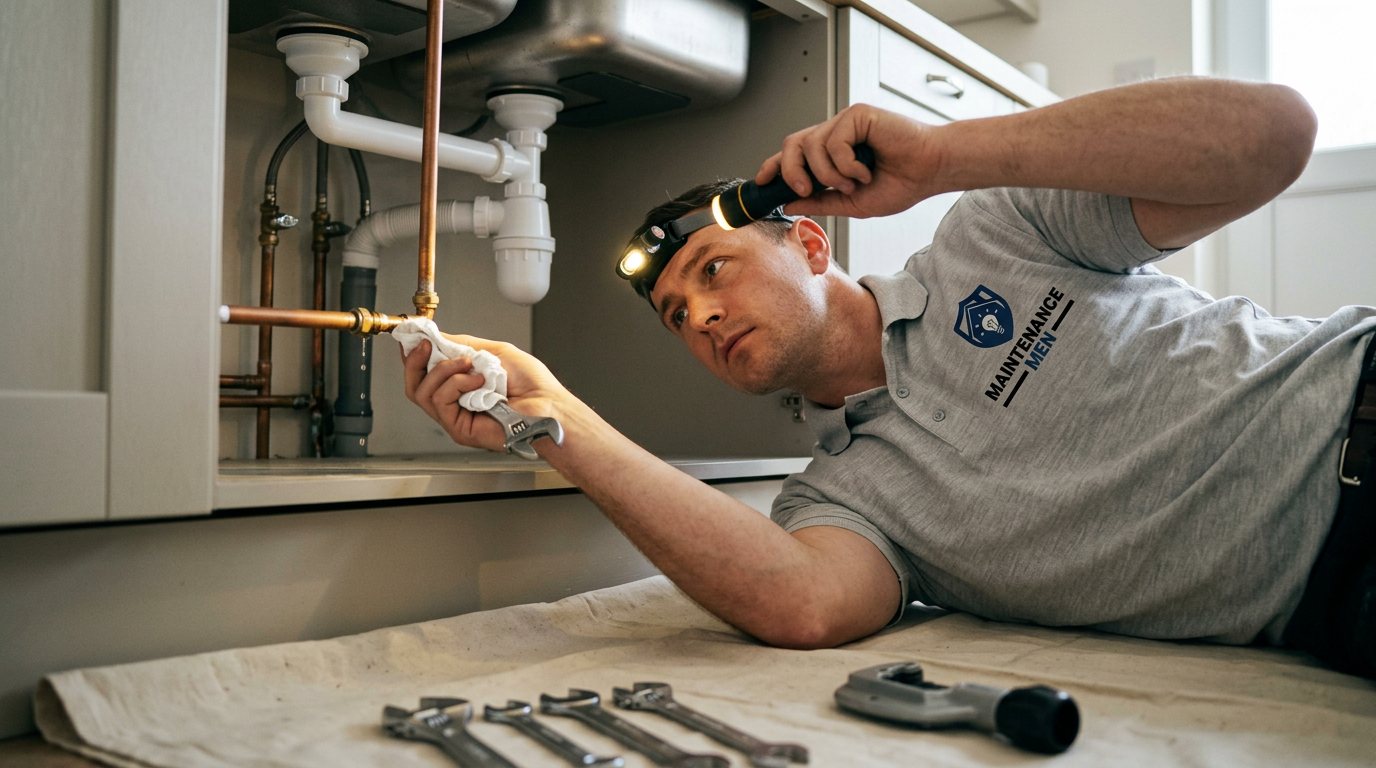
We dry the area and watch. Running a dry tissue around the valve spindle, the compression nuts, the bleed valve and the pipe connections usually locates the source within minutes. We check whether the leak appears cold, or only once the system is up to temperature — that single detail separates a joint problem from a pressure or expansion one.
The system pressure tells us how much water has been lost. We look for corrosion staining on the panel, feel along the bottom edge for soft or bubbling paint, and check the water that comes out when bleeding for heavy black sludge, which points to a system that needs more than a repair. On a leaking valve we check the spindle for play and corrosion to decide between repacking and replacing.
How we fix it
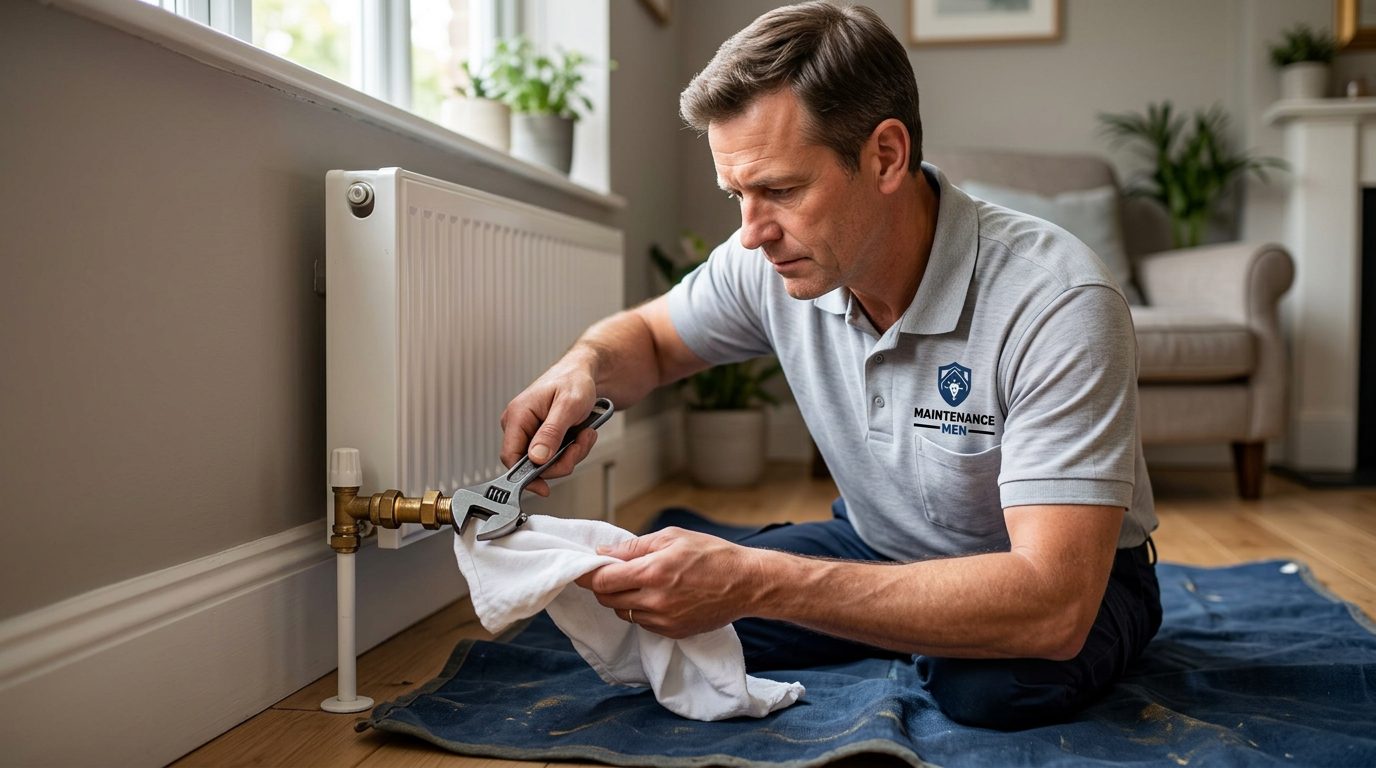
A weeping gland is repacked or, more often now, the valve is replaced with a new thermostatic or manual head matched to the pipework. Compression joints are remade with fresh olives and a correct seal, not extra turns of tape over a damaged thread. A failed bleed valve is swapped for a new one. Where the panel itself has corroded, a patch is not a repair worth doing — we replace the radiator and rebalance the system so the rest of the house still heats evenly.
Afterwards we refill, bleed the radiators properly, set the pressure and add inhibitor if the system is low. You will be told what failed and whether the same fault is likely at other radiators, which is common when one valve has corroded through.
Prevention
Keep inhibitor in the system and have the boiler serviced annually, which is when most small leaks are spotted early. Turn valve spindles a couple of times a year so they do not seize. Bleed radiators when they run cold at the top, but do not over-bleed — each bleed removes treated water. If you have a magnetic filter, have it cleaned at service. Never drain and refill a system without adding inhibitor afterwards.
When to call us
Call when you can see water or a damp patch, when the pressure gauge has dropped, or when a valve will not turn. If water is spraying rather than dripping, close the valve at both ends of the radiator and call us the same day. If a ceiling below is bulging or stained, treat it as urgent — the water is already travelling.
Book a call-out
If the radiator body needs replacing we will price that separately before ordering anything.
How the price works
We charge a booking fee to hold your slot, then an hourly rate for the work itself. The fee changes with how soon you need us; the hourly rate changes with the slot you choose. You approve the price before we start, so there is no surprise on the invoice.
Booked 14+ days ahead
£25 booking fee
then £85 per hour of labour
Best value. Book the slot now, pay the smallest booking fee.
Booked within 48 hours
£100 booking fee
then £65 per hour of labour
For jobs that can wait a day or two but not a fortnight.
Same-day call-out
£220 booking fee
then £45 per hour of labour
Urgent problems: standing water, no heat, no power, leaks.
Book the slot
Choose the window that suits you and pay the booking fee. That holds your place in the diary.
We diagnose on site
The engineer confirms the cause and tells you what the job involves and how long it should take.
You approve, we work
Nothing goes ahead until you agree the price. Labour is then charged per hour at your slot rate.
Most radiator leaks start small: a damp ring on the carpet, a tissue that comes away wet from the valve spindle, or a pressure gauge that has crept down again. Because radiators sit against walls and above floors, a slow leak does its damage quietly. We identify whether the fault is the valve, the joint or the radiator body, repair or replace as needed, and leave the system dosed and balanced.
What our customers say about our plumbing service
4.7 out of 5 from 11 reviews
Second time we have used them
What I appreciated was being told what was actually wrong before anyone started. Sorted in under 32 minutes and the invoice matched the quote to the penny.
Job: Loose Pipe Connections Repair
Worth the booking fee
Booked the £220 booking-fee slot on Tuesday and got a message confirming the time the same morning. The cause was explained, the price agreed before any work started, and the job was done in about 75 minutes. Clean and tidy when they left.
Job: Hidden Pipe Leak Repair
Turned up when they said
Turned up in the window they promised, walked me through the options (turns out the part had to be sourced locally), then cracked on. Everything was tested before they left. No mess, no drama, no surprise on the bill.
Job: Central Heating Leak Repair
Book Radiator Leak Repair
Tell us what is happening and choose a slot. If you are not sure this is the right job, use the diagnosis panel — it narrows the problem down before you book.
- Booking fee confirmed up front
- Hourly labour, agreed before work starts
- Same-day slots for urgent problems





Questions people ask about radiator leak repair
Straight answers to the things customers ask most often before booking.
Can I just tighten the nut to stop the leak?
Sometimes a quarter turn on a compression nut stops a weep, but over-tightening crushes the olive and can split the pipe, which turns a small leak into a flood. If the joint has already been tightened once, it needs remaking rather than more force.
Why does my radiator only leak when the heating is on?
Metal expands as it heats, so a joint that is marginal when cold can open when the system reaches temperature. The same applies to a valve gland. It is a useful clue for us, because it points to a mechanical joint rather than a pressure fault.
The radiator is corroded — can it be sealed instead of replaced?
Sealers can hold a pinhole for a while, but they also reduce flow and can clog valves and the boiler's narrow passages. On a panel that has rusted from the inside, the metal around the hole is already thin, so a replacement is the more honest repair.
Will you need to drain the whole system?
Usually not. Isolating the radiator at both valves lets us work on it with the rest of the system intact. A full drain is only needed for certain pipework repairs, and we will explain why if that is the case.
Is a small weep really worth a call-out?
Yes, if it has been there more than a few days. Water tracking behind a radiator soaks plaster, lifts flooring and stains ceilings, and that damage costs more than the repair. It is also a sign the system is losing pressure and taking in air.
Need radiator leak repair sorted in West Bromwich?
Book a slot in the diary and pay only the booking fee up front. We confirm the rest before we start.