
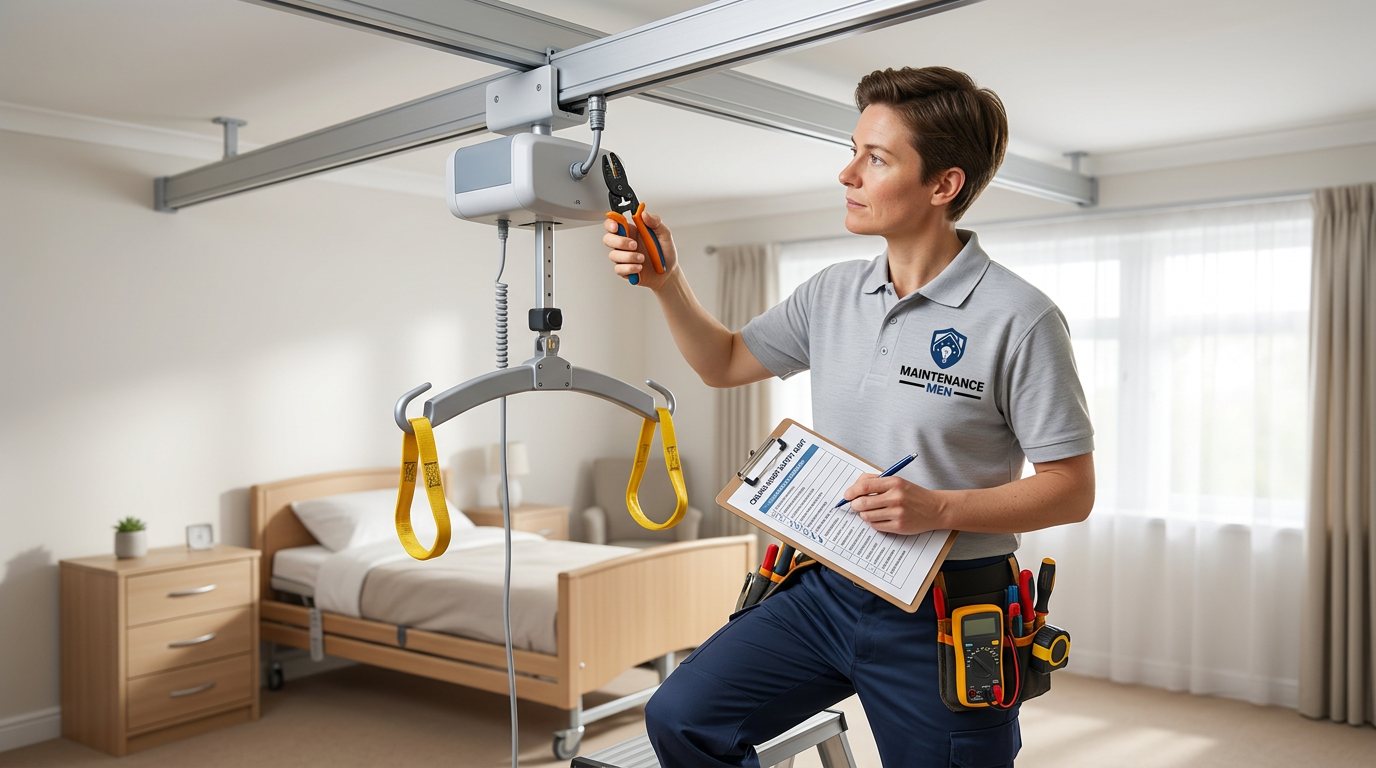
Years of Lifting Wear on the Rail? We'll Check What Still Has Life in West Bromwich
We measure wear on the rail, trolley, rollers and joints, test for play and misalignment, and tell you which parts need renewing before reliability suffers.
Booking fee plus hourly labour — the price is confirmed before any work starts.
What this costs
| Booked 14+ days ahead | £25 booking fee £85 per hour |
|---|---|
| Booked within 48 hours | £100 booking fee £65 per hour |
| Same-day call-out | £220 booking fee £45 per hour |
The booking fee secures the visit. Labour is then charged by the hour, so you only pay for the time the job actually takes.
Booking fee £25–£220
£25 + £85/hr booked 14+ days ahead, £100 + £65/hr inside 48 hours, £220 + £45/hr same day. Agreed before we arrive.
Covered under Hoists & Lifting Equipment
Mobility & Accessibility › Hoists & Lifting Equipment — one of 22 documented jobs in this section.
Same-day wear on lifting rail system
Urgent jobs can often be booked for today. Ask when you book and we will confirm the slot before you pay anything.
15 service areas
Birmingham, Coventry, Dorridge and 12 more across the West Midlands.
Wear is cumulative and easy to miss, because the change is gradual and the hoist keeps working. The purpose of an inspection is to catch it while it is still a small repair.
What Wears
- The trolley rollers. Bearings lose their grease and their tolerance, and the wheels flat-spot. A worn roller runs noisily, binds at joints and loads the rail unevenly.
- The rail itself. On aluminium tracks the running surface can wear or gall, especially where a trolley always starts and stops in the same place. A worn section produces a step the rollers feel.
- Track joints. Joining brackets loosen, and the alignment drifts. Every pass then works the joint a little more.
- End stops. These take a knock every time someone runs the trolley to the end, and they degrade quietly.
- Fixings and brackets. Vibration over years loosens bolts and can enlarge a hole in timber.
- The spreader bar and sling attachment points. Hooks, clips and pivot points wear at the contact surfaces.
- The motor unit's own mounting on the trolley, where play can develop.
Signs It Is Time to Look
A trolley that has become noisy. A rumble or vibration through the track. A track that is harder to push in one place than another. Visible play when you try to lift or rock the trolley by hand. Marks or bright spots on the rail. A joint with a visible step. End stops that have moved or look battered. None of these should be left until the hoist stops.
How We Assess It
We push the trolley along the whole length by hand and feel for variation, then inspect the rollers for play, flat spots and bearing noise. We check the rail surface for wear, galling and straightness, and each joint for alignment and tightness. We examine the end stops, the brackets and the fixings, and check the spreader bar, hooks and sling attachment points for wear at the contact surfaces. Then we test under a controlled load within the rated capacity and listen. Where we can measure play against the manufacturer's specification we do, rather than relying on an impression.
What We Renew
Rollers and bearings, joint brackets, end stops, hooks and attachment hardware, and individual track sections where a rail is worn beyond use — all with manufacturer-approved parts where they are available. Where a track is obsolete, we will tell you what the realistic options are, including replacing the run with a current system, and quote it after a survey rather than over the phone.
Honest Limits
We cannot extend the life of a worn rail by adjusting the trolley, and we will not fit non-standard rollers to compensate for a worn track — that trades a known problem for an unknown one. We cannot certify equipment as suitable for a particular person's needs, and we make no claim about how many more years a system will last; we report condition and let you decide. Parts availability is checked, never assumed.
Safety
A worn rail or a loose joint can let a trolley bind or jump with someone suspended, and worn attachment hardware is a load-path failure waiting to happen. If you find visible play, a step at a joint, or a hook that looks worn, stop using the hoist. Do not lubricate a rail with household products, and do not file or dress a worn section yourself. If someone is suspended and the unit will not move, keep them comfortable, call 999 if they are in pain or distress, and use emergency lowering only as the manufacturer's instructions describe.
Aftercare
After renewal we run the full travel under load, check the joints and end stops, confirm the spreader bar and attachments are sound, and test the hoist's functions including the emergency stop. We will tell you which parts are now new, which are ageing, and what to watch at the next inspection.
Booking
Tell us the make and model, roughly how long the track has been in use and how heavily, and what you have noticed — noise, play, a stiff spot. You pay a booking fee when you book, the hourly labour rate depends on how soon you need the visit, and the full cost is quoted and approved before work starts.
How the price works
We charge a booking fee to hold your slot, then an hourly rate for the work itself. The fee changes with how soon you need us; the hourly rate changes with the slot you choose. You approve the price before we start, so there is no surprise on the invoice.
Booked 14+ days ahead
£25 booking fee
then £85 per hour of labour
Best value. Book the slot now, pay the smallest booking fee.
Booked within 48 hours
£100 booking fee
then £65 per hour of labour
For jobs that can wait a day or two but not a fortnight.
Same-day call-out
£220 booking fee
then £45 per hour of labour
Urgent problems: standing water, no heat, no power, leaks.
Book the slot
Choose the window that suits you and pay the booking fee. That holds your place in the diary.
We diagnose on site
The engineer confirms the cause and tells you what the job involves and how long it should take.
You approve, we work
Nothing goes ahead until you agree the price. Labour is then charged per hour at your slot rate.
A hoist rail does a lot of quiet work over the years: every lift rolls the trolley over the same few metres, and the parts that carry it wear by fractions of a millimetre at a time. Nothing fails dramatically until it does. A proper inspection measures the wear rather than waiting for a symptom, and tells you whether you are looking at a part, a track section, or a replacement.
What our customers say about our mobility & accessibility service
4.5 out of 5 from 8 reviews
Proper job, no upselling
Turned up in the window they promised, walked me through the options (turns out the old fitting was seized and needed careful removal), then cracked on. Everything was tested before they left. No mess, no drama, no surprise on the bill.
Job: Loose or Faulty Brakes
Fine in the end
The problem is fixed, which is the main thing, and the engineer clearly knew what they were doing. It took a fair bit longer than the estimate on the phone and I had to ask twice for a breakdown of the hours.
Job: Stair Lift Service
Would use again
What I appreciated was being told what was actually wrong before anyone started. Sorted in under 70 minutes and the invoice matched the quote to the penny.
Job: Control Panel Fault
Book Wear on Lifting Rail System
Tell us what is happening and choose a slot. If you are not sure this is the right job, use the diagnosis panel — it narrows the problem down before you book.
- Booking fee confirmed up front
- Hourly labour, agreed before work starts
- Same-day slots for urgent problems


Questions people ask about wear on lifting rail system
Straight answers to the things customers ask most often before booking.
Is there anything I can check myself?
You can push the trolley along the track by hand with the hoist empty and notice whether it runs evenly, and you can look at the rail, joints and end stops for visible steps, bright wear marks or damage. Do not adjust, file or lubricate anything, and do not dismantle the trolley or fixings.
What will you inspect?
Rollers and bearings for play and flat spots, the rail surface for wear and straightness, every joint for alignment, the end stops, the brackets and fixings, and the spreader bar, hooks and attachment points. Then we test under a controlled load and listen for anything the hand test missed.
At what point does a worn track need replacing rather than repairing?
When the rail itself is worn or damaged beyond the manufacturer's tolerance, or when the system is obsolete and parts are no longer available. That is assessed on site and quoted after a survey — we will not guess at a figure before we have seen the run.
The trolley has play in it. Is that dangerous?
It needs checking. Play means the rollers or their mountings are worn, and a trolley that can rock loads the rail and the fixings unevenly. It is usually a straightforward parts replacement if caught early, which is exactly why it is worth looking at before it becomes a jam or a jump.
What will it cost?
You pay a booking fee when you book, and the hourly labour rate depends on how soon you need the visit. We quote the full cost of the work and you approve it before we start, with rollers, brackets or track sections quoted separately.
Need wear on lifting rail system sorted in West Bromwich?
Book a slot in the diary and pay only the booking fee up front. We confirm the rest before we start.