
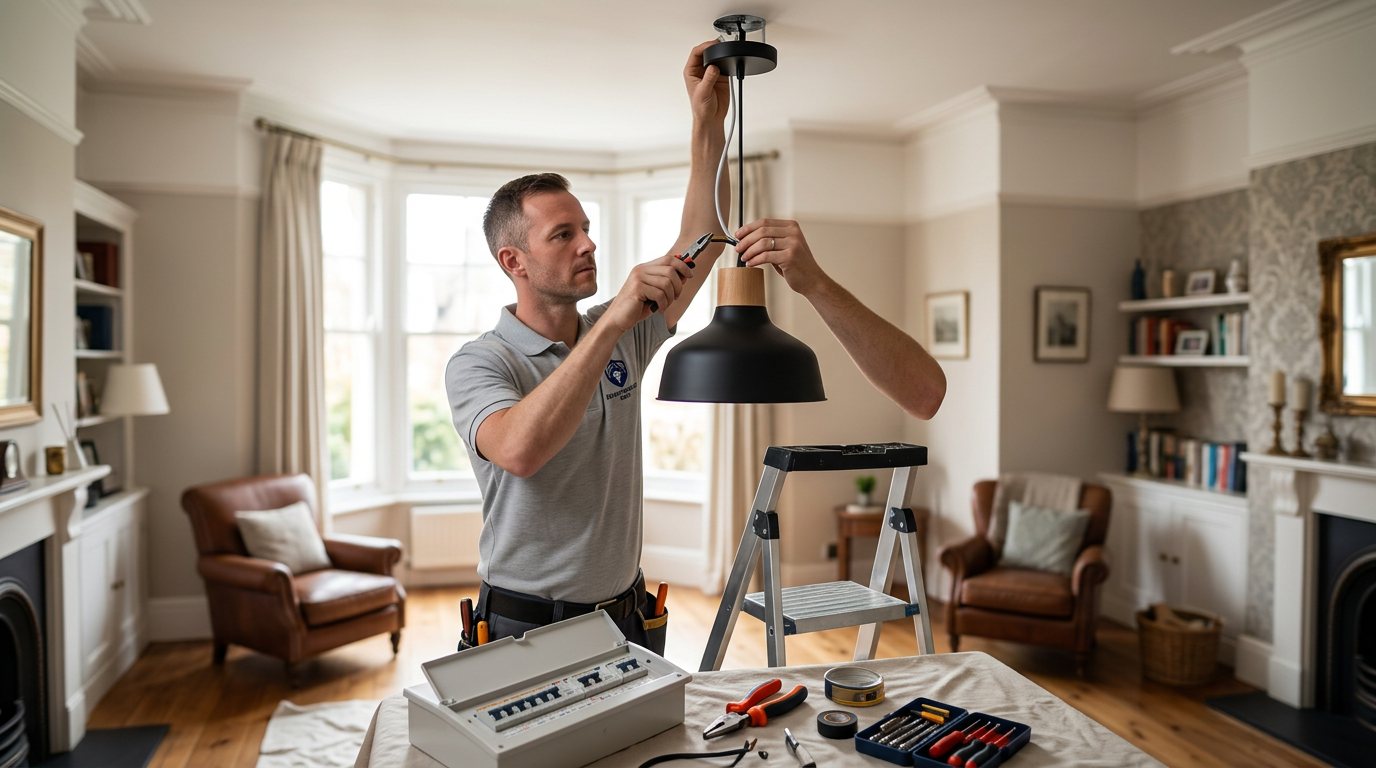
Several Lights Gone at Once? Here's How We Get Them Back in West Bromwich
When more than one light dies together, the fault is almost never the bulbs — we diagnose the circuit itself and restore every light it feeds.
Booking fee plus hourly labour — the price is confirmed before any work starts.
What this costs
| Booked 14+ days ahead | £25 booking fee £85 per hour |
|---|---|
| Booked within 48 hours | £100 booking fee £65 per hour |
| Same-day call-out | £220 booking fee £45 per hour |
The booking fee secures the visit. Labour is then charged by the hour, so you only pay for the time the job actually takes.
Booking fee £25–£220
£25 + £85/hr booked 14+ days ahead, £100 + £65/hr inside 48 hours, £220 + £45/hr same day. Agreed before we arrive.
Covered under Lighting
Electrical › Lighting — one of 20 documented jobs in this section.
Same-day multiple lights not working
Urgent jobs can often be booked for today. Ask when you book and we will confirm the slot before you pay anything.
15 service areas
Birmingham, Coventry, Dorridge and 12 more across the West Midlands.
When half the lights in your home stop working at the same moment, the penny usually drops quickly: this isn't about bulbs. A group of lights going dark together points to a single shared link in the chain failing — and that link is the circuit itself. It's a fault that needs a proper diagnosis, because the cause can sit anywhere between your consumer unit and the last ceiling rose on the line.
What Several Lights Dying Together Usually Means
Lighting circuits in UK homes are wired in a chain: the supply runs from the consumer unit, through each ceiling rose or junction box in turn, out to the switches along the way. Every light on that chain depends on the connections before it. If a connection inside one ceiling rose burns or works loose, everything beyond it in the chain loses power at the same instant — which is why the failure so often has a clean boundary, like "everything past the landing".
The other common cause is a tripped RCD or breaker. Modern consumer units protect the lighting circuits separately, and a moisture problem, a damaged cable or a faulty fitting can trip that protection and take out a whole group of lights in one go.
The First Question: Did Anything Trip?
Walk to your consumer unit before anything else. If a breaker or RCD has tripped, note which one, and try resetting it once. If it resets and the lights come back, watch it — a one-off trip can follow a storm or a temporary fault, but a repeated trip means something on the circuit is genuinely wrong and shouldn't be forced back on time after time. Repeatedly resetting protection over a live fault is how small problems become big ones.
If nothing has tripped, the break is a physical one somewhere along the chain — and that's where the diagnosis work really happens.
How We Find Where the Chain Broke
We start at the consumer unit to confirm the circuit is live, then test at the lights in the middle of the affected group — not the first one that failed, which is a trap people fall into. The failure is usually at the last working light or the first dead one, and testing in the middle halves the search straight away. From there we test ceiling by ceiling until we find the point where power arrives but doesn't leave.
Most of the time we find a failed connection: a terminal that has overheated, a conductor that has snapped, or a junction box in the loft that has finally given up. Loft junctions are a particular favourite for this, because they sit in temperature swings and get disturbed by anyone rummaging for the Christmas decorations.
Fixing It Properly
A remade connection is often all that's needed — but we remake it properly, with sound conductors and terminals torqued down, not a quick twist. If a section of cable has been damaged, we'll show you where and explain the cleanest way to replace or reroute it. If the trip was caused by a faulty fitting or moisture getting where it shouldn't, we deal with that root cause too, because restoring power without removing the cause just books you a second visit.
What It Costs and How Long It Takes
Circuit faults take longer to trace than a single dead light, and we're honest about that up front. You pay a booking fee at the point of booking and labour is hourly, with the rate depending on how quickly we can attend. The engineer quotes the complete job once the fault is found, and nothing proceeds until you've approved the figure.
When to Call Us
Call us if resetting the breaker doesn't hold, if more than one room's lights are out, if you can smell anything warm or see scorching at a fitting, or if the failures keep recurring. Multiple dead lights plus any sign of heat is a same-day problem, not a weekend project.
Book Your Lighting Circuit Repair Today
A dark half-house is no way to live, and circuit faults rarely stay stable — they tend to worsen. Phone or book online and we'll get an engineer out, trace the break and put it right. We cover the whole West Midlands, and our electricians are qualified and fully insured.
How the price works
We charge a booking fee to hold your slot, then an hourly rate for the work itself. The fee changes with how soon you need us; the hourly rate changes with the slot you choose. You approve the price before we start, so there is no surprise on the invoice.
Booked 14+ days ahead
£25 booking fee
then £85 per hour of labour
Best value. Book the slot now, pay the smallest booking fee.
Booked within 48 hours
£100 booking fee
then £65 per hour of labour
For jobs that can wait a day or two but not a fortnight.
Same-day call-out
£220 booking fee
then £45 per hour of labour
Urgent problems: standing water, no heat, no power, leaks.
Book the slot
Choose the window that suits you and pay the booking fee. That holds your place in the diary.
We diagnose on site
The engineer confirms the cause and tells you what the job involves and how long it should take.
You approve, we work
Nothing goes ahead until you agree the price. Labour is then charged per hour at your slot rate.
Losing one light is a nuisance; losing a whole room's worth, or every light upstairs, is a different order of problem. It usually means something has happened on the lighting circuit rather than in any individual fitting. We find where the circuit has been interrupted, fix it properly, and explain what caused it so it doesn't quietly happen again.
What our customers say about our electrical service
4.6 out of 5 from 11 reviews
Does what it says on the tin
No complaints about the work itself — clear explanation, sensible advice, fair price. Booking online was easy enough once I found the right job page.
Job: Smoke Alarm Replacement
Fixed it, but took longer than expected
Work itself was fine and tidy. Communication beforehand was patchy — I did not get the confirmation message and had to ring to check the slot. Would still use again.
Job: Flickering Outdoor Lights
Turned up when they said
Third time we have used Maintenance Men, and the same experience each time: agreed price, proper explanation, job done in one visit. The hourly rate is fair for the standard of work.
Job: Appliance Causing Power Trip
Book Multiple Lights Not Working
Tell us what is happening and choose a slot. If you are not sure this is the right job, use the diagnosis panel — it narrows the problem down before you book.
- Booking fee confirmed up front
- Hourly labour, agreed before work starts
- Same-day slots for urgent problems







Questions people ask about multiple lights not working
Straight answers to the things customers ask most often before booking.
What does a call-out cost for several dead lights?
There's a booking fee when you reserve your slot, then labour is charged hourly — the rate depends on how urgently you need the visit. Once the engineer has traced the fault, you get the full price of the repair before any work is carried out, and you decide whether to go ahead.
Can I fix multiple dead lights myself?
You can check the consumer unit and reset a tripped breaker once — that's genuinely worth doing. Beyond that, no. The fault lives in ceiling roses, junction boxes or cable runs that are live even with the switches off, and tracing it means opening terminations that shouldn't be opened by anyone without the training and test equipment to do it safely.
How do you find where the circuit failed?
We work down the chain. Testing at the consumer unit confirms the supply, then we test at fittings in the middle of the dead group and split the circuit in half with each measurement until we land on the exact point where power stops. It's a deliberate process, and it keeps wall damage to a minimum.
Is a whole group of dead lights dangerous?
The dead lights themselves aren't, but the cause can be. A connection that overheated badly enough to fail may have scorched nearby insulation, and a repeated RCD trip often points to moisture or damaged cable. If you notice burning smells, discoloured fittings or repeated trips, treat it as urgent rather than an inconvenience.
Why did the lights past the landing go but not the others?
Because UK lighting circuits are wired as a chain, not a star. Power flows from one light to the next, so a single broken connection cuts everything downstream of it and leaves everything upstream working. The boundary of the blackout tells us roughly where the fault sits before we even lift a screwdriver.
Need multiple lights not working sorted in West Bromwich?
Book a slot in the diary and pay only the booking fee up front. We confirm the rest before we start.