
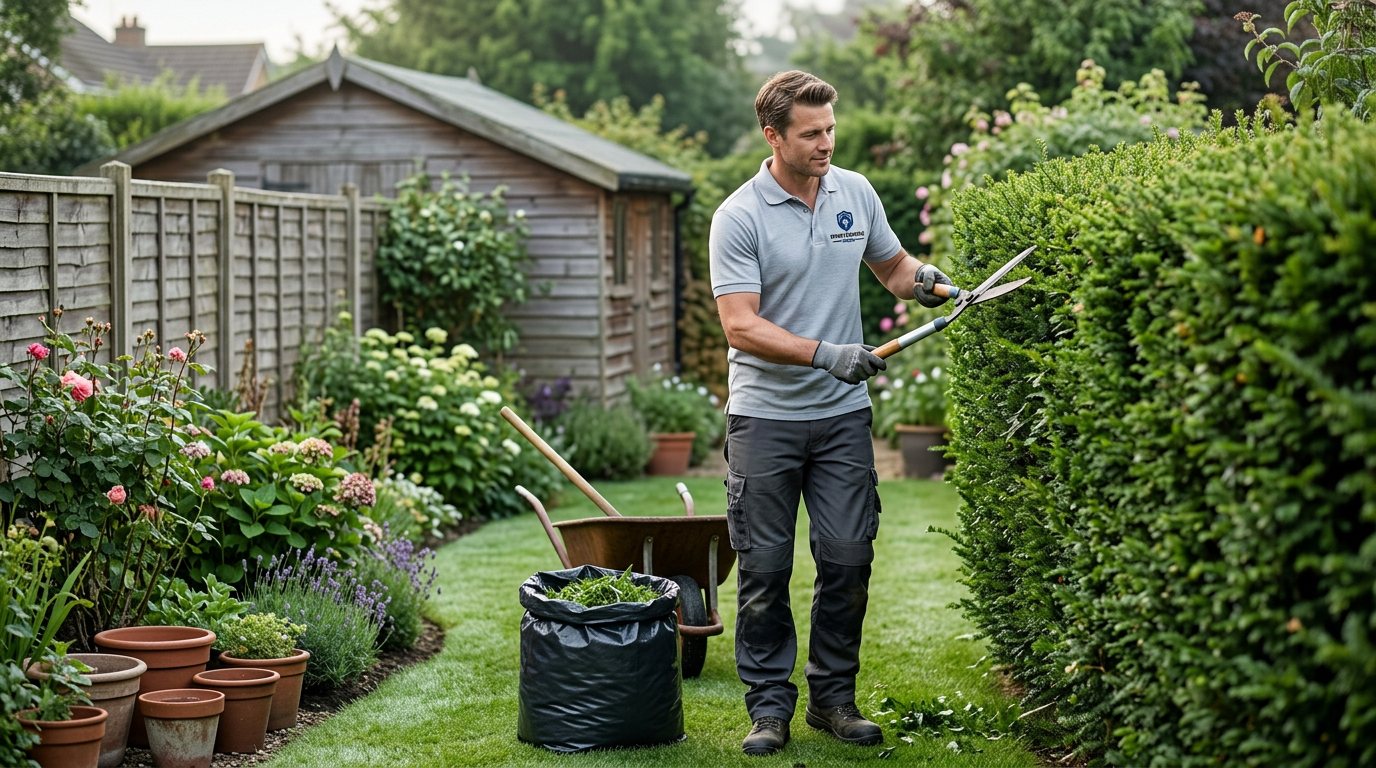
Broken Garden Features Repaired Before They Become Bigger Problems in Sutton Coldfield
We assess whether each damaged feature — bench, arch, trellis, planter or water feature — is worth repairing, then fix it soundly or tell you honestly when replacement makes more sense.
Booking fee plus hourly labour — the price is confirmed before any work starts.
What this costs
| Booked 14+ days ahead | £25 booking fee £85 per hour |
|---|---|
| Booked within 48 hours | £100 booking fee £65 per hour |
| Same-day call-out | £220 booking fee £45 per hour |
The booking fee secures the visit. Labour is then charged by the hour, so you only pay for the time the job actually takes.
Booking fee £25–£220
£25 + £85/hr booked 14+ days ahead, £100 + £65/hr inside 48 hours, £220 + £45/hr same day. Agreed before we arrive.
Covered under Garden Maintenance
Outdoor & Exterior › Garden Maintenance — one of 20 documented jobs in this section.
Same-day broken garden features
Urgent jobs can often be booked for today. Ask when you book and we will confirm the slot before you pay anything.
15 service areas
Birmingham, Coventry, Dorridge and 12 more across the West Midlands.
Every garden accumulates features: the bench under the tree, the arch the clematis has claimed, the trellis holding back a shed-load of jasmine, the raised bed built one enthusiastic bank holiday. They fail slowly and then suddenly — a wobbly leg, a split post, a trellis coming away from the wall — and because they are garden furniture, they are usually ignored until the day something falls over entirely. Repairing them early is nearly always cheaper than replacing them late.
What we look at, feature by feature
Timber features almost always fail at the joints and the ground line: a bench leg rots where it meets damp soil, an arch post goes soft at ground level, and a trellis batten splits where the screws are. The key question is how much sound timber is left — a bench with rotten slats but good legs is an easy, satisfying repair, while a frame gone soft throughout is honest replacement territory, and we will say which is which rather than charge for rescuing firewood. Metal features usually fail at fixings and rust points: hinges, chains, ground plates and the welds where rust has been quietly eating. Stone and brick features — planters, edging, sundial plinths — fail by frost heave and mortar loss, and often need re-bedding rather than rebuilding. And anything with electrics, such as a water feature or garden lighting, is checked for safety first, because a pump that has sat through two winters of freeze-thaw may be more than just jammed.
How we assess and decide
For each damaged feature we ask three questions: what actually failed, why it failed, and whether a repair will outlast the feature's remaining life. A trellis that tore off a wall in a gale because its fixings were rusted through needs new, better fixings — a straightforward repair. The same trellis fixed back to a rotten batten will come off again next winter, and we will point that out before doing cosmetic work. We also look at what the feature carries: anything supporting climbing plants, holding soil or bearing people is a structural item, and the fix has to be as strong as the load, not just look tidy. Where a repair is possible but poor value, we will give you the numbers for both repair and replacement so you can decide with real information.
The repairs themselves
Sound repairs are mostly about the fundamentals: cutting out rot back to good timber rather than screwing over it, using exterior-grade fixings that will not rust out in three winters, re-bedding anything loose onto proper footings, and treating exposed timber so the repair does not become next year's failure point. Rocking features are re-fixed securely — a bench that rocks is not just annoying, it works its joints loose faster every season. Where a feature needs a part — a new slat, a replacement panel, a pump — we measure up and quote the part separately so you can see exactly what you are choosing. And where something is beyond sensible repair but worth keeping for its look — a weathered old bench with good bones — we will tell you that too, because sentimental value is a legitimate reason to repair.
Electrics, water and the boundaries
Anything wired — water features, garden lighting, powered screens — is treated with respect: the power is isolated before we work, and where the fault is inside a pump, transformer or fixed wiring, we will tell you whether it is a straightforward swap or electrical work that needs a qualified electrician. We do not improvise with garden electrics, and we would rather hand a job to the right specialist than leave you with something that looks fine and misbehaves in the rain.
How to book
Book by phone or website, noting what the feature is, roughly what has failed and whether it is anything you want kept regardless of cost. You pay a booking fee when you book, labour is charged hourly at a rate that depends on how soon you need the visit, and the full cost is quoted and approved before we start, with any parts or replacement items quoted separately.
How the price works
We charge a booking fee to hold your slot, then an hourly rate for the work itself. The fee changes with how soon you need us; the hourly rate changes with the slot you choose. You approve the price before we start, so there is no surprise on the invoice.
Booked 14+ days ahead
£25 booking fee
then £85 per hour of labour
Best value. Book the slot now, pay the smallest booking fee.
Booked within 48 hours
£100 booking fee
then £65 per hour of labour
For jobs that can wait a day or two but not a fortnight.
Same-day call-out
£220 booking fee
then £45 per hour of labour
Urgent problems: standing water, no heat, no power, leaks.
Book the slot
Choose the window that suits you and pay the booking fee. That holds your place in the diary.
We diagnose on site
The engineer confirms the cause and tells you what the job involves and how long it should take.
You approve, we work
Nothing goes ahead until you agree the price. Labour is then charged per hour at your slot rate.
Garden features work hard for their living: a bench holds people through all weathers, an arch carries the weight of a rose in full sail, and a planter soaks and dries season after season. When one breaks, the question is always the same — repair, replace, or remove? We look at each one properly and give you a straight answer.
What our customers say about our outdoor & exterior service
4.6 out of 5 from 10 reviews
Sorted the same day
Rang in the morning and they got to us in Wolverhampton by early afternoon. Very clear about what needed doing, what it would cost and what could wait. No pressure to add extras. Exactly the sort of tradesperson you want.
Job: Uneven Shed Base
Turned up when they said
Turned up in the window they promised, walked me through the options (turns out the previous installer had left the pipework awkward to get to), then cracked on. Everything was tested before they left. No mess, no drama, no surprise on the bill.
Job: Water-Damaged Patio
Good work, poor communication
Work itself was fine and tidy. Communication beforehand was patchy — I did not get the confirmation message and had to ring to check the slot. Would still use again.
Job: Sinking Driveway
Book Broken Garden Features
Tell us what is happening and choose a slot. If you are not sure this is the right job, use the diagnosis panel — it narrows the problem down before you book.
- Booking fee confirmed up front
- Hourly labour, agreed before work starts
- Same-day slots for urgent problems








Questions people ask about broken garden features
Straight answers to the things customers ask most often before booking.
Can I repair a wobbly garden bench myself?
Often, yes — tightening or replacing bolts, gluing and clamping a split slat, or sanding and oiling a tired bench is well within DIY. What is worth having checked is anything rotting at the ground line or supporting real weight, because screwed-over rot looks solid for a season and then fails under someone. If a bench leg goes soft when you press it with a thumb, that is the moment to get it assessed.
What do you check when assessing a broken garden feature?
Where the failure is — joints, ground line, fixings, frost damage or electrics — how much sound material is left, what the feature actually carries, and why it failed in the first place. That last point matters, because fixing a trellis back to rotten battens or a rusted wall plug is a repair that comes off again next winter, and we would rather do it once, properly.
Is it safe to use a garden water feature that has stopped working?
Treat it with caution — isolate the power at the socket before touching it, and do not poke around a pump that has been through freezing weather with water in it, because cracked housings and damaged wiring are common. We check it safely with the supply isolated, and if the fault is in the pump or its wiring, we will tell you plainly whether it is a straightforward part swap or work for a qualified electrician.
My old bench is very weathered — is it worth repairing or should I replace it?
It depends on the frame, not the grey. Weathered surface timber is usually fine once cleaned and oiled; what decides the question is the structure — legs, arms and the joints that carry weight. We will press-test the frame and give you an honest verdict with the cost of both options, and if the bench is sentimental, keeping it going is a perfectly good reason to repair it.
How much does repairing a garden feature cost?
You pay a booking fee when you book, and labour is charged hourly at a rate that depends on how soon you need the visit. The full cost is quoted and approved before we start, and any parts — new timber, fixings, pumps or replacement panels — are quoted separately so you can weigh repair against replacement with the real numbers in front of you.
Need broken garden features sorted in Sutton Coldfield?
Book a slot in the diary and pay only the booking fee up front. We confirm the rest before we start.