
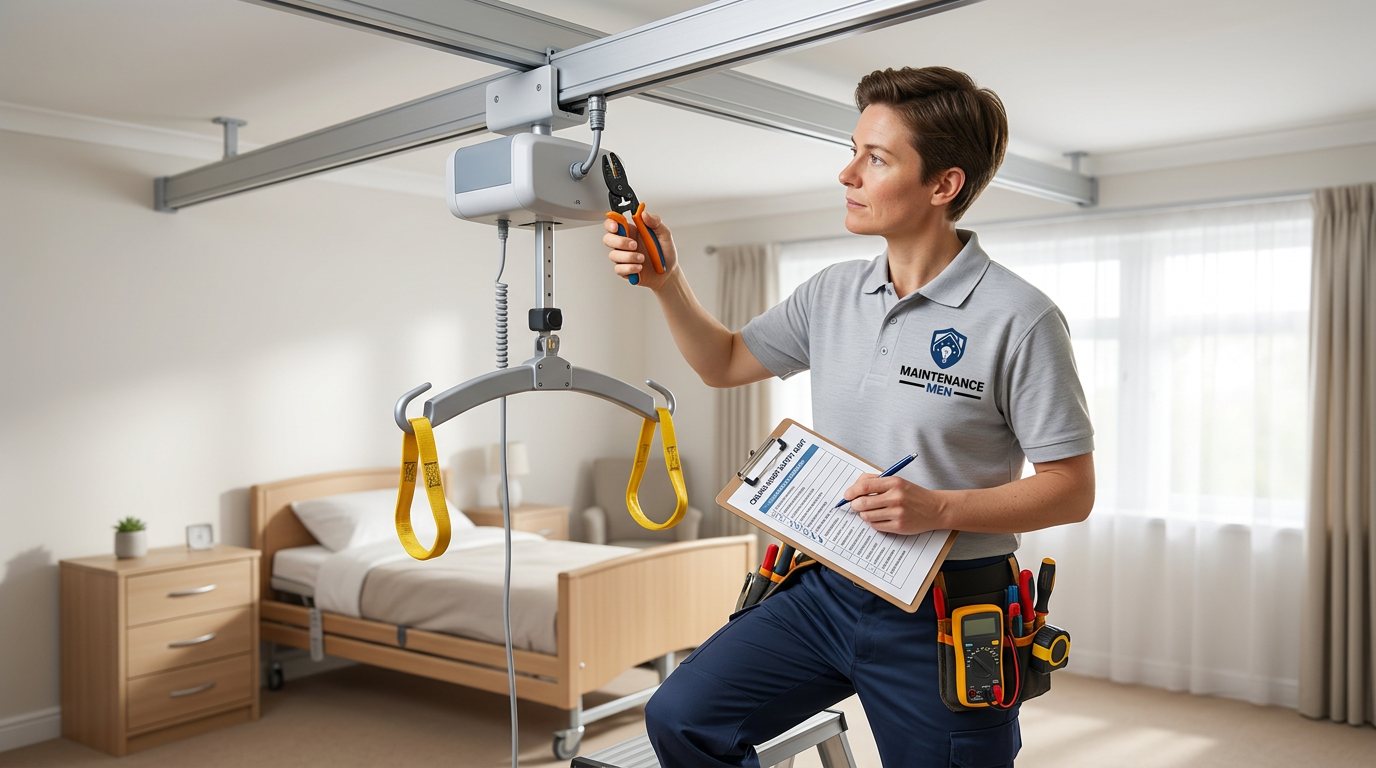
Hoist Locked Out? We'll Find Why the Safety Lock Has Engaged in Sutton Coldfield
We identify which protection has operated — key lock, control lockout, overload trip or brake lock — confirm the cause and restore the unit properly rather than defeating the device.
Booking fee plus hourly labour — the price is confirmed before any work starts.
What this costs
| Booked 14+ days ahead | £25 booking fee £85 per hour |
|---|---|
| Booked within 48 hours | £100 booking fee £65 per hour |
| Same-day call-out | £220 booking fee £45 per hour |
The booking fee secures the visit. Labour is then charged by the hour, so you only pay for the time the job actually takes.
Booking fee £25–£220
£25 + £85/hr booked 14+ days ahead, £100 + £65/hr inside 48 hours, £220 + £45/hr same day. Agreed before we arrive.
Covered under Hoists & Lifting Equipment
Mobility & Accessibility › Hoists & Lifting Equipment — one of 22 documented jobs in this section.
Same-day hoist safety lock engaged
Urgent jobs can often be booked for today. Ask when you book and we will confirm the slot before you pay anything.
15 service areas
Birmingham, Coventry, Dorridge and 12 more across the West Midlands.
Safety locks and lockouts exist because a hoist that carries people should refuse to move when something is wrong. Our job is to find out what it noticed.
The Different Kinds of Lock
Hoists use several unrelated mechanisms, and people tend to call them all "the lock". A key-operated isolator stops the unit being used without the key. A control lock or child lock is a deliberate handset function that disables movement until a sequence is entered. A control box lockout latches after a fault — low voltage, overload, a motor thermal trip or an internal error — and will not clear until the cause is removed. A mechanical track stop or park lock holds the trolley in place. Some units also have a brake lock that engages when the battery is disconnected. Knowing which one you are looking at changes everything.
Why It Engaged
- The key was removed or turned off, often by a carer for safety, and everyone has since forgotten.
- The handset lock sequence was triggered accidentally, or the handset was replaced or re-paired and reverted to a locked default.
- An overload or current trip operated because the load was above capacity or the track was dragging.
- A thermal trip operated after repeated lifts or a hot motor.
- Low battery voltage caused the control box to shut down protectively, which is the most common reason a hoist "locks" partway through a day.
- A fault on the emergency stop circuit holding the unit in a stopped state.
- A mechanical stop left engaged after transport or a track adjustment.
How We Diagnose It
We start by identifying the model and reading what the unit is telling us — indicator lights, error codes, beeps — because most control boxes are explicit once you know their language. We check the key, the handset lock state, the battery voltage under load, the charger and dock, the emergency stop circuit, and any load or current sensing. Then we look for the mechanical cause: a load above the rated capacity, a stiff track, an obstruction, a dragging brake. Only when we understand why the protection operated do we clear it, and we test the unit under load afterwards to confirm the cause is genuinely gone.
Why We Will Not Just Bypass It
A safety lock that is defeated leaves a hoist that will happily lift a person in conditions it was designed to refuse. We do not bridge a lock, tape a key switch on, disable an overload trip or disconnect an emergency stop circuit. If a customer asks us to, we will explain the risk and decline. That is not obstinacy — it is the difference between a maintained hoist and a hazard.
Repairs and Resets
Genuine repairs include replacing a failed key switch, replacing or re-pairing a handset, replacing a control box whose lockout will not clear, correcting the underlying overload or drag, replacing a battery that cannot hold voltage, and repairing the emergency stop circuit. Where a lock is functioning correctly but is inconvenient — a handset lock that keeps engaging — we can show you how the manufacturer intends it to be used and set it as the manual allows, but we will not remove the function altogether.
Safety Until It Is Sorted
Do not use the hoist while it is locked out, and do not attempt to release a mechanical lock or hold a brake open to move someone. If someone is suspended and the unit is locked, keep them comfortable, call 999 if they are in pain or distress, and use emergency lowering only exactly as the manufacturer's instructions describe and only if a confident person can do it safely. Never climb under a suspended hoist to reach a lock or a release.
Aftercare
We test every function after clearing the cause, confirm the lock behaves as the manual describes, check the charging routine, and explain what the indicator lights or beeps mean so a future lockout is understood rather than feared.
Booking
Tell us the make and model, what the unit does when you try to move it, whether any lights or codes show, and whether anything happened beforehand — a flat battery, a heavy lift, a knock. You pay a booking fee when you book, the hourly labour rate depends on how soon you need the visit, and the full cost is quoted and approved before work starts.
How the price works
We charge a booking fee to hold your slot, then an hourly rate for the work itself. The fee changes with how soon you need us; the hourly rate changes with the slot you choose. You approve the price before we start, so there is no surprise on the invoice.
Booked 14+ days ahead
£25 booking fee
then £85 per hour of labour
Best value. Book the slot now, pay the smallest booking fee.
Booked within 48 hours
£100 booking fee
then £65 per hour of labour
For jobs that can wait a day or two but not a fortnight.
Same-day call-out
£220 booking fee
then £45 per hour of labour
Urgent problems: standing water, no heat, no power, leaks.
Book the slot
Choose the window that suits you and pay the booking fee. That holds your place in the diary.
We diagnose on site
The engineer confirms the cause and tells you what the job involves and how long it should take.
You approve, we work
Nothing goes ahead until you agree the price. Labour is then charged per hour at your slot rate.
A hoist that will not move because it is locked out can look like a dead machine, but a lock is a deliberate protection rather than a breakdown. The important question is why it engaged. Something made the hoist decide it should not lift, and simply clearing the lock without answering that question is how a small fault becomes an incident.
What our customers say about our mobility & accessibility service
4.5 out of 5 from 8 reviews
Proper job, no upselling
Turned up in the window they promised, walked me through the options (turns out the old fitting was seized and needed careful removal), then cracked on. Everything was tested before they left. No mess, no drama, no surprise on the bill.
Job: Loose or Faulty Brakes
Fine in the end
The problem is fixed, which is the main thing, and the engineer clearly knew what they were doing. It took a fair bit longer than the estimate on the phone and I had to ask twice for a breakdown of the hours.
Job: Stair Lift Service
Would use again
What I appreciated was being told what was actually wrong before anyone started. Sorted in under 70 minutes and the invoice matched the quote to the penny.
Job: Control Panel Fault
Book Hoist Safety Lock Engaged
Tell us what is happening and choose a slot. If you are not sure this is the right job, use the diagnosis panel — it narrows the problem down before you book.
- Booking fee confirmed up front
- Hourly labour, agreed before work starts
- Same-day slots for urgent problems




Questions people ask about hoist safety lock engaged
Straight answers to the things customers ask most often before booking.
The handset seems locked. Can I unlock it myself?
If your manual describes a handset lock sequence, or shows a key switch, then yes — following the manual is exactly the right thing to try. If the lock keeps engaging or the manual's sequence does not clear it, stop there. Repeatedly forcing a sequence on a control box can leave it in a worse state and makes diagnosis harder.
What will you check?
We read the unit's indicator lights or error codes, check the key isolator, the handset lock state, battery voltage under load, the charger and dock, the emergency stop circuit and any load sensing, then look for a mechanical cause such as an obstruction or a dragging brake. We clear the lock only once we know why it engaged.
Will you just disable the lock so it stops happening?
No. A safety lock protects the person being lifted, and disabling it would leave a hoist that operates in conditions it was built to refuse. We will fix the underlying cause, or set the function the way the manufacturer allows, but we will not bypass a protection device.
It locked partway through a lift. Is that more serious?
Yes. A lockout during a lift means the protection operated under load, which points to low battery voltage, an overload, a thermal trip or a control fault rather than someone pressing the wrong button. Treat the unit as out of service and have it checked before it is used again.
What does it cost?
You pay a booking fee when you book, and the hourly labour rate depends on how soon you need the visit. After diagnosis we quote the full cost of the work and you approve it before we start, with any parts quoted separately.
Need hoist safety lock engaged sorted in Sutton Coldfield?
Book a slot in the diary and pay only the booking fee up front. We confirm the rest before we start.