
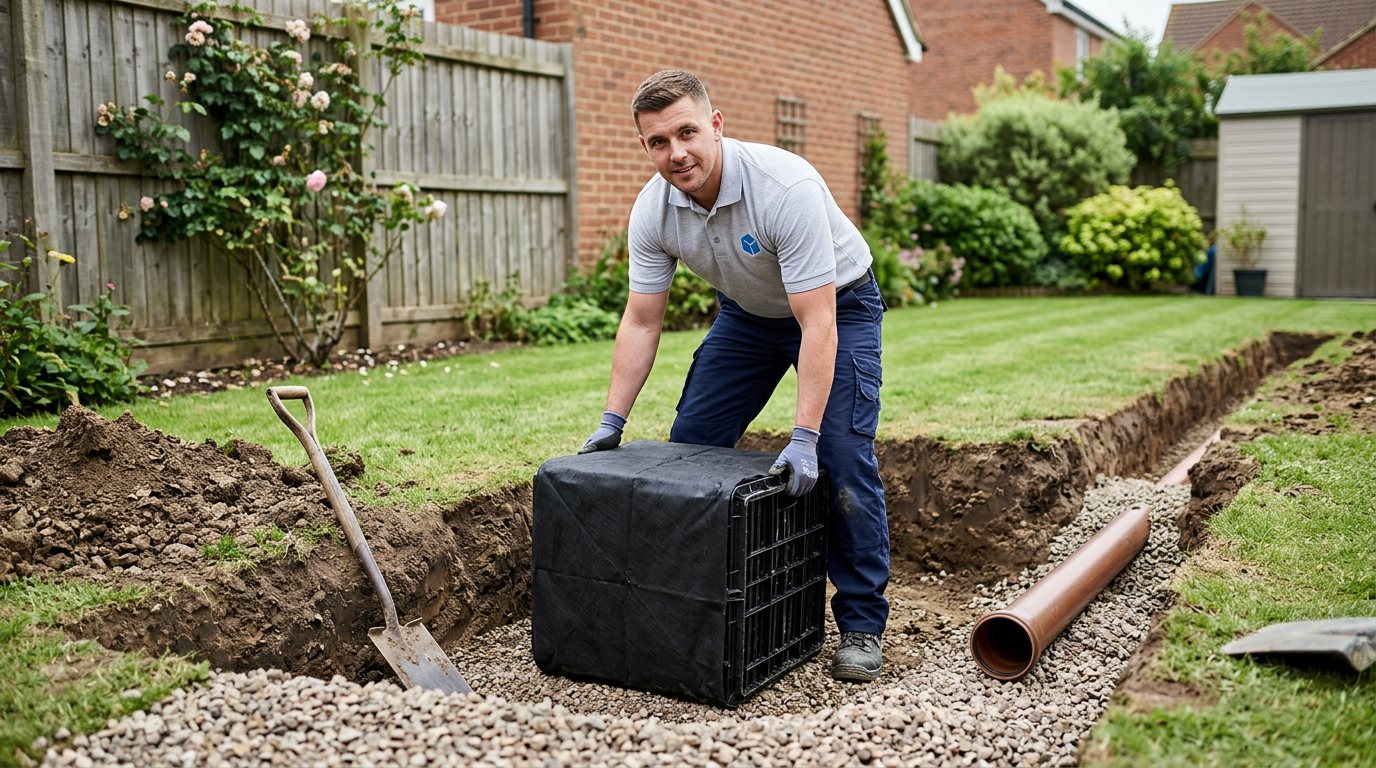
Water Draining Too Slowly? We'll Speed Up Your Surface Water in Sutton Coldfield
We find where your surface water system is slowing down — gullies, runs or soakaway — and restore the flow.
Booking fee plus hourly labour — the price is confirmed before any work starts.
What this costs
| Booked 14+ days ahead | £25 booking fee £85 per hour |
|---|---|
| Booked within 48 hours | £100 booking fee £65 per hour |
| Same-day call-out | £220 booking fee £45 per hour |
The booking fee secures the visit. Labour is then charged by the hour, so you only pay for the time the job actually takes.
Booking fee £25–£220
£25 + £85/hr booked 14+ days ahead, £100 + £65/hr inside 48 hours, £220 + £45/hr same day. Agreed before we arrive.
Covered under Soakaways & Surface Water
Drainage › Soakaways & Surface Water — one of 20 documented jobs in this section.
Same-day slow surface water drainage
Urgent jobs can often be booked for today. Ask when you book and we will confirm the slot before you pay anything.
15 service areas
Birmingham, Coventry, Dorridge and 12 more across the West Midlands.
Slow surface water drainage is the early-warning version of flooding. Water still goes somewhere — just too slowly — and that sluggishness quietly builds: silt settles faster in slow-moving water, which slows it further, which settles more silt. Dealt with early, it is usually a straightforward clearing job; left alone, it becomes a standing-water problem.
Why drainage slows down
The common culprits are silt and debris settling in gullies and along pipe runs, leaves washing into channels and gullies each autumn, a partial root intrusion narrowing a pipe, a soakaway gradually silting up so water has nowhere to go quickly, and flat or sagging sections of pipe where water pools instead of flowing. Ground conditions play their part too: if a soakaway sits in slowly draining clay, the whole system inherits that speed limit. Occasionally the system is simply doing its best with more water than it was designed for — a bigger roof area, a new extension or paved drive added since it was installed.
How we trace the problem
We start at the gullies and channels, checking how quickly they empty and whether the restriction is at the grate, in the trap or further along. We rod or jet the run to find where flow slows, and check the fall and condition of accessible pipework. If the run empties towards a soakaway, we assess whether that is accepting water at the rate it should — a choked soakaway is one of the most common hidden causes of sluggish drainage. Before any digging or lifting, we check carefully for buried services; detectors help, but no scan guarantees what is below, and utility plans are yours to provide.
Clearing and restoring flow
Most slow-drainage fixes are satisfyingly direct: jetting silt out of runs, clearing gully traps, removing root intrusion from accessible pipework, and restoring falls where a section has sagged. Where the soakaway is the bottleneck, clearing silt from the pit and its filter media restores capacity — provided the structure and ground are sound. If the system is undersized for the area it now serves, clearing fixes today's symptom but the underlying limit remains, and we will say so and quote a proper solution after survey.
One honest limit: roots and defects can recur. We clear what is there and tell you what caused it, but no clearing guarantees the same roots will not find the pipe again — particularly where a run passes close to mature trees.
Keeping it flowing
Clear leaves from gully and channel gratings in autumn rather than letting them wash down, keep gutters clean so roof debris stays out of the system, and empty gully silt buckets where fitted. Watching how quickly your gullies empty after rain is the best early-warning system you have: when that time starts creeping up, something is restricting the run.
Booking
Book a visit and tell us which drains are slow, how long water takes to disappear, and whether the problem is worse in heavy rain or constant. Access to gullies and any inspection points is what we need on the day. Clearing work within the visit is charged at our standard rates; larger repairs or a new soakaway are quoted after survey and approved before work starts.
If you are reading this page before the next rainfall, do one useful thing: take a few photos of the slow drains and puddles, and time roughly how long water stands. That record, brought to our visit, shortens the diagnosis considerably. Slow drainage rarely fixes itself — silt does not reverse — so an early visit is usually the cheaper path than waiting for the system to stop altogether and become an emergency clearance in the middle of a storm.
How the price works
We charge a booking fee to hold your slot, then an hourly rate for the work itself. The fee changes with how soon you need us; the hourly rate changes with the slot you choose. You approve the price before we start, so there is no surprise on the invoice.
Booked 14+ days ahead
£25 booking fee
then £85 per hour of labour
Best value. Book the slot now, pay the smallest booking fee.
Booked within 48 hours
£100 booking fee
then £65 per hour of labour
For jobs that can wait a day or two but not a fortnight.
Same-day call-out
£220 booking fee
then £45 per hour of labour
Urgent problems: standing water, no heat, no power, leaks.
Book the slot
Choose the window that suits you and pay the booking fee. That holds your place in the diary.
We diagnose on site
The engineer confirms the cause and tells you what the job involves and how long it should take.
You approve, we work
Nothing goes ahead until you agree the price. Labour is then charged per hour at your slot rate.
Water that takes hours to disappear from gullies, channels or puddles is telling you something is restricting the system somewhere. It is rarely one dramatic blockage; more often it is silt, a partial obstruction or a soakaway losing capacity. We trace the run, find the restriction and deal with it — and if the slow drainage points to a bigger issue, we explain that too.
What our customers say about our drainage service
4.2 out of 5 from 5 reviews
Fast, tidy and friendly
Turned up in the window they promised, walked me through the options (turns out the part had to be sourced locally), then cracked on. Everything was tested before they left. No mess, no drama, no surprise on the bill.
Job: Standing Water in Shower Tray
Happy overall
Good job overall. Turned up about 15 minutes after the window started, but rang to say so, and the work itself was tidy and well explained. Price was as quoted.
Job: Partial Soil Stack Blockage
Fixed it, but took longer than expected
The problem is fixed, which is the main thing, and the engineer clearly knew what they were doing. It took a fair bit longer than the estimate on the phone and I had to ask twice for a breakdown of the hours.
Job: Surface Water Drain Maintenance
Book Slow Surface Water Drainage
Tell us what is happening and choose a slot. If you are not sure this is the right job, use the diagnosis panel — it narrows the problem down before you book.
- Booking fee confirmed up front
- Hourly labour, agreed before work starts
- Same-day slots for urgent problems



Questions people ask about slow surface water drainage
Straight answers to the things customers ask most often before booking.
Can I clear slow-draining gullies myself?
Yes, partly: clearing leaves and debris from gratings, and rodding an accessible run from the gully, are sensible DIY. What is not DIY is jetting runs, digging up sections, or opening a soakaway pit — old pits can be unstable, and misdirected effort can push a blockage deeper. Also never use caustic supermarket chemicals on outdoor drains, and tell us if any have been used before we attend.
How do you find where the system is slowing down?
We check how quickly gullies and channels empty, rod or jet the run to locate the restriction, inspect pipework condition and falls, and assess the soakaway's rate of take-up if the system drains to one. That tells us whether the problem is a single blockage, a sagging pipe or a soakaway losing capacity — each has a different fix.
Are there risks to forcing a slow drain through?
Forcing water or rods into a run can push a partial blockage deeper or into a shared section, and old fragile pipework can be damaged by aggressive clearing. On very old systems we are also alert to fragile or asbestos-cement materials, which we leave undisturbed. We clear with the right method for the pipe's age and condition, not brute force.
My garden sits on clay — will clearing even help?
If the bottleneck is silt, roots or a sag, clearing helps a lot regardless of soil. If the limit is the ground itself — a soakaway in clay that drinks slowly — clearing restores the system to its best but that best has a ceiling. We will tell you honestly which situation you are in, and if a bigger solution is needed we quote it after survey rather than selling repeated clear-outs.
What does a visit like this cost?
You pay a booking fee when you book, and labour is charged hourly at a rate that depends on how soon you need the visit. The full cost of any clearing or repair is quoted before we start, so you approve it first, and parts are quoted separately. If a bigger fix — new drainage or a replacement soakaway — turns out to be needed, that is quoted after a survey.
Need slow surface water drainage sorted in Sutton Coldfield?
Book a slot in the diary and pay only the booking fee up front. We confirm the rest before we start.