
Appliance runs but stays cold? We test the heating circuit in Sutton Coldfield
We measure the element, thermostat and thermal protection in sequence so you know whether the fault is a cheap part or a control board.
Booking fee plus hourly labour — the price is confirmed before any work starts.
What this costs
| Booked 14+ days ahead | £25 booking fee £85 per hour |
|---|---|
| Booked within 48 hours | £100 booking fee £65 per hour |
| Same-day call-out | £220 booking fee £45 per hour |
The booking fee secures the visit. Labour is then charged by the hour, so you only pay for the time the job actually takes.
Booking fee £25–£220
£25 + £85/hr booked 14+ days ahead, £100 + £65/hr inside 48 hours, £220 + £45/hr same day. Agreed before we arrive.
Covered under Small Appliances
Home Appliances › Small Appliances — one of 20 documented jobs in this section.
Same-day appliance not heating
Urgent jobs can often be booked for today. Ask when you book and we will confirm the slot before you pay anything.
15 service areas
Birmingham, Coventry, Dorridge and 12 more across the West Midlands.
An appliance that powers up but never gets warm is a particular kind of disappointing: the lights say it is working, the display looks normal, and yet nothing heats. In most small appliances the heating circuit is a short chain of components — element, thermostat or thermistor, thermal cut-out, and the relay or triac on the control board that switches the element on. One link has failed. Finding which one is a matter of measurement.
The heating chain, link by link
The element is the part that converts current into heat, and it fails in two ways: it goes open circuit and produces nothing at all, or it partially fails and heats unevenly. The thermostat senses temperature and closes or opens the circuit to hold the set point; when its contacts weld shut the appliance overheats, and when they stop closing it never heats. The thermal cut-out is a one-shot safety device that opens permanently if the appliance exceeds a safe temperature — it protects you, and its operation is a message that something else is wrong. The control board decides when to energise the element, and its relay or triac can fail open. Each behaves differently and each is tested differently.
Why the element is not automatically the culprit
Householders often assume the element has gone, buy one, fit it, and find the appliance still cold. That happens because the element was fine and the thermostat had failed, or because the thermal cut-out had tripped and the new element simply sat there with no supply. Elements are also the most expensive single part in many appliances, so replacing one on suspicion is an expensive way to guess. Continuity and resistance testing tells you whether the element is sound in a couple of minutes, without buying anything.
What the visit involves
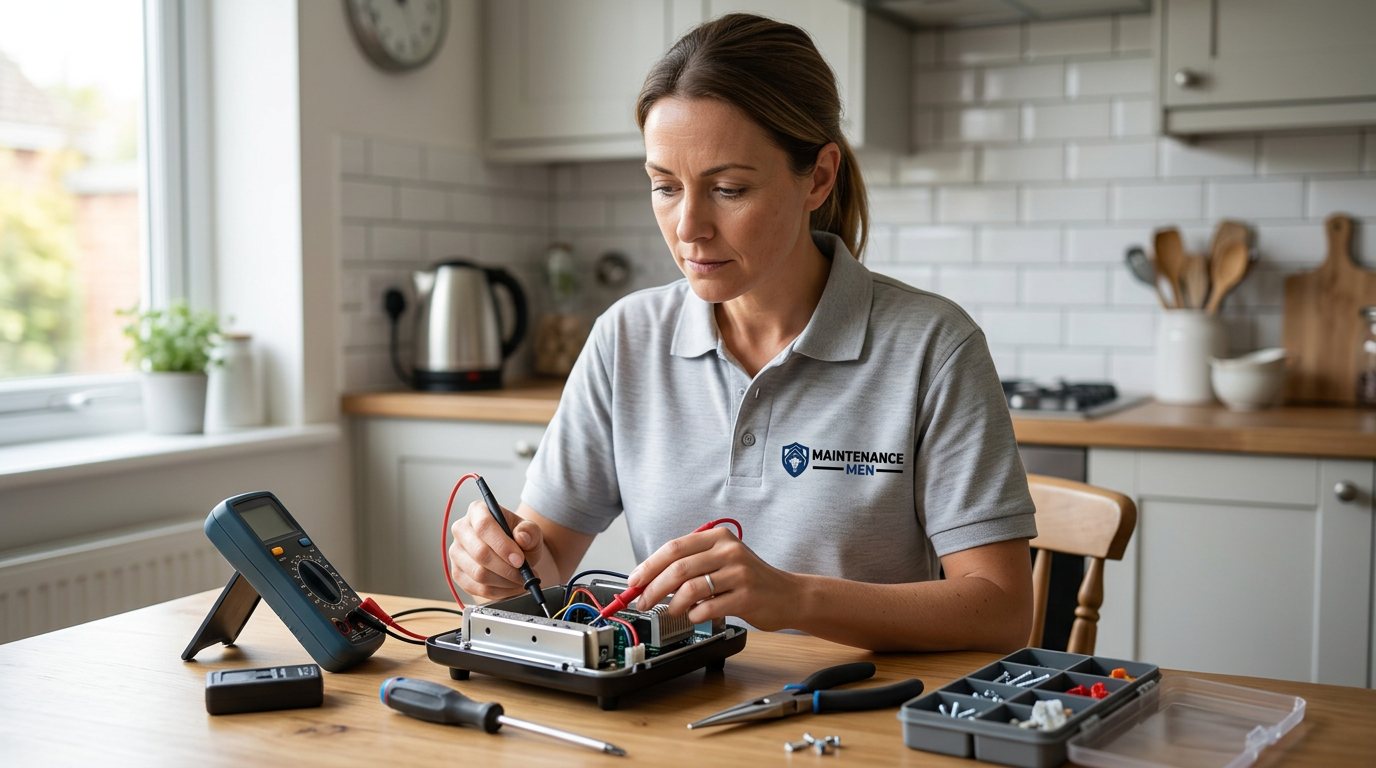
We begin with the appliance's behaviour: does it heat at all, heat slowly, heat one area only, or heat and then cut out? That answer narrows the field immediately. The appliance is then opened with the power isolated, connections are inspected for heat damage and looseness, and the element is tested for continuity and resistance against what the maker specifies. The thermostat and any thermistor are tested and, where possible, checked against a known temperature. The thermal cut-out is tested for continuity, and the supply to the element is measured with the appliance calling for heat so we can see whether the board is switching.
Repairs, and where a repair stops making sense
A thermostat, thermal cut-out or thermistor is usually a modest part and a sensible repair. An element is more expensive and worth weighing against the age of the appliance. A control board fault can be the most costly of all, and on a low-priced appliance it may exceed the value of the machine. We give you the options with the parts identified and priced separately, so you can decide with real information. We do not claim every heating fault is repairable, and on sealed refrigerant or high-voltage sections we refer rather than open them.
Safety points that matter with heat
Never bypass a thermal cut-out or fit a fuse of a higher rating to get an appliance heating again. Those devices exist because heating appliances can and do catch fire when a thermostat sticks. If you have seen flames, smoke or a burning smell, stop using the appliance and unplug it if that is safe, and mention it when booking. Allow a hot appliance to cool fully before anyone inspects it, and never test a heating appliance by leaving it running unattended.
What to have ready
The make, model and serial number, the age of the appliance, and a description of exactly what happens: does it click, do the lights come on, does it heat slightly before stopping? If you have already replaced a part, say so and keep the old one — knowing what has been ruled out saves time on the visit.
Booking
Book online with the appliance details and the heating symptom. The booking fee is paid when you book, and the hourly labour rate depends on how soon you need the visit. The full cost is quoted and you approve it before work starts; parts needed are identified and quoted separately once the diagnosis is done.
How the price works
We charge a booking fee to hold your slot, then an hourly rate for the work itself. The fee changes with how soon you need us; the hourly rate changes with the slot you choose. You approve the price before we start, so there is no surprise on the invoice.
Booked 14+ days ahead
£25 booking fee
then £85 per hour of labour
Best value. Book the slot now, pay the smallest booking fee.
Booked within 48 hours
£100 booking fee
then £65 per hour of labour
For jobs that can wait a day or two but not a fortnight.
Same-day call-out
£220 booking fee
then £45 per hour of labour
Urgent problems: standing water, no heat, no power, leaks.
Book the slot
Choose the window that suits you and pay the booking fee. That holds your place in the diary.
We diagnose on site
The engineer confirms the cause and tells you what the job involves and how long it should take.
You approve, we work
Nothing goes ahead until you agree the price. Labour is then charged per hour at your slot rate.
When a kettle, iron, air fryer or coffee machine switches on, lights up and then produces nothing but cold, the fault is somewhere in the heating chain. That chain has several links and only one of them is usually at fault. We test them in order, from the element through the thermostat to the control board, and tell you what the repair involves before anything is ordered.
What our customers say about our home appliances service
4.8 out of 5 from 14 reviews
Exactly what was quoted
What I appreciated was being told what was actually wrong before anyone started. Sorted in under 27 minutes and the invoice matched the quote to the penny.
Job: Tumble Dryer Not Starting Cycle
Good job, slightly late
Solid work. Hourly rate feels fair for the amount of work involved and everything was tested before they left. Would book again.
Job: Toaster Not Working
No mess left behind
Really straightforward. It had been bothering us for weeks; diagnosed properly, fixed the same visit, and the price was exactly what was explained when booking. Can not fault it.
Job: Microwave Button Repair
Book Appliance Not Heating
Tell us what is happening and choose a slot. If you are not sure this is the right job, use the diagnosis panel — it narrows the problem down before you book.
- Booking fee confirmed up front
- Hourly labour, agreed before work starts
- Same-day slots for urgent problems







Questions people ask about appliance not heating
Straight answers to the things customers ask most often before booking.
Can I test the element myself?
Only with the appliance unplugged and fully cooled, and only if you are confident using a multimeter on a heating circuit. A continuity test is straightforward, but misreading it is common, and the thermostat and cut-out also need checking before an element is condemned.
What gets checked on a no-heat visit?
The element for continuity and resistance, the thermostat and thermistor, the thermal cut-out, the wiring and terminations, and whether the control board is actually supplying the element when heat is called for. The appliance is isolated and cooled before any of it is tested.
Is it safe to keep using an appliance that heats intermittently?
Treat it with caution. A thermostat with sticking contacts can let an appliance run far hotter than intended. Unplug it between uses and have it checked before relying on it again.
Why did my appliance stop heating after I replaced the element?
Usually because the element was not the failed part, or because a thermal cut-out had opened and is still open. The supply to the element needs measuring, not assuming.
How do you price the work?
The booking fee is paid when you book, and the hourly labour rate depends on how soon you need the visit. We quote the full cost and get your approval before starting, with any parts identified and priced separately.
Need appliance not heating sorted in Sutton Coldfield?
Book a slot in the diary and pay only the booking fee up front. We confirm the rest before we start.