
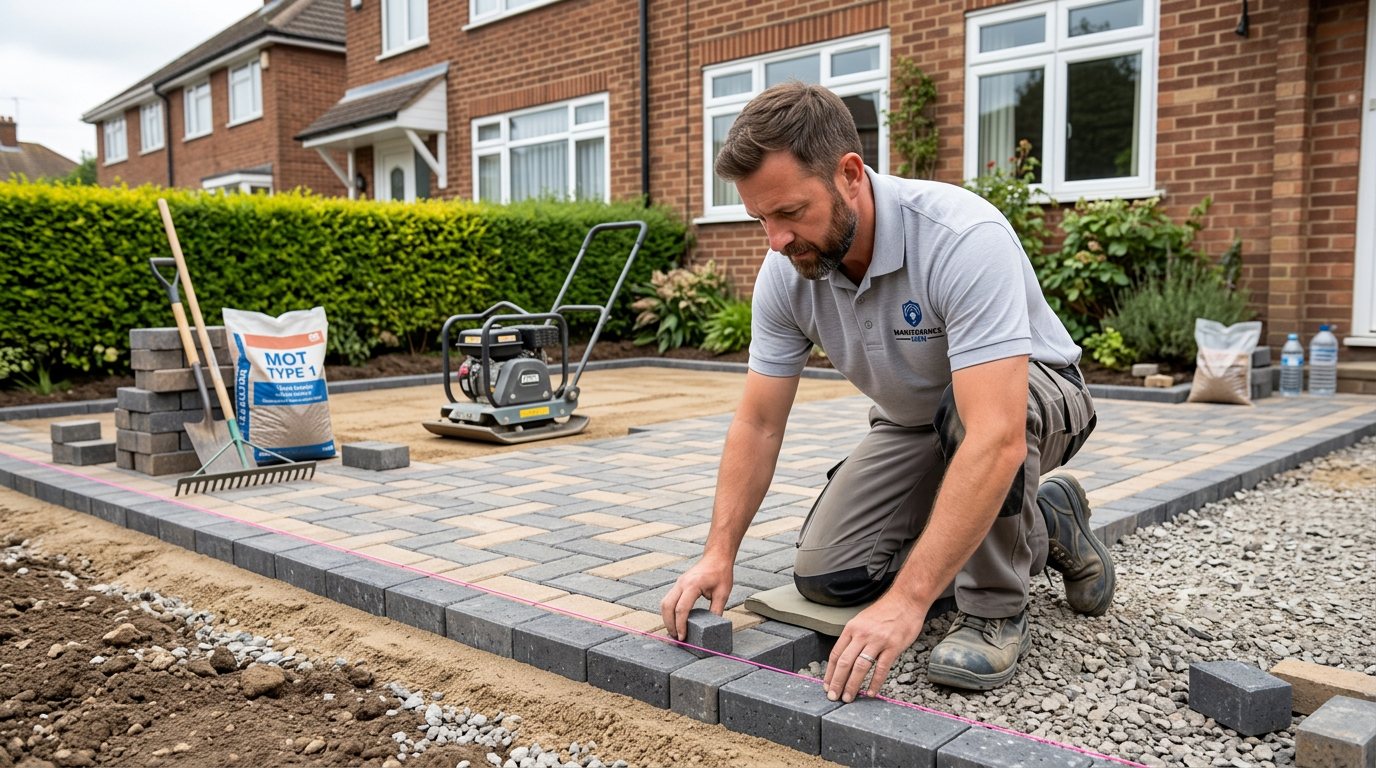
A New Garden Path Built to Last: Surveyed, Quoted and Properly Laid in Smethwick
We survey the route, ground and drainage, quote the full project after that survey, and build a pathway with correct falls and a subbase that will not sink.
Booking fee plus hourly labour — the price is confirmed before any work starts.
What this costs
| Booked 14+ days ahead | £25 booking fee £85 per hour |
|---|---|
| Booked within 48 hours | £100 booking fee £65 per hour |
| Same-day call-out | £220 booking fee £45 per hour |
The booking fee secures the visit. Labour is then charged by the hour, so you only pay for the time the job actually takes.
Booking fee £25–£220
£25 + £85/hr booked 14+ days ahead, £100 + £65/hr inside 48 hours, £220 + £45/hr same day. Agreed before we arrive.
Covered under Driveways & Pathways
Outdoor & Exterior › Driveways & Pathways — one of 22 documented jobs in this section.
Same-day pathway installation
Urgent jobs can often be booked for today. Ask when you book and we will confirm the slot before you pay anything.
15 service areas
Birmingham, Coventry, Dorridge and 12 more across the West Midlands.
A garden path seems like the simplest outdoor project there is — and it is the one where shortcuts show up fastest. A path laid straight onto soil will sink, tip and grow weeds within a couple of winters; a path laid with proper bedding, compaction and falls will outlast the fence around it. This page explains how we approach pathway installation, what the survey decides, and what a properly built path involves.
Starting with a survey
The survey settles the questions that decide everything else: the route — where people actually walk, which is not always where the last path went — the width and the surface it needs to carry, the ground along that route and how wet it gets, the levels from start to finish, and where rainwater will go. We check what is under the route — old paths to remove, services to avoid, roots to respect — and how the path will meet whatever it connects: the back door, the patio, the gate. Materials are part of the same conversation: slabs, block paving, gravel, brick edging with a gravel core, stepping stones in turf — each has a different cost, look, grip and maintenance character, and the right answer depends on your garden, your use and your budget. We lay out the trade-offs rather than steer you to whatever is easiest for us.
Planning matters you own
Most garden paths need no permission, but boundaries and shared access can change that: a path on or over a boundary, serving a shared passage, or in a conservation area may involve neighbours or the council. We will flag what we can see, but permissions and boundary agreements are the customer's responsibility and we do not promise compliance status. Better to know before the first turf is cut.
How the path is built
The sequence that separates a lasting path from a seasonal one: mark out and set levels; strip the topsoil along the route; excavate to the depth the ground and use demand; install edge restraints where the design needs them, set firm; lay and compact a subbase appropriate to the path's use — deeper for a path that will carry wheelbarrows of soil or occasional vehicles than one that only carries feet; add the bedding the surface requires; lay the surface with deliberate falls so water drains off, not into, the path; and finish joints, joints sand or gravel dressing as the material needs. Underground services matter even for shallow path work — shallow cables and pipes run through gardens at depths that hand digging can reach. We locate carefully and use detectors where appropriate, but no scan guarantees what is below; utilities' plans and a safe dig approach are part of the responsibilities we set out before digging starts.
Weather and staging
Groundwork is weather-dependent: excavating sodden ground makes a mess that has to be dug out twice, and surfacing materials have conditions we will not work around. We schedule sensibly, tell you plainly when weather must delay work, and stage the job so the garden is never left in a worse state than we found it.
What we guarantee and what we don't
We do not guarantee against settlement, weathering or future blockage — ground moves, roots grow, and frost works on everything outdoors. What we do promise is a build to appropriate depths for your ground and use, falls that keep the path dry, materials as quoted, and a cost you approve in full before work starts.
Costs and booking
The full cost of the pathway is quoted after the survey and approved by you before work starts, with materials quoted separately. The estimate attached to this job covers a defined working day on an agreed scope — longer runs or heavier-duty paths are bigger projects, staged with checkpoints, and the survey is what produces the real price. When you enquire, tell us the rough length and route, what surface you are considering, what the path needs to carry and anything you know about the ground along the way.
How the price works
We charge a booking fee to hold your slot, then an hourly rate for the work itself. The fee changes with how soon you need us; the hourly rate changes with the slot you choose. You approve the price before we start, so there is no surprise on the invoice.
Booked 14+ days ahead
£25 booking fee
then £85 per hour of labour
Best value. Book the slot now, pay the smallest booking fee.
Booked within 48 hours
£100 booking fee
then £65 per hour of labour
For jobs that can wait a day or two but not a fortnight.
Same-day call-out
£220 booking fee
then £45 per hour of labour
Urgent problems: standing water, no heat, no power, leaks.
Book the slot
Choose the window that suits you and pay the booking fee. That holds your place in the diary.
We diagnose on site
The engineer confirms the cause and tells you what the job involves and how long it should take.
You approve, we work
Nothing goes ahead until you agree the price. Labour is then charged per hour at your slot rate.
A new pathway should be the easiest walk in your garden — level, well drained and there for decades. We start with a survey of the route and ground conditions, quote the whole project from that survey, and build it properly from the subbase up, because a path is only ever as good as what is under it.
What our customers say about our outdoor & exterior service
4.6 out of 5 from 10 reviews
Sorted the same day
Rang in the morning and they got to us in Wolverhampton by early afternoon. Very clear about what needed doing, what it would cost and what could wait. No pressure to add extras. Exactly the sort of tradesperson you want.
Job: Uneven Shed Base
Turned up when they said
Turned up in the window they promised, walked me through the options (turns out the previous installer had left the pipework awkward to get to), then cracked on. Everything was tested before they left. No mess, no drama, no surprise on the bill.
Job: Water-Damaged Patio
Good work, poor communication
Work itself was fine and tidy. Communication beforehand was patchy — I did not get the confirmation message and had to ring to check the slot. Would still use again.
Job: Sinking Driveway
Book Pathway Installation
Tell us what is happening and choose a slot. If you are not sure this is the right job, use the diagnosis panel — it narrows the problem down before you book.
- Booking fee confirmed up front
- Hourly labour, agreed before work starts
- Same-day slots for urgent problems







Questions people ask about pathway installation
Straight answers to the things customers ask most often before booking.
Can I install a garden path myself?
A simple gravel path or a few stepping stones are genuinely achievable DIY projects, and we will say so where that is the honest answer. What separates a lasting path from a sinking one is depth of excavation, compaction of the subbase, edge restraint and falls — and those are the parts DIY installs usually skip. For a paved path that will carry wheelbarrows, bins or years of use, at least have the route and ground assessed before you start.
What does your pathway survey cover?
The route and width, ground conditions along it, levels start to finish, where rainwater will go, what lies beneath — old surfaces, services, roots — and how the path meets doors, patios and gates. It is also where we compare surface materials honestly on cost, look, grip and maintenance, so the quote reflects a design you chose rather than one we defaulted to.
Do I need permission for a new pathway?
Usually not for a straightforward garden path, but paths over a boundary, serving shared access, or in conservation areas can involve permissions or neighbour agreements. We flag what we can see, but permissions and boundary matters are the customer's responsibility and we do not promise compliance status. Checking first is always cheaper than relaying later.
How long does pathway installation take?
It depends on length, ground conditions, what needs removing and the surface chosen — which is why we quote after survey rather than estimate. The estimate attached to this job covers a defined working day on an agreed scope, and longer or heavier-duty paths are staged as bigger projects with checkpoints. Weather also decides timing, because groundworks need suitable conditions, and we tell you plainly when weather must delay work.
How much does a new pathway cost?
The full cost is quoted after the survey and approved before work starts, with materials quoted separately — length, ground and material choice change the scope completely, so there is no honest single figure. You pay a booking fee when you book, and labour is charged hourly at a rate that depends on how soon you need the visit; the survey is what turns your plans into a firm, comparable price.
Need pathway installation sorted in Smethwick?
Book a slot in the diary and pay only the booking fee up front. We confirm the rest before we start.