
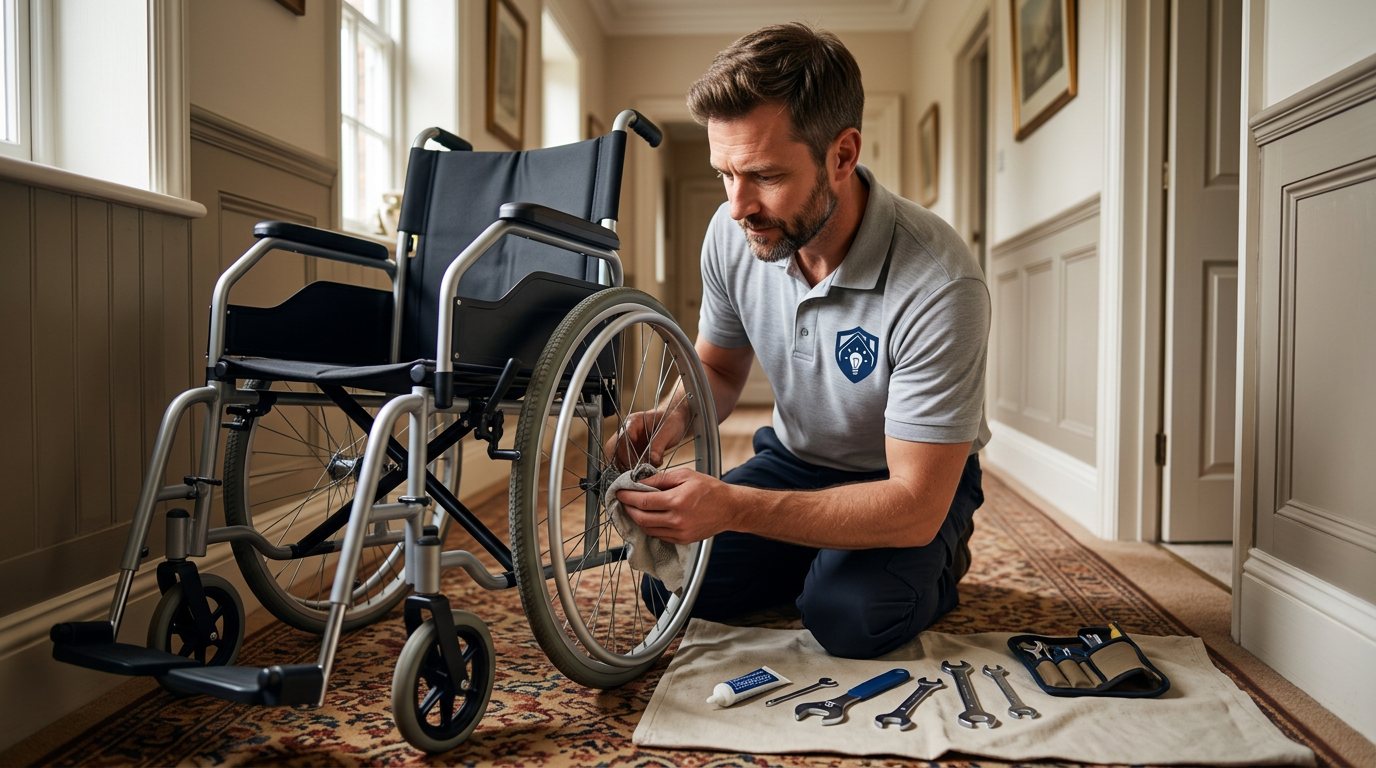
Wheelchair Wiring Issues Repaired Safely and Properly, First Time in Smethwick
We trace and repair damaged wheelchair wiring — chafed looms, corroded connectors and broken cables — to a standard we would trust under a seated user.
Booking fee plus hourly labour — the price is confirmed before any work starts.
What this costs
| Booked 14+ days ahead | £25 booking fee £85 per hour |
|---|---|
| Booked within 48 hours | £100 booking fee £65 per hour |
| Same-day call-out | £220 booking fee £45 per hour |
The booking fee secures the visit. Labour is then charged by the hour, so you only pay for the time the job actually takes.
Booking fee £25–£220
£25 + £85/hr booked 14+ days ahead, £100 + £65/hr inside 48 hours, £220 + £45/hr same day. Agreed before we arrive.
Covered under Wheelchairs & Accessories
Mobility & Accessibility › Wheelchairs & Accessories — one of 23 documented jobs in this section.
Same-day wiring issue
Urgent jobs can often be booked for today. Ask when you book and we will confirm the slot before you pay anything.
15 service areas
Birmingham, Coventry, Dorridge and 12 more across the West Midlands.
Wiring is the nervous system of a powered wheelchair, and it lives a hard life: the loom flexes every time the chair steers, vibrates over every kerb, gets splashed with rain, and is bent around whenever the chair is folded or loaded into a car. Small failures — a chafed insulation, a corroded pin, a fatigued conductor — build up over years, and they announce themselves as behaviour that seems unrelated: a flicker on the panel, a dropout on bumps, an error code that comes and goes. This page explains how wiring fails, how we trace it, and why we repair it the way we do.
How wiring fails
Chafing is the classic. Wherever the loom passes a moving joint, a sharp edge or a cable tie that was fitted too tightly, insulation wears through, and the conductor inside eventually touches its neighbour or the frame. The symptom is intermittent by nature — the fault appears when the chair bounces, turns or flexes, and disappears when it settles, which is exactly why it is so confusing to live with.
Connectors fail next: pins corrode where moisture has entered, work loose through vibration, or crack where the loom has been yanked. Conductors themselves fatigue where they flex repeatedly — usually at the connector, not in the middle. And water is the accelerator for all of it: a loom that has lived through wet winters and unshielded outdoor storage corrodes years earlier than one kept dry.
Why wiring faults matter more than they look
A wiring fault on a wheelchair is not like one on a lamp. The loom carries power to the systems that move and stop the chair, and a fault that comes and goes can do so at the least convenient moment. There is also a genuine fire and damage risk where conductors short: insulation that has melted or scorched means the fault has already been drawing current it should not. So wiring faults are diagnosed and repaired properly, not patched — a taped-over chafe on a chair that carries a person is a false economy we will not sell you.
How we trace the fault
We begin with your observations: when does the fault show, on bumps or turns or randomly, and did anything precede it — rain, a spill, a repair, the chair being folded differently? Then we test along the loom with proper instruments: continuity and insulation where the design allows, every connector inspected and reseated, the loom examined at every flex point and routing edge, and the system monitored while the chair is exercised through the movements that trigger the fault.
When we find the culprit — a chafed section, a corroded connector, a broken conductor — we repair it to a proper standard: sound conductor joins, correct insulation, connectors replaced rather than forced, and the repaired section routed and secured so it cannot rub through again. Where a whole loom section or connector set is the sensible replacement, we quote manufacturer-approved parts and confirm availability before promising anything. If the fault hides during the visit, we say so and agree next steps rather than inventing a fix.
Safety around wiring faults
Do not use a chair that has scorched or melted insulation, that has tripped your house electrics, or that behaves erratically in a way that could put its user at risk — leave it switched off until it is checked. Do not open the loom, do not tape over damage, and do not attempt to reroute or shorten cables yourself; modern wheelchair systems are sensitive to how their wiring is arranged, and improvised changes cause new faults while hiding old ones. If the chair misbehaved while someone was seated and they were hurt or distressed, call 999 first.
Aftercare
Keep the chair dry and store it out of the rain; moisture is the single biggest accelerator of wiring failure. Avoid yanking the loom when folding or lifting the chair, and report flickers and dropouts promptly — wiring faults caught early are small repairs, and the same fault left alone can take the controller with it.
Booking
Tell us the make and model, describe the fault and anything that triggers it, and mention whether the chair has been exposed to rain, spilled on, or repaired recently. You pay a booking fee when you book, labour is hourly at a rate depending on how soon you need the visit, and the full cost is quoted and approved before any repair starts.
How the price works
We charge a booking fee to hold your slot, then an hourly rate for the work itself. The fee changes with how soon you need us; the hourly rate changes with the slot you choose. You approve the price before we start, so there is no surprise on the invoice.
Booked 14+ days ahead
£25 booking fee
then £85 per hour of labour
Best value. Book the slot now, pay the smallest booking fee.
Booked within 48 hours
£100 booking fee
then £65 per hour of labour
For jobs that can wait a day or two but not a fortnight.
Same-day call-out
£220 booking fee
then £45 per hour of labour
Urgent problems: standing water, no heat, no power, leaks.
Book the slot
Choose the window that suits you and pay the booking fee. That holds your place in the diary.
We diagnose on site
The engineer confirms the cause and tells you what the job involves and how long it should take.
You approve, we work
Nothing goes ahead until you agree the price. Labour is then charged per hour at your slot rate.
Wiring faults in a powered wheelchair show up as flickers, dropouts and error codes, and they nearly always start small: a cable rubbing where it flexes, a connector working loose, damp getting in. We trace the fault along the loom, repair it properly rather than patching it, and quote for the work before we start.
What our customers say about our mobility & accessibility service
4.5 out of 5 from 8 reviews
Proper job, no upselling
Turned up in the window they promised, walked me through the options (turns out the old fitting was seized and needed careful removal), then cracked on. Everything was tested before they left. No mess, no drama, no surprise on the bill.
Job: Loose or Faulty Brakes
Fine in the end
The problem is fixed, which is the main thing, and the engineer clearly knew what they were doing. It took a fair bit longer than the estimate on the phone and I had to ask twice for a breakdown of the hours.
Job: Stair Lift Service
Would use again
What I appreciated was being told what was actually wrong before anyone started. Sorted in under 70 minutes and the invoice matched the quote to the penny.
Job: Control Panel Fault
Book Wiring Issue
Tell us what is happening and choose a slot. If you are not sure this is the right job, use the diagnosis panel — it narrows the problem down before you book.
- Booking fee confirmed up front
- Hourly labour, agreed before work starts
- Same-day slots for urgent problems






Questions people ask about wiring issue
Straight answers to the things customers ask most often before booking.
Can I repair wheelchair wiring myself?
We would advise against it. Looms are sensitive to how they are routed and secured, taped repairs hide faults rather than fixing them, and a chair that carries a person needs its wiring sound, not patched. Batteries, fuses and charging are reasonable DIY; wiring is engineer work.
How do you find a wiring fault that only happens sometimes?
We use your observations as evidence — bumps, turns, rain, folding — then test continuity and insulation along the loom, inspect and reseat every connector, and monitor the system while exercising the chair through the movements that trigger the fault. Finding it beats swapping parts on a hunch.
Is a flickering display really a wiring problem?
Often, yes. Flicker that comes and goes with movement or vibration is the classic signature of a chafed conductor or a loose connector. It can also be a failing panel or a supply issue, which is why we diagnose the whole chain rather than assuming the loom is guilty.
Why won't you just tape up the damaged wire?
Because a taped repair on a load of moving, vibrating, wet-prone loom is a temporary patch on a safety system, and it hides the fault so it cannot be verified fixed. We repair conductors properly, replace worn connectors, and route the repair so it cannot rub through again.
What does a wiring repair cost?
You pay a booking fee when you book, and labour is charged hourly at a rate that depends on how soon you need the visit. The full cost of the repair is quoted and approved before work starts, and any replacement loom sections or connectors are quoted separately.
Need wiring issue sorted in Smethwick?
Book a slot in the diary and pay only the booking fee up front. We confirm the rest before we start.