
Fuse blowing again? That is a short circuit, not a fuse fault in Smethwick
We find what is drawing excessive current inside the appliance instead of simply replacing the fuse that keeps failing.
Booking fee plus hourly labour — the price is confirmed before any work starts.
What this costs
| Booked 14+ days ahead | £25 booking fee £85 per hour |
|---|---|
| Booked within 48 hours | £100 booking fee £65 per hour |
| Same-day call-out | £220 booking fee £45 per hour |
The booking fee secures the visit. Labour is then charged by the hour, so you only pay for the time the job actually takes.
Booking fee £25–£220
£25 + £85/hr booked 14+ days ahead, £100 + £65/hr inside 48 hours, £220 + £45/hr same day. Agreed before we arrive.
Covered under Small Appliances
Home Appliances › Small Appliances — one of 20 documented jobs in this section.
Same-day fuse blowing appliance
Urgent jobs can often be booked for today. Ask when you book and we will confirm the slot before you pay anything.
15 service areas
Birmingham, Coventry, Dorridge and 12 more across the West Midlands.
A plug fuse costs pennies, which is why so many appliances get through several before anyone thinks to ask why. The fuse is not the fault. It is a deliberately weak link that melts when current exceeds a safe level, protecting the flex and the appliance from overheating. If it keeps melting, something inside is drawing far more current than the appliance was designed for, and the only useful question is what.
What makes a fuse blow
There are two distinct mechanisms. A short circuit is a near-zero resistance path between live and neutral, or live and earth, and the current rises almost instantly to a level the fuse cannot survive. An overload is a slower affair: the appliance draws more than its rated current for long enough to heat the fuse element. Short circuits are usually caused by damaged insulation, a failed heating element that has collapsed internally, a pinched cable or a control board with a burnt track. Overloads often come from a motor seizing, a gearbox jammed, or a heating element with a partial short that draws heavy current without failing completely.
Why the rating matters so much
Fuses are rated in amps, and the correct rating is set by the appliance's stated wattage. Fitting a 13A fuse where a 3A or 5A fuse belongs removes the protection the maker intended and lets a fault burn inside the appliance instead of blowing the fuse. It is also worth checking that the fuse is the right physical size and type: a fuse that sits loosely in its holder creates heat of its own and can fail for the wrong reason. If someone has previously fitted a nail, foil or a higher-rated fuse, that is a red flag worth mentioning.
Tracing the fault
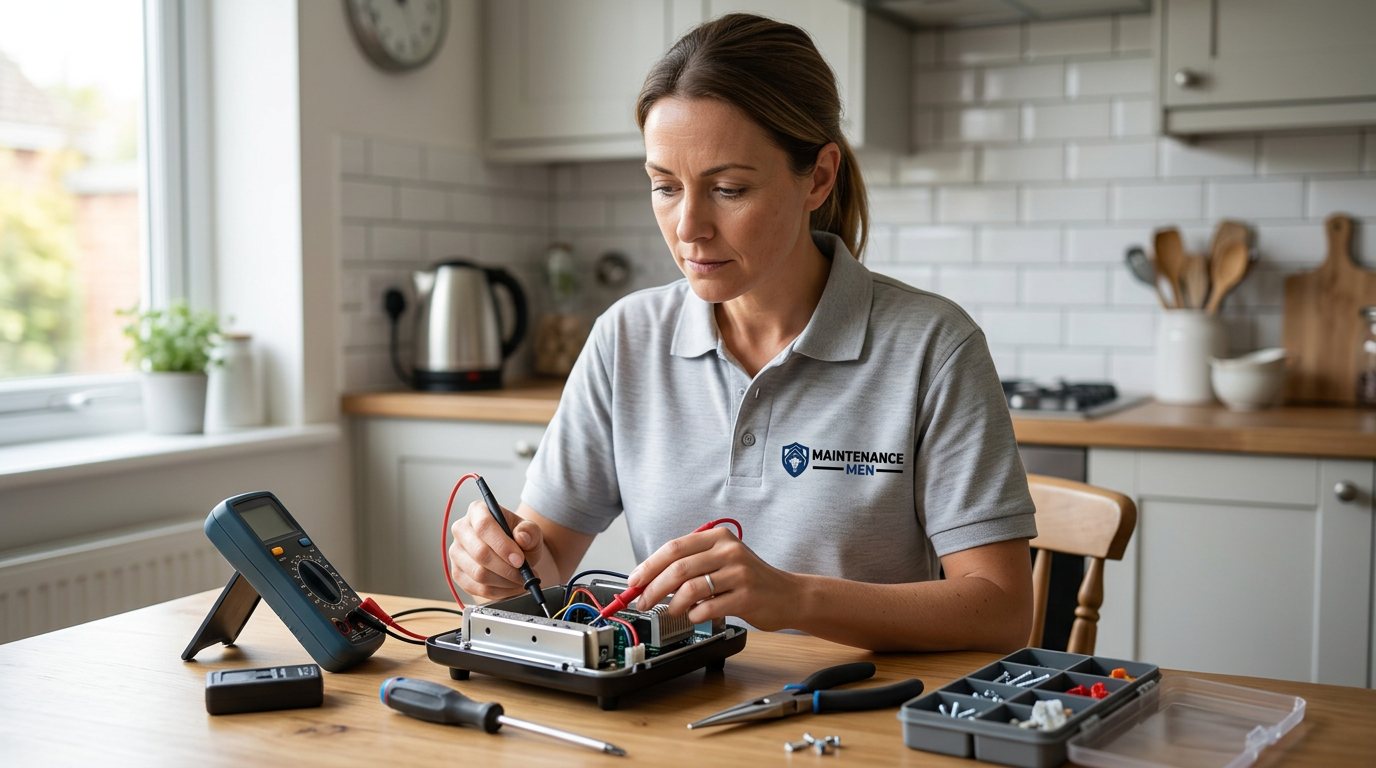
With the appliance isolated, the plug is opened and the fuse holder inspected for heat damage and poor contact. The flex is checked along its length for crush damage and for water ingress at the connector. Inside, we isolate sections in turn: disconnect the element and test it for resistance and for insulation to earth, test the motor windings and check for a seized shaft, and inspect the control board for burnt tracks or failed components. Disconnecting a section and testing whether the fuse holds is a diagnostic method, not a repair, but it reliably narrows the field.
What is usually fixable
A damaged flex or plug, a failed element, a perished gasket letting moisture onto a terminal, or a chafed internal wire are all reasonable repairs. A control board with a burnt track may be repairable or may need replacement depending on the model and parts availability. A motor with a shorted winding is usually the end of the road on a small appliance. We tell you which category you are in, with the part identified and quoted separately, and we are clear when a repair is not worth doing.
Safety points worth repeating
Never fit a fuse of a higher rating than the appliance specifies, and never bypass a fuse with wire or foil. If a fuse has blown, unplug the appliance before investigating and do not switch it on again to "see if it holds" when there has been scorching or a smell. A fuse that blows with a bang, or leaves blackening inside the plug, points to a serious short and warrants a proper test before further use.
Information that speeds things up
Note how quickly the fuse blows — instantly on switching on, after a few seconds, or after several minutes of use — because the timing separates a hard short from an overload. Tell us the fuse rating that was fitted and whether it was the correct one, and give the make, model and wattage from the rating plate.
Booking
Book online with the appliance details and the fuse behaviour. The booking fee is paid when you book, and the hourly labour rate depends on how soon you need the visit. The full cost is quoted and approved before work begins, and any parts are identified and priced separately.
How the price works
We charge a booking fee to hold your slot, then an hourly rate for the work itself. The fee changes with how soon you need us; the hourly rate changes with the slot you choose. You approve the price before we start, so there is no surprise on the invoice.
Booked 14+ days ahead
£25 booking fee
then £85 per hour of labour
Best value. Book the slot now, pay the smallest booking fee.
Booked within 48 hours
£100 booking fee
then £65 per hour of labour
For jobs that can wait a day or two but not a fortnight.
Same-day call-out
£220 booking fee
then £45 per hour of labour
Urgent problems: standing water, no heat, no power, leaks.
Book the slot
Choose the window that suits you and pay the booking fee. That holds your place in the diary.
We diagnose on site
The engineer confirms the cause and tells you what the job involves and how long it should take.
You approve, we work
Nothing goes ahead until you agree the price. Labour is then charged per hour at your slot rate.
A fuse that blows once is an accident. A fuse that blows every time is a report of a short circuit or an overload inside the appliance, and replacing it with another of the same rating just repeats the experiment. We trace the excess current to its source — element, motor, wiring or board — and explain what a proper repair involves.
What our customers say about our home appliances service
4.8 out of 5 from 14 reviews
Exactly what was quoted
What I appreciated was being told what was actually wrong before anyone started. Sorted in under 27 minutes and the invoice matched the quote to the penny.
Job: Tumble Dryer Not Starting Cycle
Good job, slightly late
Solid work. Hourly rate feels fair for the amount of work involved and everything was tested before they left. Would book again.
Job: Toaster Not Working
No mess left behind
Really straightforward. It had been bothering us for weeks; diagnosed properly, fixed the same visit, and the price was exactly what was explained when booking. Can not fault it.
Job: Microwave Button Repair
Book Fuse Blowing Appliance
Tell us what is happening and choose a slot. If you are not sure this is the right job, use the diagnosis panel — it narrows the problem down before you book.
- Booking fee confirmed up front
- Hourly labour, agreed before work starts
- Same-day slots for urgent problems







Questions people ask about fuse blowing appliance
Straight answers to the things customers ask most often before booking.
Can I keep replacing the fuse myself?
You can replace it once with the correct rating, and that is a fair test. If it blows again, stop: repeated blowing means a fault inside the appliance that a new fuse cannot fix.
What is checked during the visit?
The plug and fuse holder for heat damage, the flex for damage or moisture, the element for resistance and insulation failure, the motor for a shorted winding or seized shaft, and the control board for burnt tracks. The appliance is opened only after it has been isolated and the fault traced as far as possible from outside.
Is a higher-rated fuse acceptable if it stops blowing?
No. It removes the protection the appliance was designed with and allows a fault to overheat wiring inside the casing. That is a genuine fire risk and never a fix.
The fuse blows only after a few minutes of use. What does that suggest?
A slower blow usually indicates an overload rather than a hard short — a motor labouring, a partially failed element or a component breaking down as it heats. That pattern is useful and worth noting when you book.
How do you charge for this?
The booking fee is paid when you book, and the hourly labour rate depends on how soon you need the visit. The full cost is quoted for your approval before work starts, and parts are quoted separately once identified.
Need fuse blowing appliance sorted in Smethwick?
Book a slot in the diary and pay only the booking fee up front. We confirm the rest before we start.