
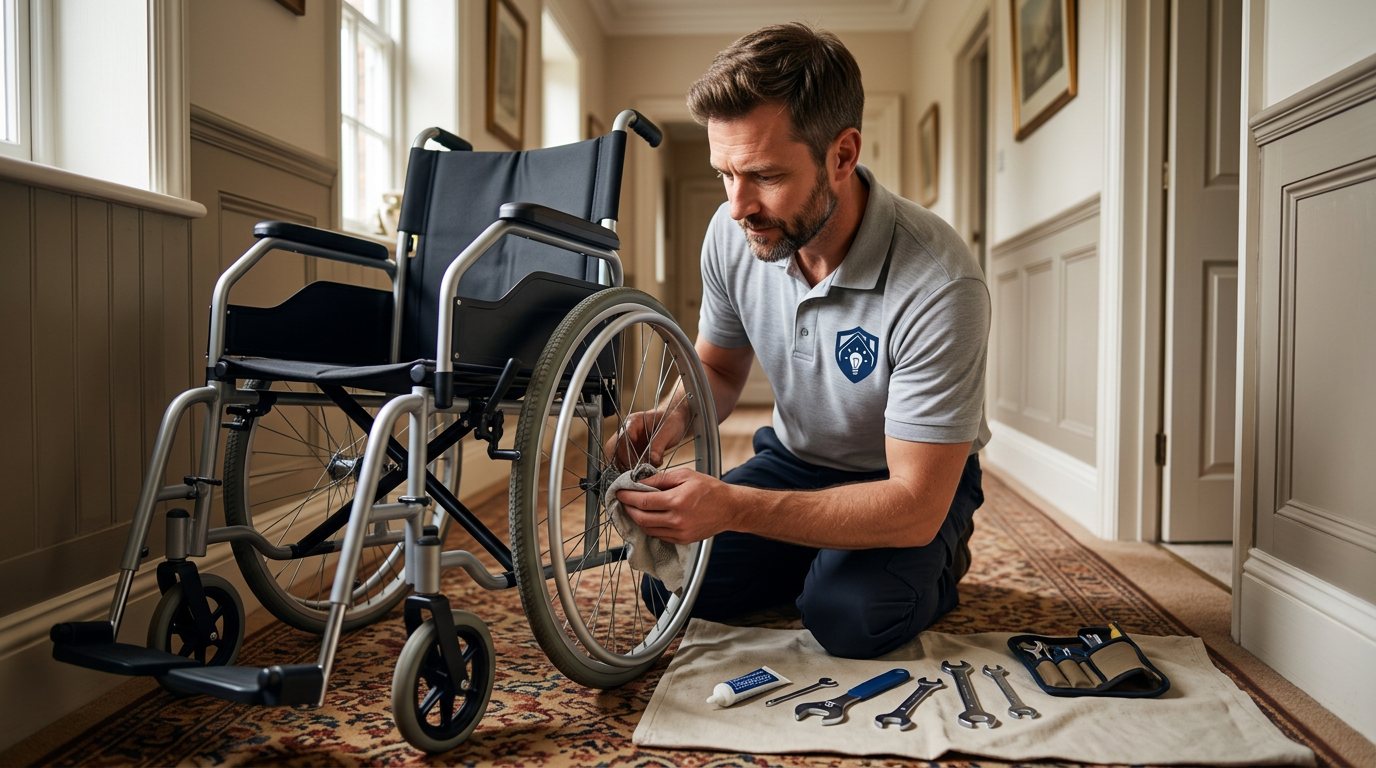
Your Wheelchair Feels Sluggish? We'll Restore Its Get-Up-And-Go in Shirley
We track down why a wheelchair has lost its easy movement — wheels, bearings, brakes, batteries or drive — and put it right with your approval.
Booking fee plus hourly labour — the price is confirmed before any work starts.
What this costs
| Booked 14+ days ahead | £25 booking fee £85 per hour |
|---|---|
| Booked within 48 hours | £100 booking fee £65 per hour |
| Same-day call-out | £220 booking fee £45 per hour |
The booking fee secures the visit. Labour is then charged by the hour, so you only pay for the time the job actually takes.
Booking fee £25–£220
£25 + £85/hr booked 14+ days ahead, £100 + £65/hr inside 48 hours, £220 + £45/hr same day. Agreed before we arrive.
Covered under Wheelchairs & Accessories
Mobility & Accessibility › Wheelchairs & Accessories — one of 23 documented jobs in this section.
Same-day weak wheelchair movement
Urgent jobs can often be booked for today. Ask when you book and we will confirm the slot before you pay anything.
15 service areas
Birmingham, Coventry, Dorridge and 12 more across the West Midlands.
Loss of movement in a wheelchair usually creeps up on you. One month the chair glides; a few months later pushing it feels like wading through treacle, or an electric model responds sluggishly and runs out of puff halfway down the road. Because the decline is gradual, it is easy to assume the chair is just getting old — but in most cases one or two specific components are worn, and restoring them brings the chair back. This page explains where that lost movement hides and how we find it.
Why chairs get sluggish
On manual wheelchairs, sluggishness is nearly always friction. Wheel bearings wear and bind. Axles and casters collect hair, thread and grime. Tyres soften, go out of true, or rub against the frame or side guards because they have slipped or the wheel has worked loose. Brakes that no longer retract fully drag on the tyre all the time. Even a chair that looks clean can have enough resistance in two bearings and a dragging brake to make every journey an effort.
On powered chairs, weak movement has a different set of causes. Batteries that are past their best will still show a charge but cannot supply the current the motors ask for, so the chair feels slow and dies early — this is the classic symptom. A charger that no longer charges fully produces the same result. Beyond batteries, dragging brakes, a binding gearbox, worn drive components, or a controller that has reduced power (sometimes deliberately, sometimes not) will all take the spring out of the chair.
How we diagnose it
We start by establishing what "weak" means for your chair: hard to push, slow to respond, short on range, or all three. Then we measure and inspect rather than guess. On a manual chair we lift and spin each wheel, check bearing play and roughness, examine tyres for pressure, wear and rubbing, confirm the brakes release fully, and check the casters and axles for debris and wear. On a powered chair we test the batteries under load — the only honest test — check the charger's actual output, inspect the brakes and drive units, and read any controller settings or error codes.
We will show you what we find, because it matters for your decision. A dragging brake and a tyre rubbing may be a small adjustment. Worn bearings are a modest parts job. Tired batteries mean a replacement decision. Each comes with its own quoted cost, and nothing proceeds until you approve the quote.
Repairs and honest limits
Bearing replacement, wheel and caster work, brake adjustment, tyre replacement and debris removal are routine, satisfying jobs that often transform a chair. Battery replacement on a powered chair is common, expected maintenance — batteries are consumables, not a sign you bought badly — and we fit manufacturer-approved types. Charger and drive faults are engineer work, and quoted with parts once diagnosed.
What we cannot promise is a specific top speed or range after repair; that depends on the chair's design, the battery type and how it is used, and we will not make performance claims. Nor will we certify a chair as suitable for anyone's medical needs — suitability is for you, your carers and the manufacturer's specifications to settle. What we can promise is a chair whose wheels turn as freely as its design allows and whose electrics are working as intended.
Keeping it that way
Sluggishness is largely preventable. Keep tyres inflated to the pressure printed on the sidewall, wipe hair and fluff from axles and casters, and have brakes checked so they release cleanly. On powered chairs, charge fully and regularly, replace batteries when their range clearly shortens rather than struggling on, and keep the chair dry. A periodic service catches bearing wear and brake drag before they drain the user's energy.
Booking a visit
Book us if the chair has noticeably lost its ease of movement, whether over months or suddenly. Tell us the make and model, whether the chair is manual or powered, how the sluggishness shows itself, and when it last had any attention. You pay a booking fee when you book; labour is hourly at a rate depending on how soon you need us; and the full cost of any work is quoted and approved before we begin, with parts itemised separately.
How the price works
We charge a booking fee to hold your slot, then an hourly rate for the work itself. The fee changes with how soon you need us; the hourly rate changes with the slot you choose. You approve the price before we start, so there is no surprise on the invoice.
Booked 14+ days ahead
£25 booking fee
then £85 per hour of labour
Best value. Book the slot now, pay the smallest booking fee.
Booked within 48 hours
£100 booking fee
then £65 per hour of labour
For jobs that can wait a day or two but not a fortnight.
Same-day call-out
£220 booking fee
then £45 per hour of labour
Urgent problems: standing water, no heat, no power, leaks.
Book the slot
Choose the window that suits you and pay the booking fee. That holds your place in the diary.
We diagnose on site
The engineer confirms the cause and tells you what the job involves and how long it should take.
You approve, we work
Nothing goes ahead until you agree the price. Labour is then charged per hour at your slot rate.
A wheelchair that has gradually become hard to push or slow to respond is telling you something is wearing out, and it rarely happens overnight. We find the cause — whether it is friction in the wheels, tired bearings or fading batteries — and explain the fix before any work begins. Gradual problems are usually far cheaper to solve than sudden ones.
What our customers say about our mobility & accessibility service
4.5 out of 5 from 8 reviews
Proper job, no upselling
Turned up in the window they promised, walked me through the options (turns out the old fitting was seized and needed careful removal), then cracked on. Everything was tested before they left. No mess, no drama, no surprise on the bill.
Job: Loose or Faulty Brakes
Fine in the end
The problem is fixed, which is the main thing, and the engineer clearly knew what they were doing. It took a fair bit longer than the estimate on the phone and I had to ask twice for a breakdown of the hours.
Job: Stair Lift Service
Would use again
What I appreciated was being told what was actually wrong before anyone started. Sorted in under 70 minutes and the invoice matched the quote to the penny.
Job: Control Panel Fault
Book Weak Wheelchair Movement
Tell us what is happening and choose a slot. If you are not sure this is the right job, use the diagnosis panel — it narrows the problem down before you book.
- Booking fee confirmed up front
- Hourly labour, agreed before work starts
- Same-day slots for urgent problems






Questions people ask about weak wheelchair movement
Straight answers to the things customers ask most often before booking.
The chair pushes fine downhill but feels heavy on the flat — is that a fault?
Often yes. Freewheeling easily but dragging under load points to friction — worn bearings, a dragging brake, a rubbing tyre or debris in the casters. Those are all things we diagnose and usually fix in a single visit, subject to your approval of the quote.
What do you check for weak movement?
On manual chairs: wheel spin, bearings, tyre pressure and wear, brake retraction, casters and axles. On powered chairs: batteries tested under load, charger output, brake and drive condition, and controller settings or error codes. We explain the findings and quote before starting any repair.
Could weak batteries actually be dangerous?
Not usually dangerous, but a battery that collapses under load can leave a powered chair short of power at an awkward moment, such as halfway across a road. If the range has dropped noticeably, it is worth having the batteries tested promptly rather than waiting for the chair to stop altogether.
Will a service make my wheelchair faster?
We will not promise speed or range figures — those depend on the chair's design and batteries. What a service restores is the chair's intended performance: wheels that spin freely, brakes that release, and batteries that deliver what they are rated for. Anything beyond the manufacturer's design is not something we will attempt.
What will this cost me?
You pay a booking fee when you book the visit. Labour is charged hourly, at a rate that depends on how soon you need us. Once we have diagnosed the cause, the full cost is quoted and approved before work starts, and parts are quoted separately within that figure.
Need weak wheelchair movement sorted in Shirley?
Book a slot in the diary and pay only the booking fee up front. We confirm the rest before we start.