
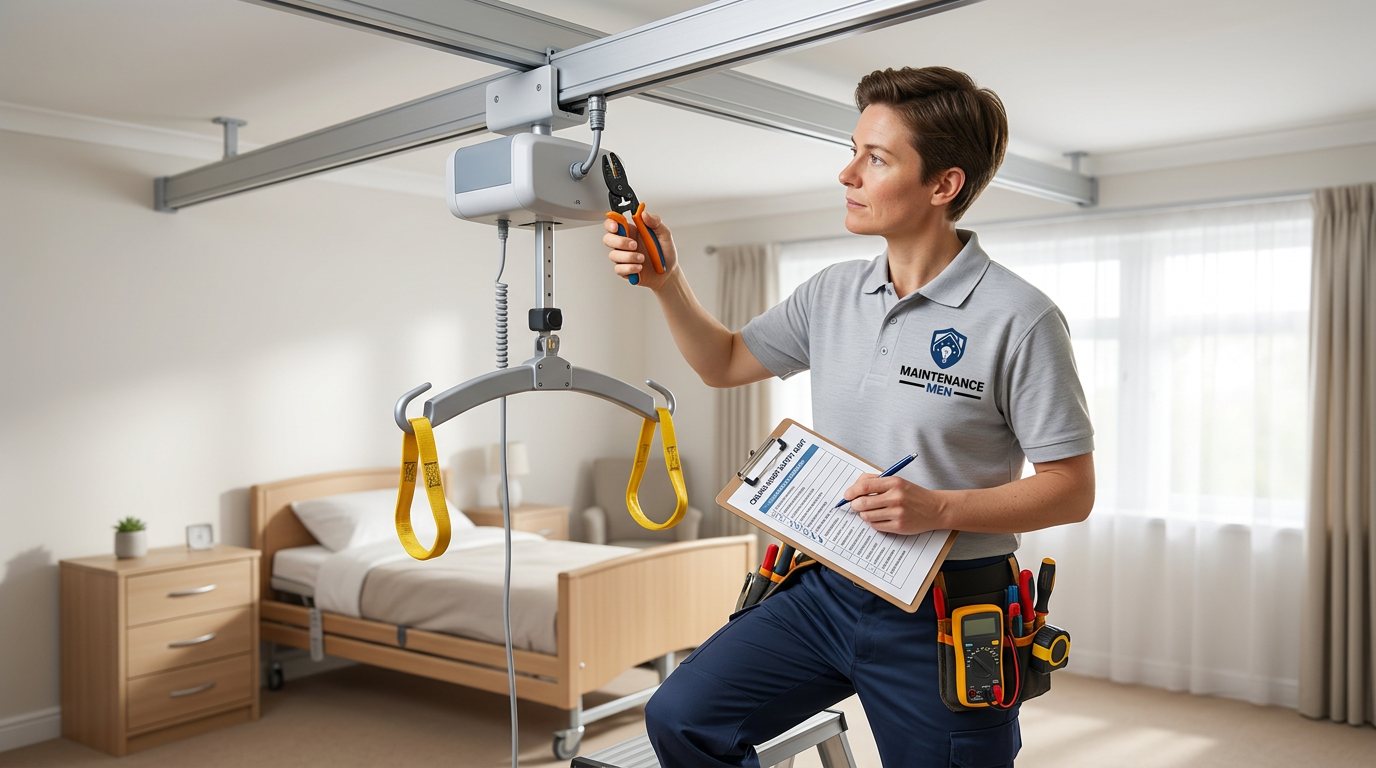
Hoist Wiring Fault? We'll Trace the Cable Run and Put It Right Safely in Shirley
We test the supply, charger lead and any wiring inside the track or wall for continuity and insulation faults, then repair or renew the section that has failed.
Booking fee plus hourly labour — the price is confirmed before any work starts.
What this costs
| Booked 14+ days ahead | £25 booking fee £85 per hour |
|---|---|
| Booked within 48 hours | £100 booking fee £65 per hour |
| Same-day call-out | £220 booking fee £45 per hour |
The booking fee secures the visit. Labour is then charged by the hour, so you only pay for the time the job actually takes.
Booking fee £25–£220
£25 + £85/hr booked 14+ days ahead, £100 + £65/hr inside 48 hours, £220 + £45/hr same day. Agreed before we arrive.
Covered under Hoists & Lifting Equipment
Mobility & Accessibility › Hoists & Lifting Equipment — one of 22 documented jobs in this section.
Same-day wiring issue in hoist
Urgent jobs can often be booked for today. Ask when you book and we will confirm the slot before you pay anything.
15 service areas
Birmingham, Coventry, Dorridge and 12 more across the West Midlands.
A wiring fault is a fault in the path the electricity takes, not in the components at either end. Finding it is a process of elimination along that path.
The Patterns Worth Noticing
- The hoist works at one end of the track but not the other, which points to wiring inside the track or a damaged conductor where the trolley flexes it.
- It fails in damp weather and recovers in the dry, which suggests moisture reaching a joint or a cracked sheath.
- It works until someone walks across the charger lead, which tells you the conductor is broken inside and making contact by luck.
- The handset works only when held at a particular angle, which is a break in the handset lead rather than the fixed wiring.
- The charger light flickers or the unit charges only when the trolley is nudged into position, which is worn dock contacts or a loose terminal.
Each pattern narrows the search before we arrive, so it is worth describing.
Where Wiring Goes Wrong
Hoist wiring is short but it moves. On a ceiling track, a charging lead often runs down a wall to a dock or along the track to a charging point, and every one of those runs is subject to flexing, steam and the occasional knock from a sling or a wheelchair. Common failures include a conductor broken inside an intact sheath at a strain relief; a cable trapped behind a track bracket or pinched where it passes through a ceiling; corroded terminals in the charger dock; a fused spur with a loose screw; a joint that was taped rather than properly made; and wiring inside a track that has been abraded by the trolley over years of travel.
How We Trace It
We isolate the circuit, then work from the supply outwards: supply voltage and polarity at the spur, the condition of the flex and plug, continuity of each conductor while the cable is flexed, insulation resistance to earth, and voltage at the far end under load rather than open circuit. A voltmeter reading with no load can look perfect while the connection fails the moment current flows, so a loaded test matters. Where wiring runs inside a track we inspect the accessible joints and the points where the cable enters and leaves, and we look for the witness marks of abrasion.
What We Repair
Replacing a damaged charger lead or handset lead, re-terminating corroded connections, renewing a charger dock, replacing a fused spur, and re-routing a cable properly with clips so it cannot be stood on, trapped or pulled. We make joints in an accessible enclosure, never taped inside a wall or under a floor. Where the fault is in the fixed installation, we carry out the work we are competent for, isolate the circuit while doing it, and test the circuit before handing it back.
What We Will Not Do
We will not tape over a damaged mains cable and call it repaired, run a hoist charger from an extension lead as a permanent arrangement, or bury a joint where nobody can inspect it later. We will not dismantle the motor or track fixings to chase a wiring fault if a safer route exists. And we cannot certify the hoist as suitable for a particular user's needs — that rests with the user, their family and carers, and the manufacturer's specifications.
Safety Until We Arrive
If the cable is damaged, the plug is scorched, or the unit cuts out unpredictably, switch off at the spur and stop using the hoist. Do not move the charger to a different socket to keep it going, and do not let anyone use the hoist while a lead is lying where it can be walked on. If someone is suspended and the unit has lost power, keep them comfortable and call 999 if they are in pain or distress; emergency lowering is only for someone confident they can do it exactly as the manufacturer instructs.
After the Repair
We test the repaired circuit with the hoist running under load, check the dock or charging point makes reliable contact, confirm the cable is routed clear of feet and trolley travel, and show you how to spot the early signs — a warm plug, a flickering charge light, a lead that has started to kink.
Booking
Tell us the make and model, whether the hoist is ceiling, wall or mobile, where the charger is plugged in, and which conditions make the fault appear. You pay a booking fee when you book, labour is hourly at a rate that depends on how soon you need the visit, and the full cost is quoted and approved before work starts.
How the price works
We charge a booking fee to hold your slot, then an hourly rate for the work itself. The fee changes with how soon you need us; the hourly rate changes with the slot you choose. You approve the price before we start, so there is no surprise on the invoice.
Booked 14+ days ahead
£25 booking fee
then £85 per hour of labour
Best value. Book the slot now, pay the smallest booking fee.
Booked within 48 hours
£100 booking fee
then £65 per hour of labour
For jobs that can wait a day or two but not a fortnight.
Same-day call-out
£220 booking fee
then £45 per hour of labour
Urgent problems: standing water, no heat, no power, leaks.
Book the slot
Choose the window that suits you and pay the booking fee. That holds your place in the diary.
We diagnose on site
The engineer confirms the cause and tells you what the job involves and how long it should take.
You approve, we work
Nothing goes ahead until you agree the price. Labour is then charged per hour at your slot rate.
Wiring faults on a hoist are the quiet ones. Nothing looks broken, the unit often works most of the time, and the only clue is that it behaves differently at one end of the track, in damp weather, or when somebody happens to stand on the charger lead. Left alone, a damaged conductor turns into an intermittent cut-out, and an intermittent cut-out on a hoist is a safety problem rather than an inconvenience.
What our customers say about our mobility & accessibility service
4.5 out of 5 from 8 reviews
Proper job, no upselling
Turned up in the window they promised, walked me through the options (turns out the old fitting was seized and needed careful removal), then cracked on. Everything was tested before they left. No mess, no drama, no surprise on the bill.
Job: Loose or Faulty Brakes
Fine in the end
The problem is fixed, which is the main thing, and the engineer clearly knew what they were doing. It took a fair bit longer than the estimate on the phone and I had to ask twice for a breakdown of the hours.
Job: Stair Lift Service
Would use again
What I appreciated was being told what was actually wrong before anyone started. Sorted in under 70 minutes and the invoice matched the quote to the penny.
Job: Control Panel Fault
Book Wiring Issue in Hoist
Tell us what is happening and choose a slot. If you are not sure this is the right job, use the diagnosis panel — it narrows the problem down before you book.
- Booking fee confirmed up front
- Hourly labour, agreed before work starts
- Same-day slots for urgent problems






Questions people ask about wiring issue in hoist
Straight answers to the things customers ask most often before booking.
Can I replace the charger lead myself?
If the lead plugs in with a moulded plug and the manufacturer supplies a replacement, that is reasonable DIY. Anything that involves opening a charger, a control box or a fused spur is not — mains wiring in a bathroom needs proper testing, and a joint that is taped rather than enclosed is a real hazard. When in doubt, leave it.
How will you find a fault that only happens sometimes?
By testing under load and while flexing the cable, which is how a broken conductor inside an intact sheath shows itself. We also check insulation resistance to earth, which picks up damp and abrasion that a simple continuity test misses. Describing when the fault appears helps us target the right section.
Is it safe to keep using the hoist with a damaged lead?
No. A damaged mains lead in a wet room is one of the higher-risk faults you can have, and taping it does not restore the insulation. Switch it off at the spur and leave the hoist out of use until it is repaired.
The hoist only charges if I push the trolley into position. Is that a wiring fault?
It is more likely worn or corroded dock contacts, or a terminal that has worked loose, than a break in the cable — but we test both because the symptoms overlap. Either way it needs correcting, since a hoist that charges unreliably will eventually strand someone mid-lift.
What will it cost?
You pay a booking fee when you book, and the hourly labour rate depends on how soon you need the visit. We quote the full cost of the work and you approve it before we start, with any parts or cable quoted separately.
Need wiring issue in hoist sorted in Shirley?
Book a slot in the diary and pay only the booking fee up front. We confirm the rest before we start.