
Ground Won't Absorb Water? We'll Test It and Tell You Honestly in Shirley
We measure how your ground takes up water, find out why permeability is poor, and set out what drainage options remain.
Booking fee plus hourly labour — the price is confirmed before any work starts.
What this costs
| Booked 14+ days ahead | £25 booking fee £85 per hour |
|---|---|
| Booked within 48 hours | £100 booking fee £65 per hour |
| Same-day call-out | £220 booking fee £45 per hour |
The booking fee secures the visit. Labour is then charged by the hour, so you only pay for the time the job actually takes.
Booking fee £25–£220
£25 + £85/hr booked 14+ days ahead, £100 + £65/hr inside 48 hours, £220 + £45/hr same day. Agreed before we arrive.
Covered under Soakaways & Surface Water
Drainage › Soakaways & Surface Water — one of 20 documented jobs in this section.
Same-day poor ground permeability
Urgent jobs can often be booked for today. Ask when you book and we will confirm the slot before you pay anything.
15 service areas
Birmingham, Coventry, Dorridge and 12 more across the West Midlands.
Poor ground permeability means the soil accepts water slowly or barely at all. Rain sits on the surface, soaks in over hours or days rather than minutes, and every drainage system that relies on the ground absorbing water inherits that limit. It is one of the most common and most misunderstood problems in surface water drainage, particularly across the West Midlands' clay belt.
Why ground loses permeability
Clay soils are naturally slow-draining: their fine particles hold water and leave few gaps for new water to pass through. Compaction is the other big cause — years of foot traffic, mowers, vehicles or stored materials squeeze the structure until water has nowhere to move. A high water table leaves no headroom for new water to enter. Layers buried in the soil matter too: a compacted pan, clay backfill from old building work, or a layer of impermeable material just below the surface can stop water moving down even where the topsoil is decent. And sometimes the ground was never the problem until more water arrived — a new roof area or paved surface discharging onto soil that always drained slowly.
How we test it
The core test is simple and honest: dig trial holes, fill them, and time how quickly the water drains away — at different spots, because permeability varies across a garden more than people expect. We examine the soil profile as we dig: topsoil, clay content, compaction, buried layers. We check levels, water sources and any existing drainage, including old land drains that may be silted. Before any digging we check carefully for buried services; detectors help, but no scan guarantees what is below, and utility plans are yours to provide.
What the results mean
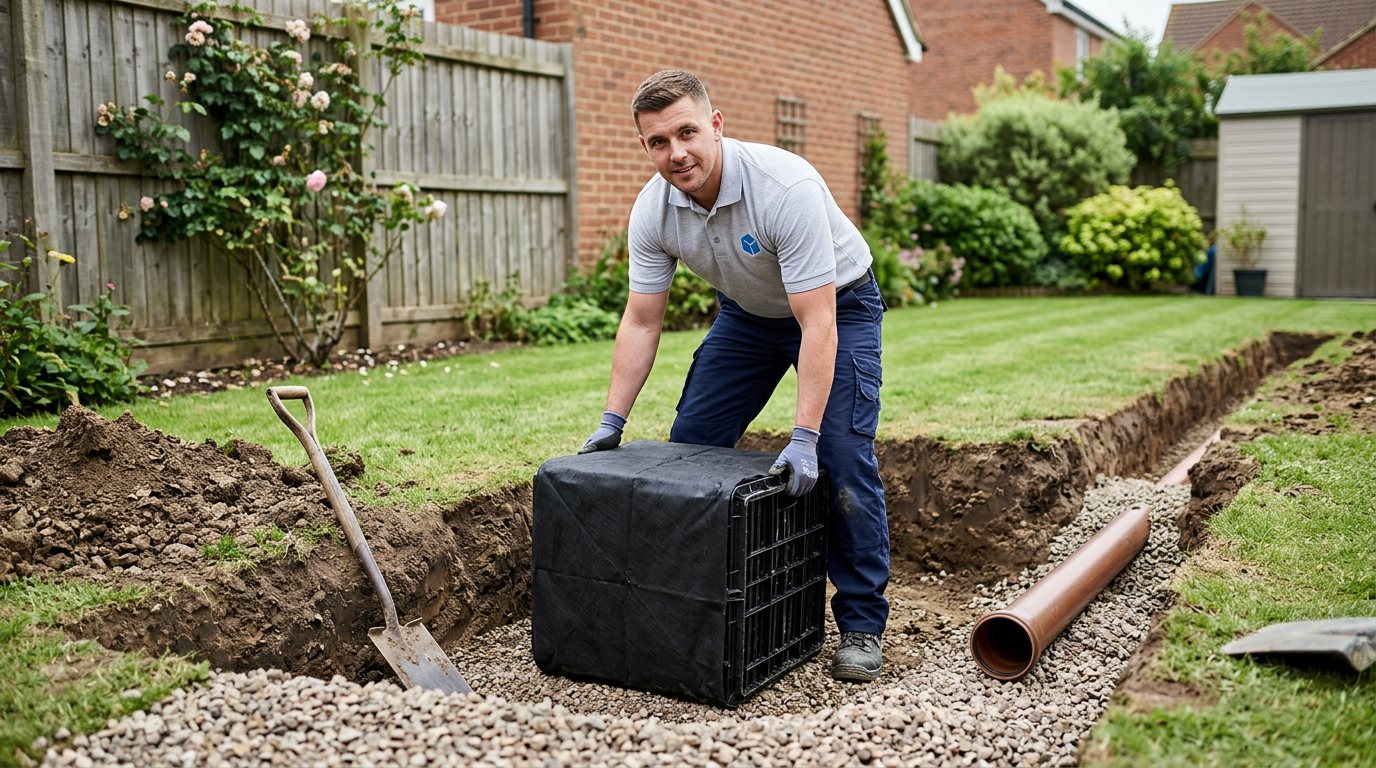
If the ground accepts water, just slowly, land drainage can carry water away faster than the soil would, using perforated pipes in gravel trenches to reach a working outfall — an existing drain, a ditch or lower ground. If the ground accepts almost nothing, a soakaway is the wrong tool and we will say so plainly: a chamber in impermeable ground just stands full. In that case the realistic options are surface improvements (breaking compaction, aeration, organic matter), redirecting water that is being added, land drainage to a genuinely working outfall, or a pumped solution where gravity has nowhere to take the water. Where water arrives from a highway, watercourse or neighbouring land, we help establish which section is whose responsibility — those sources sit beyond your boundary and no single-property fix covers them fully.
Honest limits
No drainage guarantees a dry garden. In extended wet weather even good ground saturates, and in impermeable ground the best achievable outcome is water moving off the surface quickly and the garden recovering faster — which is a real improvement, and worth designing properly for.
Booking
Book a visit and tell us how the ground behaves: how long puddles last, whether some spots are worse, and any digging or building history in the garden. The assessment sits within the standard visit; any drainage installation is a quoted project surveyed and approved before work starts, and groundworks are scheduled sensibly around weather.
A note on what the test feels like: it is unhurried. Filled trial holes may need watching for an hour or returning to the next day, and in clay the answer can take a full day to become clear. That patience is the point — a rushed reading overstates infiltration and leads to undersized or inappropriate systems. We do the test properly, discuss the numbers with you, and only then talk about what to build, if anything.
How the price works
We charge a booking fee to hold your slot, then an hourly rate for the work itself. The fee changes with how soon you need us; the hourly rate changes with the slot you choose. You approve the price before we start, so there is no surprise on the invoice.
Booked 14+ days ahead
£25 booking fee
then £85 per hour of labour
Best value. Book the slot now, pay the smallest booking fee.
Booked within 48 hours
£100 booking fee
then £65 per hour of labour
For jobs that can wait a day or two but not a fortnight.
Same-day call-out
£220 booking fee
then £45 per hour of labour
Urgent problems: standing water, no heat, no power, leaks.
Book the slot
Choose the window that suits you and pay the booking fee. That holds your place in the diary.
We diagnose on site
The engineer confirms the cause and tells you what the job involves and how long it should take.
You approve, we work
Nothing goes ahead until you agree the price. Labour is then charged per hour at your slot rate.
When rain pools on the surface instead of soaking in, everything downstream suffers — gullies back up, soakaways stand full, the garden stays wet. Permeability is a property of your ground, and we test it properly rather than assume. Then we explain which solutions work in your soil and which are a waste of money, because that difference is real.
What our customers say about our drainage service
4.2 out of 5 from 5 reviews
Fast, tidy and friendly
Turned up in the window they promised, walked me through the options (turns out the part had to be sourced locally), then cracked on. Everything was tested before they left. No mess, no drama, no surprise on the bill.
Job: Standing Water in Shower Tray
Happy overall
Good job overall. Turned up about 15 minutes after the window started, but rang to say so, and the work itself was tidy and well explained. Price was as quoted.
Job: Partial Soil Stack Blockage
Fixed it, but took longer than expected
The problem is fixed, which is the main thing, and the engineer clearly knew what they were doing. It took a fair bit longer than the estimate on the phone and I had to ask twice for a breakdown of the hours.
Job: Surface Water Drain Maintenance
Book Poor Ground Permeability
Tell us what is happening and choose a slot. If you are not sure this is the right job, use the diagnosis panel — it narrows the problem down before you book.
- Booking fee confirmed up front
- Hourly labour, agreed before work starts
- Same-day slots for urgent problems



Questions people ask about poor ground permeability
Straight answers to the things customers ask most often before booking.
Is testing ground permeability something I can do myself?
A basic version is genuinely DIY: dig a small hole, fill it with water, and see how long it takes to drain — a few hours is good ground, days is poor. Interpreting the result, digging safely around services, and designing a system that works with your soil is not DIY. Tell us what you found and we will test properly from there.
How do you measure permeability and diagnose the cause?
We dig trial holes in several spots and time the drainage rate, examine the soil profile for clay, compaction and buried layers, and check levels, water sources and existing drainage. Before any digging we check for buried services — detectors help, but no scan guarantees what is below. The combination tells us why permeability is poor and what, if anything, will genuinely help.
Is a soakaway always the answer for poorly draining ground?
No — and this is the misunderstanding we most often correct. A soakaway relies on the surrounding ground accepting water. In ground that barely drinks, the chamber fills and stays full. If our testing shows very poor infiltration, we will recommend against a soakaway and set out the options that do work in your soil, rather than install something we know will disappoint.
What actually works in heavy clay ground?
Depending on the site: breaking compaction and improving the surface, land drainage (perforated pipes in gravel trenches) carrying water to a working outfall, redirecting roof or paved water that is being added, or a pumped solution where gravity has no route. Each is quoted after survey, and we are honest that clay ground sets a ceiling on results — no drainage guarantees a dry garden in extended wet weather.
How is the work priced?
You pay a booking fee when you book, and labour is charged hourly at a rate that depends on how quickly you need us. The full cost of any work is quoted and approved before we start, with parts and materials quoted separately. Drainage installation is a surveyed project, so pricing follows the proper assessment of your ground and the design that assessment supports.
Need poor ground permeability sorted in Shirley?
Book a slot in the diary and pay only the booking fee up front. We confirm the rest before we start.