
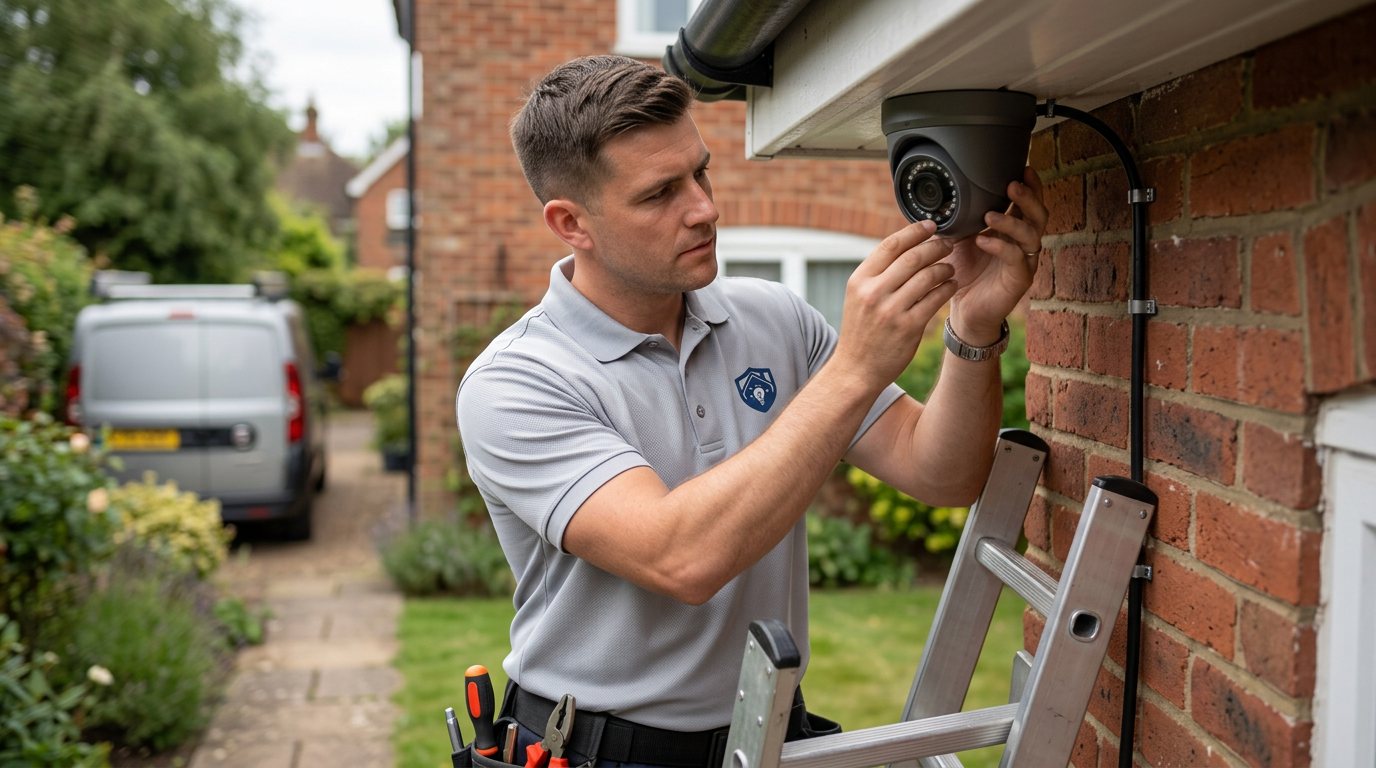
Cameras Pointing the Wrong Way? We'll Reposition Them With Care
We adjust camera angles, heights and coverage to match what you need to see — and respect neighbouring privacy.
Booking fee plus hourly labour — the price is confirmed before any work starts.
What this costs
| Booked 14+ days ahead | £25 booking fee £85 per hour |
|---|---|
| Booked within 48 hours | £100 booking fee £65 per hour |
| Same-day call-out | £220 booking fee £45 per hour |
The booking fee secures the visit. Labour is then charged by the hour, so you only pay for the time the job actually takes.
Booking fee £25–£220
£25 + £85/hr booked 14+ days ahead, £100 + £65/hr inside 48 hours, £220 + £45/hr same day. Agreed before we arrive.
Covered under CCTV Systems
Security & CCTV › CCTV Systems — one of 20 documented jobs in this section.
Same-day camera position adjustment
Urgent jobs can often be booked for today. Ask when you book and we will confirm the slot before you pay anything.
15 service areas
Birmingham, Coventry, Dorridge and 12 more across the West Midlands.
A camera that was right when it was installed can be wrong a year later, and a camera that was never quite right usually stayed that way because adjusting it is awkward — up a ladder, half-blind while looking at a phone screen, with nobody to check the picture while you hold the camera. Repositioning done properly is a small job with a disproportionate effect on how useful your system is.
When a camera needs repositioning
The reasons are varied. Coverage may not match your current concerns — an entrance that has become more important, a gate, a driveway, a side passage that was never covered well. The scene itself changes: trees and hedges grow into the frame, new buildings or parked vehicles block views, and boundaries shift. Image issues are common drivers too — a camera catching glare from a window or reflective surface, pointing too high so it films nothing but sky and guttering, too low so it only sees the ground, or too far away to identify anything useful at the distances that matter. And sometimes a camera is covering space it should not — reaching into a neighbour's property or over public space — and needs angling back onto your own boundary, which is worth doing both for consideration and because the owner is responsible for using recordings lawfully.
How we reposition properly
Adjusting a camera blind, from the top of a ladder, gets you roughly right at best. Our engineer works with the picture visible while positioning: we check the field of view at the recorder or on a screen, set the angle and height to cover what you actually want to see, and consider the practicalities — identification at distance versus detail up close, avoiding glare and backlighting, keeping the frame clear of future growth, and not filming beyond your property. We check night performance specifically, because infrared reach and reflections change with angle more than people expect. Where the camera is a varifocal or adjustable-focus model, we refocus at the new position rather than leaving it soft. Once positioned, we secure the bracket properly, reseal any wall penetration, and verify the camera still connects and records.
Coverage choices and neighbourly considerations
Repositioning is the natural moment to review what your cameras cover overall. Recordings are personal data and you, as the owner, are responsible for using them lawfully and considerately — cameras should cover your own property and avoid unnecessarily filming neighbours' homes, gardens or public space such as pavements and roads. If a camera is currently reaching beyond your boundary, we will help bring it back onto your own land and discuss what that means for the coverage you wanted. Footage should be retained for a sensible period and shared only appropriately, for example with the police if they request it. We adjust and configure equipment; we do not provide legal advice.
Aftercare
After repositioning, watch the new view across a few days and nights — a position that looks perfect at midday can glare at sunset or under headlights, and we would rather you told us and we made one small further tweak than you lived with it. Note that repositioned cameras sometimes need their recording zones redone, since motion detection areas are tied to the picture; we handle that during the visit.
When to call us
Book a visit when coverage no longer matches your needs, and tell us what you want each camera to show, whether any views are causing concern — yours or a neighbour's — and what the picture currently looks like. You pay a booking fee when you book, labour is charged hourly at a rate that depends on how soon you need the visit, and the full cost is quoted and approved before work starts, with any parts such as longer brackets quoted separately.
How the price works
We charge a booking fee to hold your slot, then an hourly rate for the work itself. The fee changes with how soon you need us; the hourly rate changes with the slot you choose. You approve the price before we start, so there is no surprise on the invoice.
Booked 14+ days ahead
£25 booking fee
then £85 per hour of labour
Best value. Book the slot now, pay the smallest booking fee.
Booked within 48 hours
£100 booking fee
then £65 per hour of labour
For jobs that can wait a day or two but not a fortnight.
Same-day call-out
£220 booking fee
then £45 per hour of labour
Urgent problems: standing water, no heat, no power, leaks.
Book the slot
Choose the window that suits you and pay the booking fee. That holds your place in the diary.
We diagnose on site
The engineer confirms the cause and tells you what the job involves and how long it should take.
You approve, we work
Nothing goes ahead until you agree the price. Labour is then charged per hour at your slot rate.
Cameras drift out of purpose: trees grow, boundaries change, or the original position simply never quite showed what you wanted. Repositioning a camera is more than loosening a bracket — it is matching coverage to your actual needs while staying considerate of neighbours. Our engineer adjusts, refocuses and retests every camera we move.
What our customers say about our Security & CCTV service
5 out of 5 from 7 reviews
Would use again
Third time we have used Maintenance Men, and the same experience each time: agreed price, proper explanation, job done in one visit. The hourly rate is fair for the standard of work.
Job: CCTV Installation
Second time we have used them
I had put off sorting this for months because I expected a runaround. Quoted the booking fee plus hourly rate upfront, stuck to it, and actually found the underlying cause rather than just clearing the symptom. Worked neatly and hoovered up afterwards.
Job: Backup Battery Fault
Exactly what was quoted
What I appreciated was being told what was actually wrong before anyone started. Sorted in under 56 minutes and the invoice matched the quote to the penny.
Job: Alarm Repair Service
Book Camera Position Adjustment
Tell us what is happening and choose a slot. If you are not sure this is the right job, use the diagnosis panel — it narrows the problem down before you book.
- Booking fee confirmed up front
- Hourly labour, agreed before work starts
- Same-day slots for urgent problems




Questions people ask about camera position adjustment
Straight answers to the things customers ask most often before booking.
Could I adjust my camera angles myself?
A small nudge to a reachable camera is harmless, but most repositioning involves working at height, refocusing adjustable lenses and verifying the picture while positioning — effectively impossible to do alone and easy to do badly. It is also worth knowing that motion detection zones usually need redoing after a move.
What do you do during a repositioning visit?
We reposition each camera with the picture visible on a screen, set angle and height for the coverage you want, check for glare and obstruction, test night performance and infrared reach, refocus adjustable lenses, secure brackets and reseal fixings, and redo motion detection zones for the new view.
My camera covers part of my neighbour's garden — can you fix that?
Yes, and it is worth doing: cameras should cover your own property and avoid unnecessarily filming neighbours' homes or public space, because recordings are personal data and you as the owner are responsible for using them lawfully and considerately. We will re-angle it onto your own boundary and discuss what that means for your coverage.
Can a camera be moved to a completely different position?
Often yes, but it depends on the cabling reach, the mounting surface and whether the new position serves a useful view. Small moves are usually straightforward; relocating a camera across the property may mean extending cable runs, which we will assess and quote before any work starts.
How is the cost worked out?
You pay a booking fee when you book. Labour is charged hourly at a rate that depends on how soon you need the visit. The full cost is quoted and approved before work starts; parts are quoted separately.
Need camera position adjustment sorted?
Book a slot in the diary and pay only the booking fee up front. We confirm the rest before we start.