
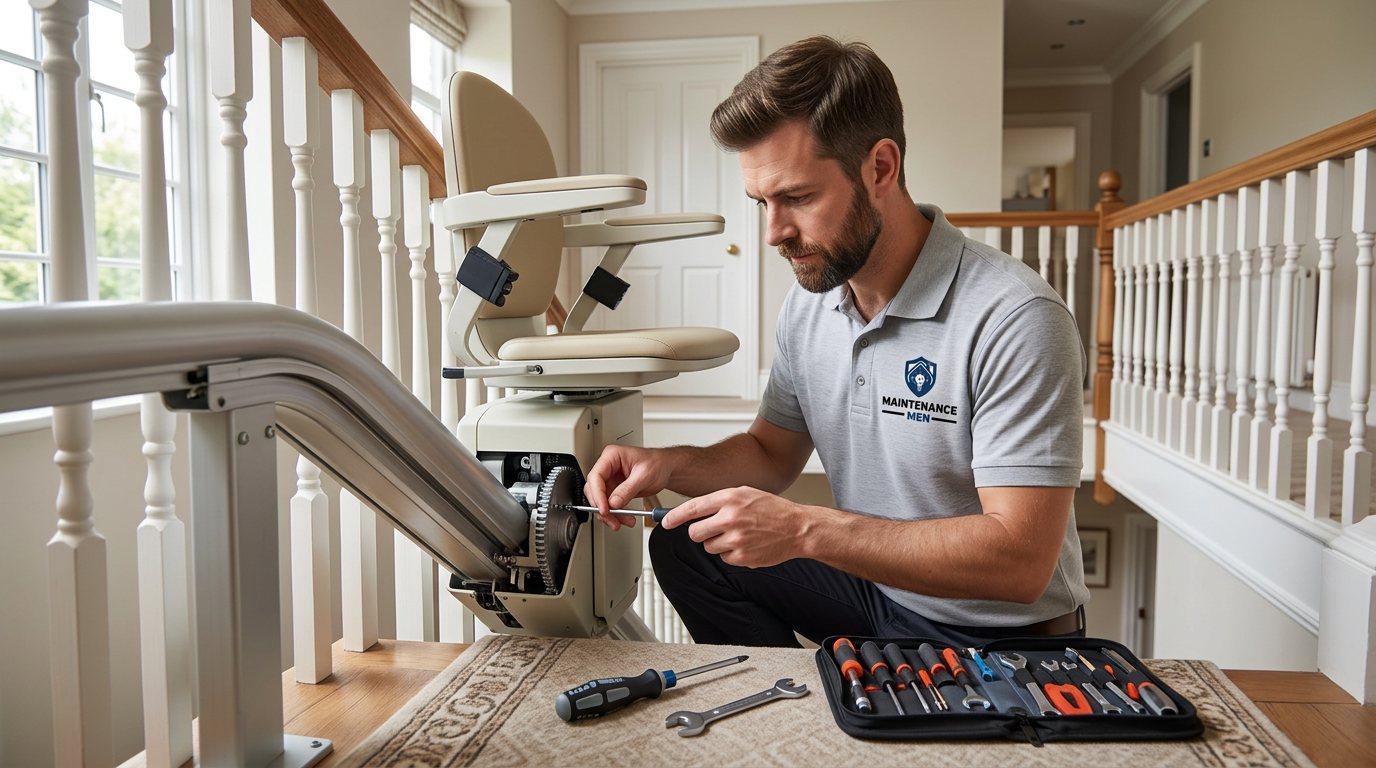
Stair Lift Safety Sensor Fault? Keep the Protection Working
We test every safety sensor on your lift, realign or replace what has failed, and quote the work for your approval first.
Booking fee plus hourly labour — the price is confirmed before any work starts.
What this costs
| Booked 14+ days ahead | £25 booking fee £85 per hour |
|---|---|
| Booked within 48 hours | £100 booking fee £65 per hour |
| Same-day call-out | £220 booking fee £45 per hour |
The booking fee secures the visit. Labour is then charged by the hour, so you only pay for the time the job actually takes.
Booking fee £25–£220
£25 + £85/hr booked 14+ days ahead, £100 + £65/hr inside 48 hours, £220 + £45/hr same day. Agreed before we arrive.
Covered under Stair Lifts
Mobility & Accessibility › Stair Lifts — one of 24 documented jobs in this section.
Same-day safety sensor fault
Urgent jobs can often be booked for today. Ask when you book and we will confirm the slot before you pay anything.
15 service areas
Birmingham, Coventry, Dorridge and 12 more across the West Midlands.
Every modern stair lift carries a set of safety sensors: the pressure-sensitive edges on the footplate that stop the lift if anything is in its path, the seat sensor that prevents travel when nobody is seated properly, the swivel and armrest interlocks, the footplate-up sensor, and limit sensors at the ends of the rail. Together they are the reason stair lifts are safe machines. When one of them faults, the lift's behaviour changes — and the fault needs proper attention, because safety systems are the one part of a lift you never want improvised.
How a sensor fault presents
A failing obstruction sensor usually shows as a lift that stops repeatedly at the same spot with nothing visible in the way, or one that will not start at all because it believes the footplate edge is pressed. A drifting seat or footplate sensor produces a lift that will not move even when everything is squared away properly. A failing limit sensor can stop the lift short of its park position — which then stops it charging, creating a second fault. Some lifts display a fault code pointing at the sensor circuit; others simply refuse to move and beep.
Why sensors fail
Mechanical knocks are the most common — a footplate edge that has been struck once too often by the vacuum cleaner, a dropped object, or a lift pushed by hand when it should not have been. Wear follows: sensor contacts and switches are mechanical items with finite lives. Dirt and moisture cause false readings — dust packed into a footplate edge, cleaning fluid seeping into a seat sensor. Wiring and connectors to the sensors age like any others. And occasionally a sensor fails within an otherwise healthy lift, as any component eventually can.
What you can and cannot do
You can keep the sensors clean and the areas around them clear, check the footplate edges are free of packed debris, and confirm the seat, armrests and footplate are fully locked in position before each journey. If your manual describes a sensor reset, following it exactly is reasonable. What you must not do is bypass, tape over, adjust or disable a sensor — not to get the lift moving for one journey, not ever. A bypassed safety system is a lift that will run into an obstruction or travel with an unsecured seat. If a lift has been running with a suspected bypassed or failed sensor, stop using it and book a visit. And if it ever stops with someone aboard, keep them safe, comfortable and calm, call 999 if they are in pain or distress, and use a manual release only strictly per the manufacturer's instructions by a confident person — never climb under, push or force a suspended lift.
How we test and repair sensors
We test each sensor individually: footplate edges under gentle pressure at several points, seat presence and interlock sensors through their full ranges, and limit switches at both rail ends. We inspect their wiring and connectors, clean contact surfaces with the correct materials, and realign sensors that have drifted. Where a sensor has genuinely failed we replace it with manufacturer-approved parts. Then we prove the repair with full travel cycles including deliberate, controlled sensor tests — the lift must demonstrate its protection is back, not merely move. Everything is quoted in full for your approval before work starts, parts quoted separately.
Aftercare
Treat the footplate edges gently — they are sensors, not bumpers — keep cleaning fluids away from seat and panel sensors, and report any change in how the lift stops or refuses to start. An annual service includes full sensor testing and is the best way to catch drift before it strands you.
Booking
Contact us with the make and model and a description of what the lift does and when. You pay a booking fee when you book, the hourly labour rate depends on how soon you need us, and the full cost is quoted and approved before work begins, with parts quoted separately.
How the price works
We charge a booking fee to hold your slot, then an hourly rate for the work itself. The fee changes with how soon you need us; the hourly rate changes with the slot you choose. You approve the price before we start, so there is no surprise on the invoice.
Booked 14+ days ahead
£25 booking fee
then £85 per hour of labour
Best value. Book the slot now, pay the smallest booking fee.
Booked within 48 hours
£100 booking fee
then £65 per hour of labour
For jobs that can wait a day or two but not a fortnight.
Same-day call-out
£220 booking fee
then £45 per hour of labour
Urgent problems: standing water, no heat, no power, leaks.
Book the slot
Choose the window that suits you and pay the booking fee. That holds your place in the diary.
We diagnose on site
The engineer confirms the cause and tells you what the job involves and how long it should take.
You approve, we work
Nothing goes ahead until you agree the price. Labour is then charged per hour at your slot rate.
Safety sensors are the quiet guardians of a stair lift — they stop it for obstructions, monitor the seat and footplate, and hold everything together mid-journey. When one misreads or fails, the lift either refuses to run or, worse, runs without full protection. Our visit puts that protection back.
What our customers say about our mobility & accessibility service
4.5 out of 5 from 8 reviews
Proper job, no upselling
Turned up in the window they promised, walked me through the options (turns out the old fitting was seized and needed careful removal), then cracked on. Everything was tested before they left. No mess, no drama, no surprise on the bill.
Job: Loose or Faulty Brakes
Fine in the end
The problem is fixed, which is the main thing, and the engineer clearly knew what they were doing. It took a fair bit longer than the estimate on the phone and I had to ask twice for a breakdown of the hours.
Job: Stair Lift Service
Would use again
What I appreciated was being told what was actually wrong before anyone started. Sorted in under 70 minutes and the invoice matched the quote to the penny.
Job: Control Panel Fault
Book Safety Sensor Fault
Tell us what is happening and choose a slot. If you are not sure this is the right job, use the diagnosis panel — it narrows the problem down before you book.
- Booking fee confirmed up front
- Hourly labour, agreed before work starts
- Same-day slots for urgent problems



Questions people ask about safety sensor fault
Straight answers to the things customers ask most often before booking.
Can a sensor be bypassed just for one journey?
No. Bypassing or disabling any safety sensor is exactly what we and every manufacturer warn against — the sensors are what stop the lift for obstructions and prevent travel with an unsecured seat. If the lift will not run because of a sensor, book a repair rather than working around it.
What sensors do you test on a visit?
The footplate obstruction edges, the seat presence sensor, the swivel and armrest interlocks, the footplate position sensor and the rail limit switches — each tested through its full range, with wiring and connectors inspected and any faulty sensor replaced using manufacturer-approved parts. We then prove the repair with full travel cycles.
My lift stops at the same spot with nothing there — is that the sensor?
Very likely, yes — a footplate edge sensor that has been knocked or packed with debris can read an obstruction that is not visible, or a limit sensor may be drifting. Clean the visible areas first, and if the stops continue, book us in. Do not keep resetting the lift and hoping it clears.
Is a sensor fault dangerous to keep using?
A lift with a failed sensor may refuse to run, which is inconvenient, or may run with reduced protection, which is genuinely unsafe. Stop using it until it is checked. If it stops with someone aboard, keep them safe and comfortable, call 999 if they are in distress, and use manual release only strictly per the manufacturer's instructions.
How is the repair charged?
You pay a booking fee when you book, and labour is charged hourly at a rate that depends on how soon you need the visit. After diagnosis we quote the full cost of the work for your approval before starting, and the sensor parts themselves are quoted separately.
Need safety sensor fault sorted?
Book a slot in the diary and pay only the booking fee up front. We confirm the rest before we start.