
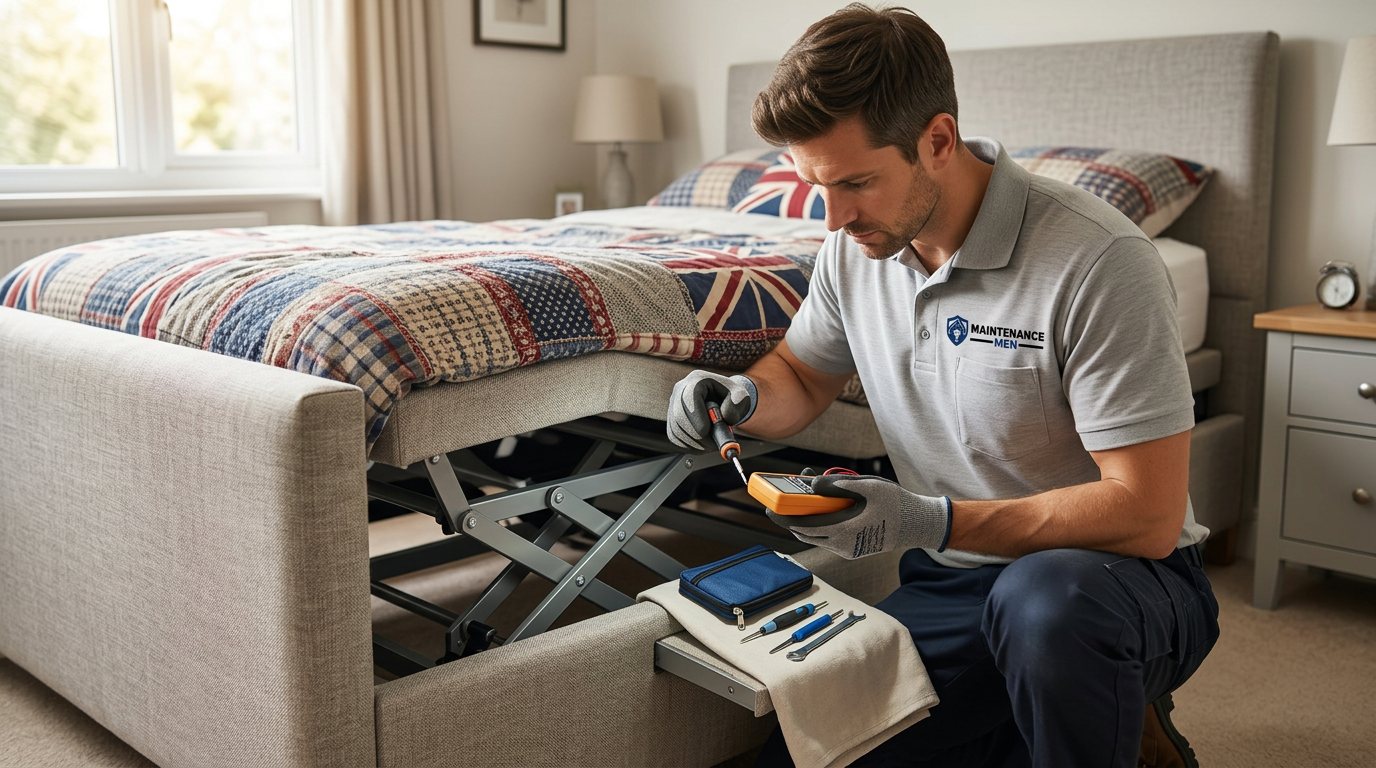
Stuck Mid-Position? We'll Free Your Adjustable Furniture Safely in Leamington Spa
We establish why the mechanism has halted — obstruction, limit switch, control fault or motor brake — and get the furniture moving again without forcing the frame or mechanism.
Booking fee plus hourly labour — the price is confirmed before any work starts.
What this costs
| Booked 14+ days ahead | £25 booking fee £85 per hour |
|---|---|
| Booked within 48 hours | £100 booking fee £65 per hour |
| Same-day call-out | £220 booking fee £45 per hour |
The booking fee secures the visit. Labour is then charged by the hour, so you only pay for the time the job actually takes.
Booking fee £25–£220
£25 + £85/hr booked 14+ days ahead, £100 + £65/hr inside 48 hours, £220 + £45/hr same day. Agreed before we arrive.
Covered under Electric Adjustable Furniture
Mobility & Accessibility › Electric Adjustable Furniture — one of 17 documented jobs in this section.
Same-day furniture stuck in position
Urgent jobs can often be booked for today. Ask when you book and we will confirm the slot before you pay anything.
15 service areas
Birmingham, Coventry, Dorridge and 12 more across the West Midlands.
A mechanism that stops dead mid-travel is telling you something. Either it has met resistance it is designed to refuse, or a component that controls its end points has lost track of where it is. Forcing it — by pushing the frame, holding a button through a stall, or levering the mechanism — is the fastest way to turn a modest repair into a bent linkage and two failed motors.
Getting the Person Safe First
If someone is on the furniture, help them off or into a comfortable position before anything else. A rise chair stuck partway can usually be left in position while a person stands; a bed stuck with the head raised can be slept in for a night, though it is not ideal. If the person cannot be moved and is in pain or distressed, call 999 — do not try to lower them yourself by forcing the mechanism.
Manual release or emergency lowering exists on some equipment, usually a lever, a hex key point or a battery pack, and it must only ever be used exactly as the manufacturer's instructions describe. It is not a universal feature and it is not a workaround for a jammed mechanism. If you are not certain, wait for us.
Why Mechanisms Stall
The common causes fall into five groups:
- An obstruction. Bedding, a trailing cushion, a phone charger, a pet toy or a piece of clothing caught in the linkage will stop the mechanism. Many control boxes sense the extra current and cut out rather than crush it.
- A limit switch or position sensor. These tell the control box when to stop. A failed switch, a dislodged magnet or a dirty sensor can leave the system believing it has reached the end of travel when it has not.
- Lost synchronisation. On beds with two actuators, the pair must move together. If one runs ahead, the control box may halt both to protect the frame.
- The motor brake. Actuators hold position with a brake. A brake that fails to release will lock the furniture solid even though the motor tries to run.
- A control box latch. After an overload, thermal trip or error code, some systems stay locked until reset in a specific sequence.
How We Approach a Stuck Mechanism
We start by isolating the power and looking, with a torch, at what the mechanism is doing — where it has stopped, whether the two sides are level, whether anything is trapped. Nothing goes into the gap while the furniture is powered. From there we test the handset inputs, check whether the control box is receiving a signal and whether it is refusing to act, and inspect the limit switches and actuator plugs.
Freeing a genuine jam is often straightforward once the obstruction is removed, but the mechanism must then be checked for bent pins, distorted linkages and strained mountings, because a stall puts load through parts that were never meant to take it. A frame that has twisted will keep jamming until it is straightened or replaced.
What We Repair, and What We Replace
We replace actuators, handsets, control boxes and position switches as complete units, and we can straighten or replace bent linkage components where the manufacturer supplies them. We do not cut, weld or re-machine load-bearing parts, and we do not dismantle a sealed actuator to free a seized brake — that unit is replaced.
Where the underlying problem is a worn or distorted frame, we will tell you plainly, because there is a point at which repair costs more than it is worth and the honest answer is a new base or chair.
Avoiding a Repeat
Once it is moving again, keep the floor and the frame clear, and route cables so they cannot be drawn into the mechanism. Do not use the furniture as storage. Operate it through its full travel occasionally so the mechanism does not sit in one position for months, and stop pressing the button the moment it sounds laboured — that noise is the system telling you it is working too hard.
Booking the Visit
Tell us the make and model if you can find it, whether the furniture is stuck with or without anyone on it, and whether you have already tried a manual release. That information decides what we bring and whether we need two people. You pay a booking fee when you book, labour is charged hourly at a rate that depends on how soon you need us, and the full cost of the work is quoted and approved before we start.
How the price works
We charge a booking fee to hold your slot, then an hourly rate for the work itself. The fee changes with how soon you need us; the hourly rate changes with the slot you choose. You approve the price before we start, so there is no surprise on the invoice.
Booked 14+ days ahead
£25 booking fee
then £85 per hour of labour
Best value. Book the slot now, pay the smallest booking fee.
Booked within 48 hours
£100 booking fee
then £65 per hour of labour
For jobs that can wait a day or two but not a fortnight.
Same-day call-out
£220 booking fee
then £45 per hour of labour
Urgent problems: standing water, no heat, no power, leaks.
Book the slot
Choose the window that suits you and pay the booking fee. That holds your place in the diary.
We diagnose on site
The engineer confirms the cause and tells you what the job involves and how long it should take.
You approve, we work
Nothing goes ahead until you agree the price. Labour is then charged per hour at your slot rate.
Furniture that stops halfway is awkward at best and distressing at worst, particularly when a rise chair has left someone tilted forward or a bed has stopped with the head section up. Our first concern is always the person using it, not the machine. Once everyone is safe, we look at why the mechanism halted and whether it can be freed properly rather than bullied back into place.
What our customers say about our mobility & accessibility service
4.5 out of 5 from 8 reviews
Proper job, no upselling
Turned up in the window they promised, walked me through the options (turns out the old fitting was seized and needed careful removal), then cracked on. Everything was tested before they left. No mess, no drama, no surprise on the bill.
Job: Loose or Faulty Brakes
Fine in the end
The problem is fixed, which is the main thing, and the engineer clearly knew what they were doing. It took a fair bit longer than the estimate on the phone and I had to ask twice for a breakdown of the hours.
Job: Stair Lift Service
Would use again
What I appreciated was being told what was actually wrong before anyone started. Sorted in under 70 minutes and the invoice matched the quote to the penny.
Job: Control Panel Fault
Book Furniture Stuck in Position
Tell us what is happening and choose a slot. If you are not sure this is the right job, use the diagnosis panel — it narrows the problem down before you book.
- Booking fee confirmed up front
- Hourly labour, agreed before work starts
- Same-day slots for urgent problems




Questions people ask about furniture stuck in position
Straight answers to the things customers ask most often before booking.
Can I just push it back into position?
No. Pushing a stalled mechanism puts load through linkages and mountings that are not designed for it and often turns a small repair into a bent frame. Keep it switched off and leave it where it is until it has been looked at properly.
What will you check when you arrive?
We isolate the power, inspect the mechanism for anything trapped, check whether the two sides are level, then test the handset, control box, limit switches and actuator connections. Once it is freed we check for bent pins and strained mountings before running it through its full travel.
There is someone stuck on it right now — what do I do?
Help them off if you safely can, or make them comfortable. If they are in pain or distressed, call 999. Manual release or emergency lowering should only be used exactly as the manufacturer describes, by someone confident to do it. Never force the frame or climb underneath.
Why does it stop in the same place every time?
That pattern usually points to a limit switch or position sensor that has failed or shifted, or to lost synchronisation between two actuators, rather than a random jam. Mention it when you book because it narrows the diagnosis straight away.
What will the visit cost?
You pay a booking fee when you book, and the hourly labour rate depends on how soon you need the visit. After diagnosis we quote the full cost of the work and you approve it before we start. Parts are quoted separately, so you know the complete figure before anything is ordered.
Need furniture stuck in position sorted in Leamington Spa?
Book a slot in the diary and pay only the booking fee up front. We confirm the rest before we start.