
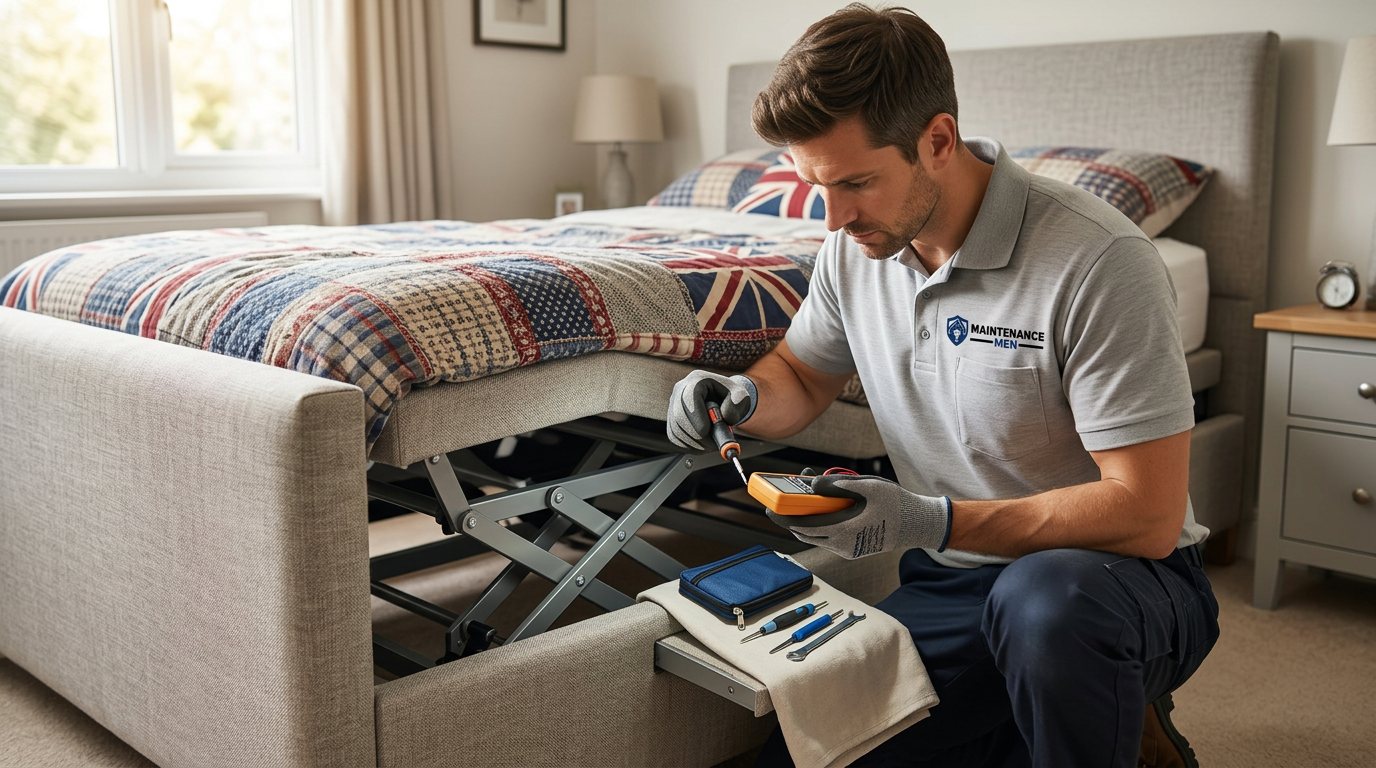
Slow, Jerky Movement? We'll Restore Smooth, Quiet Adjustment in Leamington Spa
We check the runners, linkage and actuators for binding and drag, and test whether the supply is delivering steady voltage, so the furniture moves evenly again instead of lurching.
Booking fee plus hourly labour — the price is confirmed before any work starts.
What this costs
| Booked 14+ days ahead | £25 booking fee £85 per hour |
|---|---|
| Booked within 48 hours | £100 booking fee £65 per hour |
| Same-day call-out | £220 booking fee £45 per hour |
The booking fee secures the visit. Labour is then charged by the hour, so you only pay for the time the job actually takes.
Booking fee £25–£220
£25 + £85/hr booked 14+ days ahead, £100 + £65/hr inside 48 hours, £220 + £45/hr same day. Agreed before we arrive.
Covered under Electric Adjustable Furniture
Mobility & Accessibility › Electric Adjustable Furniture — one of 17 documented jobs in this section.
Same-day slow or jerky movement
Urgent jobs can often be booked for today. Ask when you book and we will confirm the slot before you pay anything.
15 service areas
Birmingham, Coventry, Dorridge and 12 more across the West Midlands.
Adjustment should be unremarkable: press, move, stop. When it becomes slow, jerky or uneven, the mechanism is telling you that the effort required has gone up or the power arriving has gone down. Neither tends to correct itself, and both shorten the life of the most expensive parts in the furniture.
Recognising What You Are Seeing
It helps to separate three different behaviours. Slowness — the furniture moves but takes far longer than it used to — usually means friction, a failing motor or low voltage. Jerking — a series of lurches rather than a smooth glide — often means something is binding intermittently, or a linkage has worn oval and is catching. Stalling under load — moving fine until weight is applied, then stopping — points to a motor at the end of its life or a mechanism that is no longer aligned.
Note which sections are affected. A single section moving badly narrows things to that actuator and its runners. All sections moving badly suggests power, control or a frame that has twisted.
Common Causes
- Dry or contaminated runners. Bed sections run on rollers, glides or slides. Dust, pet hair and spilled drinks turn into a sticky paste that drags. So does the wrong lubricant, which attracts grit.
- Worn rollers and pivots. Nylon rollers flat-spot; pins wear oval; bushes crumble. The result is a rumble, then a lurch as the mechanism moves through the worn spot.
- A failing actuator. Motors lose torque before they lose function. A unit that is slow and warm to the touch is on its way out.
- Voltage drop. Long extension leads, shared sockets, a tired transformer or a poor connection all reduce the power reaching the motor, which then struggles to move a load it once handled easily.
- Overload. A heavy mattress topper, an extra cushion wedged behind a section, or furniture pushed hard against a wall can all add resistance.
- Frame distortion. A base that has been dragged rather than lifted can twist out of square, so the mechanism binds against itself.
What We Do About It
We begin by running the furniture through its travel, unloaded, and listening and watching rather than immediately reaching for tools. Then we isolate the power, inspect the runners and pivots for debris and wear, check that the frame sits square and that nothing is fouling, and test the supply under load with a meter to see whether voltage is holding.
Where the problem is friction, cleaning and correct lubrication often transforms the movement. Where rollers, glides or pins are worn, they are replaced — these are inexpensive parts and worth renewing before they damage the actuator. Where an actuator is losing torque, it is replaced as a unit against your manufacturer's specification. Where the cause is electrical — a tired transformer, a damaged lead, a loose connector — we repair or replace the affected part and check the supply is adequate for the furniture's rating.
What We Will Not Do
We do not open sealed actuators to re-grease a gearbox, and we do not fit motors of a different specification to "make it stronger". That changes the load the frame was designed for and is exactly the kind of alteration that leads to failures later. We do not lubricate with whatever is in the van: the wrong product attacks nylon and rubber and makes the problem worse within weeks, so we use what the manufacturer specifies.
Living With It in the Meantime
Use the furniture as little as you reasonably can until it is seen, and stop the movement the moment it labours rather than holding the button through it. Keep the runners free of hair and grit, and if you have a pet that sheds, a quick vacuum around the base every few weeks pays for itself. Do not add weight beyond what the manufacturer states, and lift the furniture rather than dragging it if it needs to move.
Getting It Looked At
Book with the make and model, a note of which section misbehaves and whether the problem is worse with someone on it. We will diagnose first and quote before any work, with the booking fee payable at booking and labour charged hourly at a rate that depends on how soon you need us.
How the price works
We charge a booking fee to hold your slot, then an hourly rate for the work itself. The fee changes with how soon you need us; the hourly rate changes with the slot you choose. You approve the price before we start, so there is no surprise on the invoice.
Booked 14+ days ahead
£25 booking fee
then £85 per hour of labour
Best value. Book the slot now, pay the smallest booking fee.
Booked within 48 hours
£100 booking fee
then £65 per hour of labour
For jobs that can wait a day or two but not a fortnight.
Same-day call-out
£220 booking fee
then £45 per hour of labour
Urgent problems: standing water, no heat, no power, leaks.
Book the slot
Choose the window that suits you and pay the booking fee. That holds your place in the diary.
We diagnose on site
The engineer confirms the cause and tells you what the job involves and how long it should take.
You approve, we work
Nothing goes ahead until you agree the price. Labour is then charged per hour at your slot rate.
A bed or recliner that stutters, lurches or crawls is doing more than annoying you — every uneven movement puts extra strain on the actuator, the linkage and the frame. It is usually a sign of friction where there should be none, or of a motor working against something it cannot overcome. Both are worth looking at before the part that is straining gives up entirely.
What our customers say about our mobility & accessibility service
4.5 out of 5 from 8 reviews
Proper job, no upselling
Turned up in the window they promised, walked me through the options (turns out the old fitting was seized and needed careful removal), then cracked on. Everything was tested before they left. No mess, no drama, no surprise on the bill.
Job: Loose or Faulty Brakes
Fine in the end
The problem is fixed, which is the main thing, and the engineer clearly knew what they were doing. It took a fair bit longer than the estimate on the phone and I had to ask twice for a breakdown of the hours.
Job: Stair Lift Service
Would use again
What I appreciated was being told what was actually wrong before anyone started. Sorted in under 70 minutes and the invoice matched the quote to the penny.
Job: Control Panel Fault
Book Slow or Jerky Movement
Tell us what is happening and choose a slot. If you are not sure this is the right job, use the diagnosis panel — it narrows the problem down before you book.
- Booking fee confirmed up front
- Hourly labour, agreed before work starts
- Same-day slots for urgent problems





Questions people ask about slow or jerky movement
Straight answers to the things customers ask most often before booking.
Can I lubricate the mechanism myself?
Only with the product the manufacturer specifies, and only on the points they identify. General-purpose sprays and thin oils attract dust and can attack nylon and rubber components, which makes the drag worse within weeks. If you are unsure what to use, leave it — cleaning and correct lubrication is part of what we do on the visit.
What causes jerky movement rather than simple slowness?
Jerking usually means intermittent binding — a flat-spotted roller, a worn pivot, a linkage catching on a frame edge — rather than steady friction. It can also come from a failing motor or an unstable supply. We watch the mechanism run unloaded before testing anything, because the pattern of the judder points to the cause.
Is it safe to keep using it while it is like this?
Use it as little as you can and stop the movement when it labours rather than holding the button through it. A mechanism that is binding is putting strain through the actuator and frame, and continuing to drive it is how a cheap repair becomes an expensive one. If it trips the electrics or smells hot, unplug it and stop using it.
Will you fit a stronger motor to cope with the weight?
No. Fitting a motor outside the manufacturer's specification changes the loads the frame and linkage were designed for and tends to cause failures elsewhere. If the existing unit is under-specified for how the furniture is used, we will say so honestly and discuss the realistic options rather than altering the machine.
How is the cost worked out?
You pay a booking fee when you book, and the hourly labour rate depends on how soon you need the visit. We diagnose the cause first, then quote the full cost of the work for your approval before starting. Any parts, such as rollers, glides or an actuator, are quoted separately.
Need slow or jerky movement sorted in Leamington Spa?
Book a slot in the diary and pay only the booking fee up front. We confirm the rest before we start.