
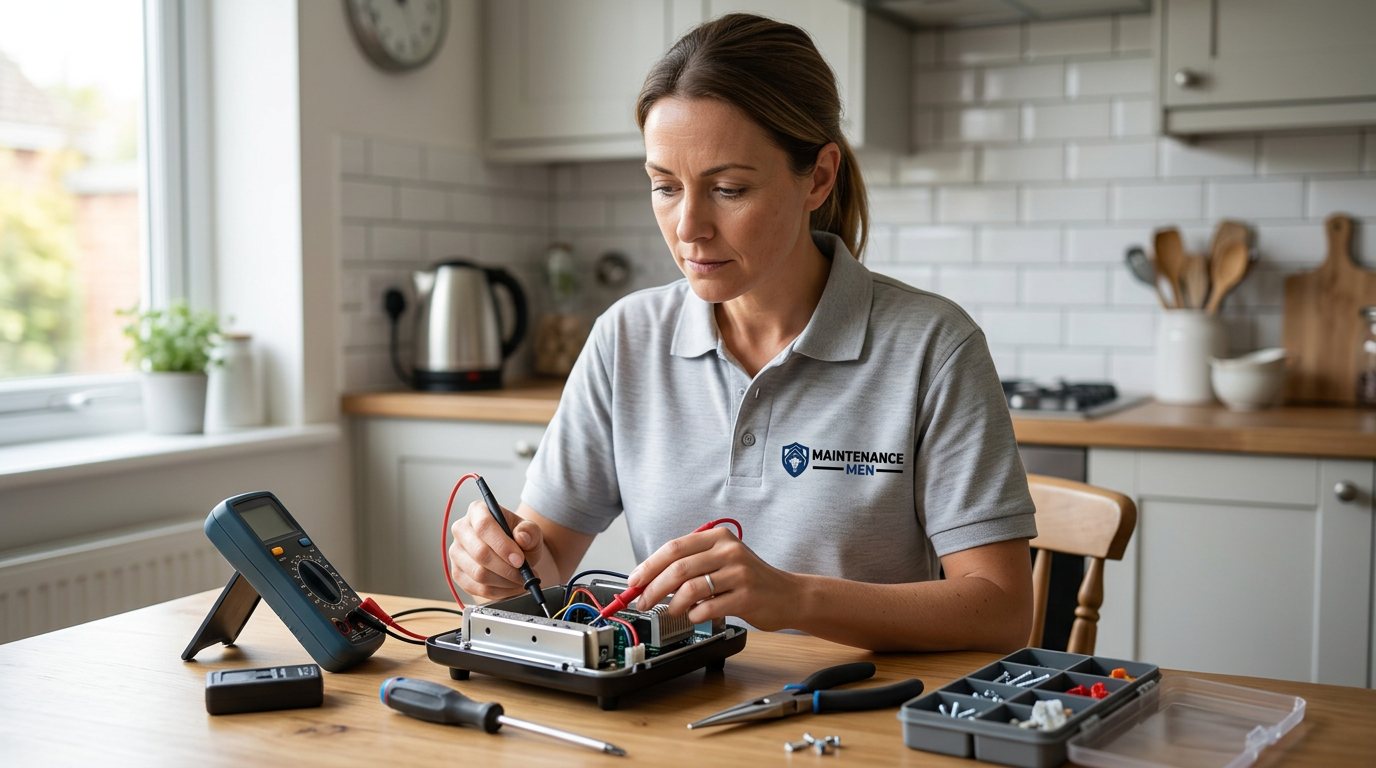
Motor not turning? We check brushes, capacitor and drive in Leamington Spa
We test the motor circuit from supply to shaft so a failed capacitor or worn brush is not mistaken for a dead motor.
Booking fee plus hourly labour — the price is confirmed before any work starts.
What this costs
| Booked 14+ days ahead | £25 booking fee £85 per hour |
|---|---|
| Booked within 48 hours | £100 booking fee £65 per hour |
| Same-day call-out | £220 booking fee £45 per hour |
The booking fee secures the visit. Labour is then charged by the hour, so you only pay for the time the job actually takes.
Booking fee £25–£220
£25 + £85/hr booked 14+ days ahead, £100 + £65/hr inside 48 hours, £220 + £45/hr same day. Agreed before we arrive.
Covered under Small Appliances
Home Appliances › Small Appliances — one of 20 documented jobs in this section.
Same-day motor not working
Urgent jobs can often be booked for today. Ask when you book and we will confirm the slot before you pay anything.
15 service areas
Birmingham, Coventry, Dorridge and 12 more across the West Midlands.
When a motor-driven appliance stops turning, the instinct is to assume the motor has died. In practice the motor itself is often sound, and the fault sits in something feeding it or something it drives. Brushes wear down to nothing, start or run capacitors lose their capacitance, drive belts slacken, couplings strip their teeth and bearings seize solid. Because these failures sound and behave differently, a short sequence of tests usually identifies the culprit without dismantling the motor.
The sounds a failing motor makes
A motor that hums but does not turn is receiving power but cannot start. That typically means a failed capacitor on a capacitor-start motor, a mechanical jam downstream, or a seized bearing. A motor that is completely silent suggests no supply at all — a switch, a thermal cut-out, a fuse or a broken wire. A motor that runs slowly and gets hot points to worn brushes, a failing winding or excessive mechanical drag. A rhythmic clicking or grinding usually comes from the drive: a stripped gear, a worn belt or a foreign object in the impeller. Listening properly before opening anything saves a lot of time.
What we test, in order
Supply first: is voltage reaching the motor when the appliance is switched on? Then the control path: switches, interlocks, thermal cut-outs and any speed control module. Then the motor circuit itself: brush length and condition on universal motors, capacitor capacitance on induction motors, winding resistance and insulation to earth. Finally the mechanical side: does the shaft turn freely by hand, is the belt intact, is the coupling engaged? That sequence separates electrical from mechanical failure conclusively, which is what determines whether a repair is even possible.
Brushes, capacitors and couplings
Carbon brushes are consumable and are designed to be replaced. When they wear short, contact becomes intermittent, the motor sparks heavily and eventually stops. Brushes are inexpensive and, on many appliances, accessible with the casing open. Start capacitors are also a common and modest failure: the motor hums, cannot generate starting torque, and a replacement capacitor restores normal running. Drive couplings and belts are mechanical consumables too. None of these is a motor replacement, and all of them are worth checking before anyone quotes for a new motor.
When the motor itself has failed
A motor with an open winding, a short to earth or a seized and corroded bearing that will not release is generally beyond economic repair on a domestic small appliance. Motors are often made specifically for a model, availability is limited, and the cost of the part plus labour can exceed a new appliance. We will say so directly rather than proposing a repair that does not stack up. Where a motor is replaceable and available, we identify it and quote the part separately so you can decide.
Safety and scope
Never run a motor-driven appliance with the casing open to "see what happens" — exposed terminals and a spinning shaft are both hazardous. Unplug before any inspection, and keep water away from motor housings; wet cleaning of a motor compartment causes exactly the earth faults that trip RCDs. Microwave motors and high-voltage sections stay sealed. Gas appliance components are outside our scope entirely.
What to tell us
Describe the sound and behaviour precisely: silent, humming, slow, sparking, grinding, or cutting out after a few minutes. Note whether it happens on all settings or only under load, and whether the appliance smells hot. Bring any removable parts — jug, blade assembly, floor head, hose — so the drive can be checked assembled.
Booking
Book online with the make, model and symptom. The booking fee is paid when you book, and the hourly labour rate depends on how soon you need the visit. The full cost is quoted and approved before work starts, and parts are identified and quoted separately after diagnosis.
How the price works
We charge a booking fee to hold your slot, then an hourly rate for the work itself. The fee changes with how soon you need us; the hourly rate changes with the slot you choose. You approve the price before we start, so there is no surprise on the invoice.
Booked 14+ days ahead
£25 booking fee
then £85 per hour of labour
Best value. Book the slot now, pay the smallest booking fee.
Booked within 48 hours
£100 booking fee
then £65 per hour of labour
For jobs that can wait a day or two but not a fortnight.
Same-day call-out
£220 booking fee
then £45 per hour of labour
Urgent problems: standing water, no heat, no power, leaks.
Book the slot
Choose the window that suits you and pay the booking fee. That holds your place in the diary.
We diagnose on site
The engineer confirms the cause and tells you what the job involves and how long it should take.
You approve, we work
Nothing goes ahead until you agree the price. Labour is then charged per hour at your slot rate.
A blender, vacuum, food processor or extractor that hums, stalls or stays silent usually has a motor circuit fault rather than a dead motor. Brushes wear, start capacitors fail, drive couplings strip and bearings seize, and each presents differently. We test the circuit in sequence and tell you whether the fix is a small part or a new machine.
What our customers say about our home appliances service
4.8 out of 5 from 14 reviews
Exactly what was quoted
What I appreciated was being told what was actually wrong before anyone started. Sorted in under 27 minutes and the invoice matched the quote to the penny.
Job: Tumble Dryer Not Starting Cycle
Good job, slightly late
Solid work. Hourly rate feels fair for the amount of work involved and everything was tested before they left. Would book again.
Job: Toaster Not Working
No mess left behind
Really straightforward. It had been bothering us for weeks; diagnosed properly, fixed the same visit, and the price was exactly what was explained when booking. Can not fault it.
Job: Microwave Button Repair
Book Motor Not Working
Tell us what is happening and choose a slot. If you are not sure this is the right job, use the diagnosis panel — it narrows the problem down before you book.
- Booking fee confirmed up front
- Hourly labour, agreed before work starts
- Same-day slots for urgent problems







Questions people ask about motor not working
Straight answers to the things customers ask most often before booking.
Can I check the brushes myself?
On some appliances the brushes are accessible behind a cover, but you need the appliance unplugged and the correct replacement parts. If the motor hums rather than runs, the capacitor is a more likely cause and needs proper testing.
How do you establish whether the motor has failed?
By testing supply to the motor, the control path, brush condition, winding resistance and insulation to earth, then checking that the shaft and drive turn freely. Only after those tests is a motor condemned. The machine is unplugged and cooled before any of this, and the fan or drive is checked by hand before power is applied.
Is it dangerous to use an appliance that sparks inside?
Yes. Sparking at the brushes or commutator can ignite dust and lint, and it usually means the motor is drawing excessive current. Stop using it and have it checked.
My appliance hums but the blades do not turn. Is the motor dead?
Not necessarily. A hum with no rotation commonly means a failed start capacitor or a jammed drive. Both are worth testing before anyone quotes for a motor.
What is the pricing structure?
The booking fee is paid when you book, and the hourly labour rate depends on how soon you need the visit. We quote the full cost and you approve it before work begins; parts are identified and priced separately.
Need motor not working sorted in Leamington Spa?
Book a slot in the diary and pay only the booking fee up front. We confirm the rest before we start.