
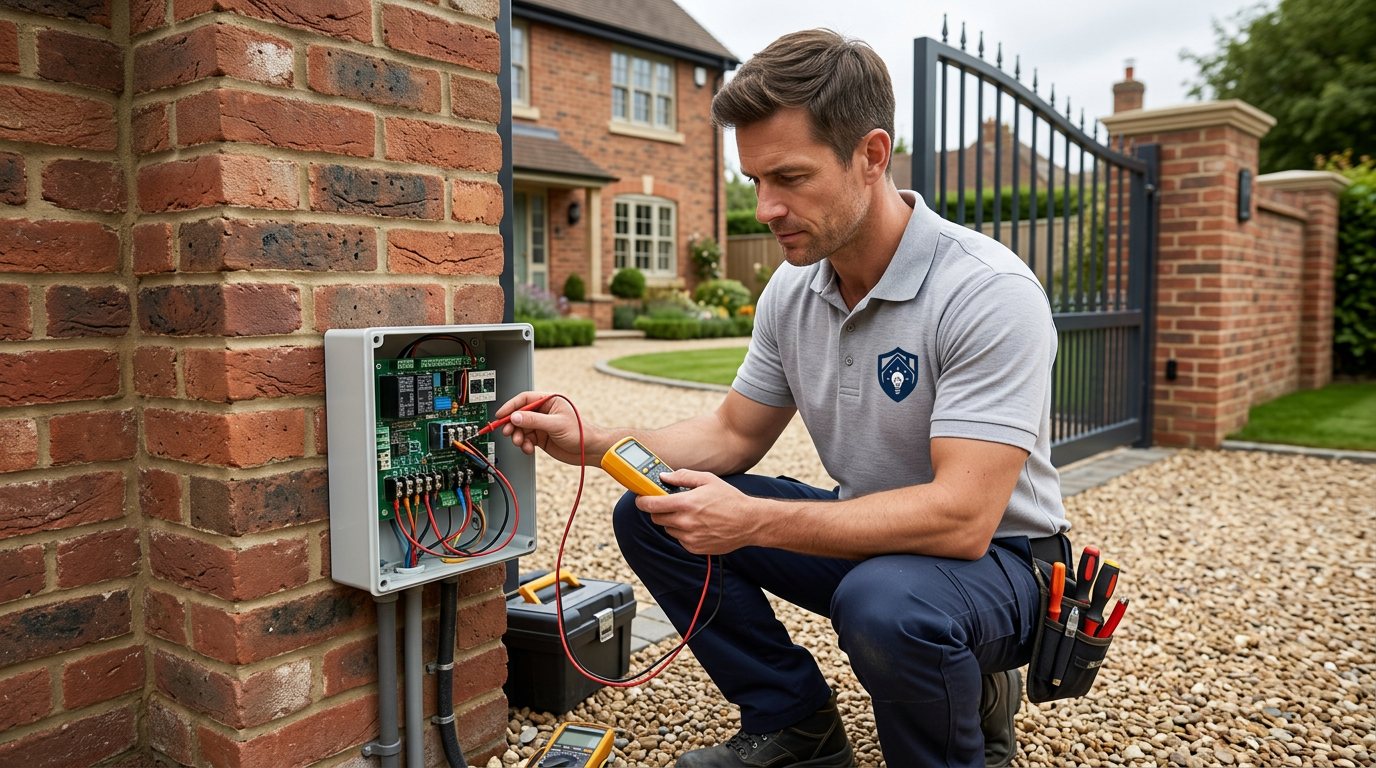
Sluggish Electric Gate? We'll Restore Smooth, Reliable Movement in Knowle
We measure how your gate is actually performing, find what is dragging it down, and quote the work that restores full speed.
Booking fee plus hourly labour — the price is confirmed before any work starts.
What this costs
| Booked 14+ days ahead | £25 booking fee £85 per hour |
|---|---|
| Booked within 48 hours | £100 booking fee £65 per hour |
| Same-day call-out | £220 booking fee £45 per hour |
The booking fee secures the visit. Labour is then charged by the hour, so you only pay for the time the job actually takes.
Booking fee £25–£220
£25 + £85/hr booked 14+ days ahead, £100 + £65/hr inside 48 hours, £220 + £45/hr same day. Agreed before we arrive.
Covered under Electric Gates
Security & CCTV › Electric Gates — one of 20 documented jobs in this section.
Same-day weak gate motor performance
Urgent jobs can often be booked for today. Ask when you book and we will confirm the slot before you pay anything.
15 service areas
Birmingham, Coventry, Dorridge and 12 more across the West Midlands.
A gate that moves slowly is easy to put up with — right up until the day it stops altogether. Weak performance rarely appears overnight. It builds: a little slower each month, a strained noise on frosty mornings, a stall halfway across the drive that recovers if you try again. That gradual decline is useful diagnostic information, because it usually points to progressive causes — friction, fatigue or a component fading — rather than one sudden breakage.
What Makes a Gate Weak and Slow
Mechanical resistance is the most common cause. Gate hinges that have dried out or worn, sliding tracks clogged with grit or rusted, rams and arms with worn bushes, and gates that have dropped on their posts so they scrape all make a motor work far harder than it was designed to. On the electrical side, a fading start capacitor robs the motor of its get-up-and-go, tired battery backups sag under load, low supply voltage weakens everything, and corroded connections throttle the current. Force and speed settings that have drifted or been reduced can also make a healthy gate look feeble.
Why Weakness Matters Beyond Annoyance
A motor that continually strains against resistance runs hot, and heat is what kills gate motors. Left alone, weak performance becomes thermal cutouts tripping mid-cycle, then a dead motor. There is a safety angle too: we assess weak gates with their safety devices firmly in mind, because force limits exist to make a straining gate stop rather than barge through. Those limits must never be turned up to mask a mechanical problem — the right answer is to remove the resistance, not to overpower it.
How We Assess Performance
We time the gate's travel and compare it with the manufacturer's specification, watch and listen through full cycles, and check current draw where the operator allows. We work through the mechanics by hand — hinges, rams, racks, tracks and posts — to find where resistance lives, then test the electrical side: supply voltage under load, capacitor condition, battery backup health and connection quality. Finally we review the control settings, because a system that someone has quietly detuned months ago behaves exactly like a failing one.
Repair Options, Honest and Practical
Freeing the mechanics is often the biggest single win: cleaning and lubricating hinges and tracks, replacing worn bushes, realigning a gate that has dropped, clearing rust and grit. Electrical fixes include replacing a failing capacitor, renewing battery backups, remaking corroded connections and restoring correct settings. Where the motor itself is genuinely worn out, we say so plainly and quote a replacement operator matched to your gates, with parts quoted separately and fitted only after your approval.
What DIY Can and Cannot Do
You can safely keep a sliding track clear of leaves and grit, and visual checks of hinges cost nothing. Lubrication itself needs some care — the wrong product on the wrong component attracts grit and makes things worse — so it is worth asking us to show you what your specific system needs at a service. What is never DIY is adjusting force settings, opening the operator, or working on wiring and capacitors. And at no point should safety edges, photocells or force limits be disabled or bypassed to make a weak gate feel stronger; that removes the protection that stops a heavy gate striking a person.
Aftercare That Prevents a Repeat
Once the gate is moving properly again, we confirm the force settings and safety devices with a proper obstruction test, and we will flag anything mechanical that is on its way out — a hinge with visible wear, a track with a worn patch — so you can plan rather than be surprised. A periodic service suits most households, especially if gates are large, exposed to weather or used many times a day.
When to Call Us
Book a visit when slowness or stalling is noticeable and repeatable, when the motor sounds strained, or when the gate needs several attempts to complete a cycle. Do not wait for a complete stop on a morning you are already late. Tell us the make and model, when the decline started, and whether it is worse in cold or wet weather — those details speed up the diagnosis.
Booking Your Visit
You pay a booking fee when you book, and labour is charged hourly at a rate that depends on how soon you need the visit. The full cost of the work is quoted and approved before we start, with any parts quoted separately. Same-day visits may be available depending on schedule. Book by phone or on our website.
How the price works
We charge a booking fee to hold your slot, then an hourly rate for the work itself. The fee changes with how soon you need us; the hourly rate changes with the slot you choose. You approve the price before we start, so there is no surprise on the invoice.
Booked 14+ days ahead
£25 booking fee
then £85 per hour of labour
Best value. Book the slot now, pay the smallest booking fee.
Booked within 48 hours
£100 booking fee
then £65 per hour of labour
For jobs that can wait a day or two but not a fortnight.
Same-day call-out
£220 booking fee
then £45 per hour of labour
Urgent problems: standing water, no heat, no power, leaks.
Book the slot
Choose the window that suits you and pay the booking fee. That holds your place in the diary.
We diagnose on site
The engineer confirms the cause and tells you what the job involves and how long it should take.
You approve, we work
Nothing goes ahead until you agree the price. Labour is then charged per hour at your slot rate.
A gate that used to sweep open in seconds and now grinds across the drive slowly, or stalls on cold mornings, is telling you something is wearing out or fighting resistance. Our visit measures the real condition of the motor, mechanics and supply so the fix is aimed at the true cause.
What our customers say about our Security & CCTV service
5 out of 5 from 7 reviews
Would use again
Third time we have used Maintenance Men, and the same experience each time: agreed price, proper explanation, job done in one visit. The hourly rate is fair for the standard of work.
Job: CCTV Installation
Second time we have used them
I had put off sorting this for months because I expected a runaround. Quoted the booking fee plus hourly rate upfront, stuck to it, and actually found the underlying cause rather than just clearing the symptom. Worked neatly and hoovered up afterwards.
Job: Backup Battery Fault
Exactly what was quoted
What I appreciated was being told what was actually wrong before anyone started. Sorted in under 56 minutes and the invoice matched the quote to the penny.
Job: Alarm Repair Service
Book Weak Gate Motor Performance
Tell us what is happening and choose a slot. If you are not sure this is the right job, use the diagnosis panel — it narrows the problem down before you book.
- Booking fee confirmed up front
- Hourly labour, agreed before work starts
- Same-day slots for urgent problems






Questions people ask about weak gate motor performance
Straight answers to the things customers ask most often before booking.
Can I lubricate my gate myself?
Keeping a sliding track free of leaves and grit is sensible DIY, and it helps. Beyond that, lubrication is easy to get wrong — the wrong product attracts grit or damages seals — so it is safest done at a service where the right product is used for your hinges, rams or rack. Never adjust force settings or dismantle anything yourself.
What causes a gate to become slow?
The usual causes are mechanical resistance from dry or worn hinges, clogged tracks and gates that have dropped on their posts, plus electrical fade from a failing capacitor, tired battery backup or poor connections. Drifted force and speed settings can also mimic a weak motor. The assessment identifies which combination applies to your gate.
Is a slow gate dangerous?
It is a warning sign rather than an immediate danger, but it matters. A straining motor runs hot and can trip its thermal protection or eventually fail, and a gate fighting resistance is exactly the situation force limits and safety edges exist for. Those protections must never be disabled or bypassed — the correct fix is removing the resistance.
Will you just turn the force up so it moves faster?
No. Increasing force to overpower mechanical resistance makes the gate dangerous and is exactly how gates end up striking people and cars. We find and remove the resistance instead, then set force and speed to the manufacturer's specification so the gate moves properly and still reverses safely on an obstruction.
How much does the visit and repair cost?
You pay a booking fee when you book. Labour is charged hourly at a rate that depends on how soon you need us, and the full cost is quoted and approved before any work begins. Parts such as capacitors, batteries or bushes are quoted separately, so you always know what you are approving.
Need weak gate motor performance sorted in Knowle?
Book a slot in the diary and pay only the booking fee up front. We confirm the rest before we start.