
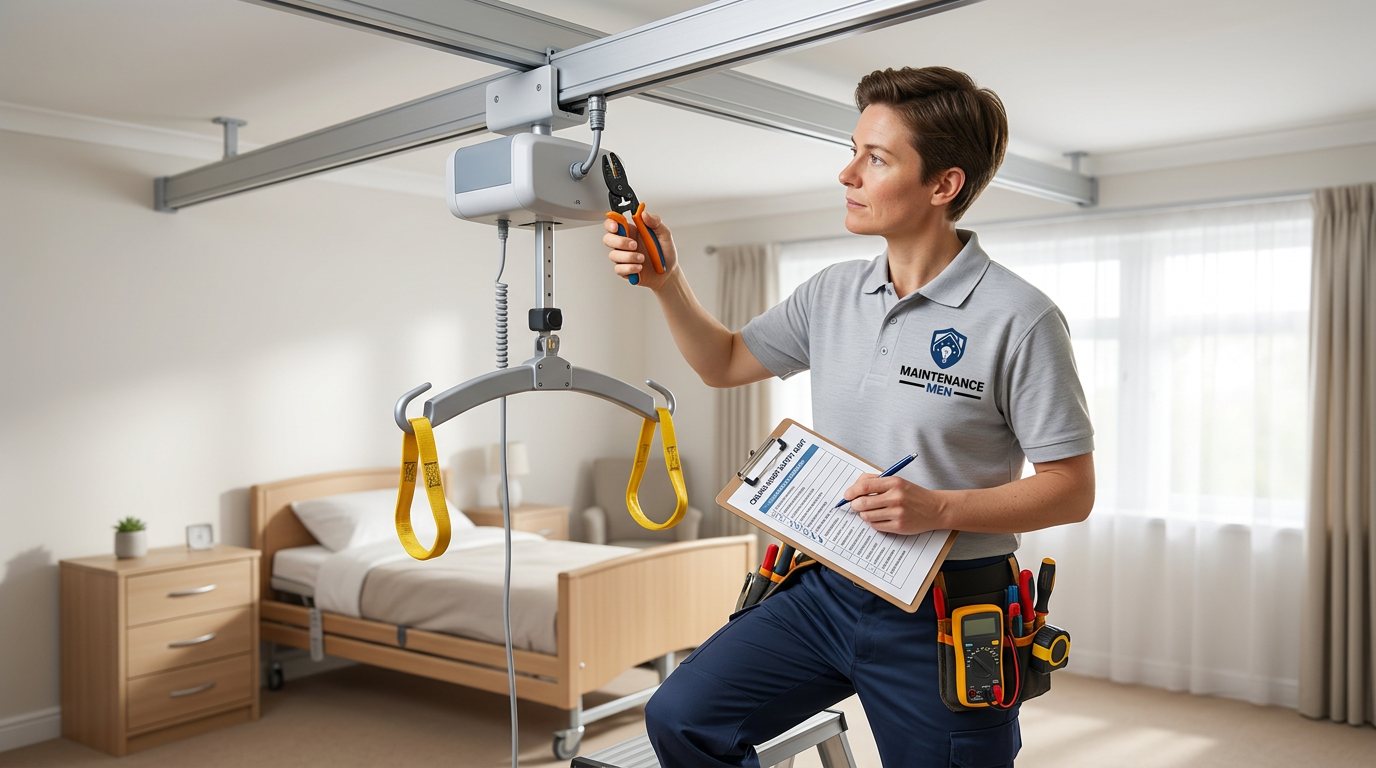
Wireless Handset Not Responding? We'll Restore the Link to Your Hoist in Knowle
We check the remote's batteries, pairing and signal path, test the receiver in the control box, and confirm every function works before we leave.
Booking fee plus hourly labour — the price is confirmed before any work starts.
What this costs
| Booked 14+ days ahead | £25 booking fee £85 per hour |
|---|---|
| Booked within 48 hours | £100 booking fee £65 per hour |
| Same-day call-out | £220 booking fee £45 per hour |
The booking fee secures the visit. Labour is then charged by the hour, so you only pay for the time the job actually takes.
Booking fee £25–£220
£25 + £85/hr booked 14+ days ahead, £100 + £65/hr inside 48 hours, £220 + £45/hr same day. Agreed before we arrive.
Covered under Hoists & Lifting Equipment
Mobility & Accessibility › Hoists & Lifting Equipment — one of 22 documented jobs in this section.
Same-day hoist remote not working
Urgent jobs can often be booked for today. Ask when you book and we will confirm the slot before you pay anything.
15 service areas
Birmingham, Coventry, Dorridge and 12 more across the West Midlands.
Wireless remotes make a hoist much easier to use, and they add a few failure points that a wired handset does not have.
What Stops a Remote Working
- Handset batteries. The most common cause by a distance. A remote with a low battery may respond when you are close and not across the room, or respond only after several presses.
- Lost pairing. Many remotes must be paired to their receiver, and a battery change, a flat battery left in place, or a replacement handset can break that link.
- Infrared line of sight. If the remote is infrared rather than radio, it must be pointed at the receiver window, and a dusty window, a handset held at the wrong angle or something hanging in front of the sensor will stop it dead.
- The receiver. The receiving module inside the control box can fail, particularly where moisture has got in.
- Radio interference or range. Some units share channels with other equipment, and a neighbour's remote or a new device nearby can cause intermittent behaviour.
- A control box fault that presents as a remote problem, which is why we test the box as well as the handset.
- Physical damage — a dropped remote, a cracked casing, a button that no longer makes contact.
What You Can Check Before We Arrive
Replace the remote's batteries with the correct type and check the terminals are clean. Re-pair the handset following the manufacturer's instructions if your manual describes it. If it is infrared, clean the window on both the remote and the receiver with a dry cloth and try from directly in front at close range. Check that the hoist itself is powered and not locked out. Those four steps solve a good share of remote faults and cost nothing.
How We Diagnose It
We start by establishing whether the hoist responds to anything at all — a wired handset or a control box button, if the unit has one — because that tells us instantly whether the fault is the remote or the machine. We then test the remote's battery under load, re-pair it as the manufacturer specifies, check its transmission with the receiver, and inspect the receiver and its aerial or window. If the unit is infrared, we check alignment and cleanliness. We test every function afterwards, in both directions, from the distance the carer actually uses.
Repairs
Replacement batteries, a new handset, a re-pair, a replacement receiver module or a replacement control box are the realistic outcomes. We use manufacturer-approved parts and check availability rather than promising it. Where a remote has been discontinued, we will tell you what the manufacturer offers as a replacement and whether the receiver needs changing with it, so the cost is clear before you commit.
The Safety Point About Remotes
A remote that works intermittently is more dangerous than one that has failed, because it can start a lift and then not stop it. If the hoist keeps moving after you release the button, or responds unpredictably, stop using it. Never leave a wireless handset where a child or a visitor could press it, and do not use two remotes on one hoist unless the manufacturer supports it — conflicting commands are exactly the sort of thing that ends with someone suspended and a hoist that will not answer. And no remote, however good, replaces the emergency stop: check that still works.
If Someone Is Suspended and the Remote Is Dead
Keep them calm and comfortable. If they are in pain or in distress, call 999. Emergency lowering or manual release should only be used exactly as the manufacturer's instructions describe, by someone confident they can do it safely from a stable position — never by climbing under the load to reach a control.
Aftercare
We test the remote across the room, confirm the pairing survives a battery change, show you how to re-pair it if it happens again, and go through the warning signs of a failing remote battery. A spare set of the correct batteries in the drawer saves a lot of anxiety.
Booking
Tell us the make and model, whether the remote is infrared or radio, what it does when pressed, and whether the hoist responds to anything else. You pay a booking fee when you book, the hourly labour rate depends on how soon you need the visit, and the full cost is quoted and approved before work starts.
How the price works
We charge a booking fee to hold your slot, then an hourly rate for the work itself. The fee changes with how soon you need us; the hourly rate changes with the slot you choose. You approve the price before we start, so there is no surprise on the invoice.
Booked 14+ days ahead
£25 booking fee
then £85 per hour of labour
Best value. Book the slot now, pay the smallest booking fee.
Booked within 48 hours
£100 booking fee
then £65 per hour of labour
For jobs that can wait a day or two but not a fortnight.
Same-day call-out
£220 booking fee
then £45 per hour of labour
Urgent problems: standing water, no heat, no power, leaks.
Book the slot
Choose the window that suits you and pay the booking fee. That holds your place in the diary.
We diagnose on site
The engineer confirms the cause and tells you what the job involves and how long it should take.
You approve, we work
Nothing goes ahead until you agree the price. Labour is then charged per hour at your slot rate.
A wireless handset that stops talking to the hoist is usually one of three things: the remote has lost its pairing, its battery has gone flat, or the receiver has stopped listening. Those are quick to separate and often quick to fix, and none of them require replacing the hoist. What they do require is not guessing, because a remote that works only sometimes is a hazard.
What our customers say about our mobility & accessibility service
4.5 out of 5 from 8 reviews
Proper job, no upselling
Turned up in the window they promised, walked me through the options (turns out the old fitting was seized and needed careful removal), then cracked on. Everything was tested before they left. No mess, no drama, no surprise on the bill.
Job: Loose or Faulty Brakes
Fine in the end
The problem is fixed, which is the main thing, and the engineer clearly knew what they were doing. It took a fair bit longer than the estimate on the phone and I had to ask twice for a breakdown of the hours.
Job: Stair Lift Service
Would use again
What I appreciated was being told what was actually wrong before anyone started. Sorted in under 70 minutes and the invoice matched the quote to the penny.
Job: Control Panel Fault
Book Hoist Remote Not Working
Tell us what is happening and choose a slot. If you are not sure this is the right job, use the diagnosis panel — it narrows the problem down before you book.
- Booking fee confirmed up front
- Hourly labour, agreed before work starts
- Same-day slots for urgent problems




Questions people ask about hoist remote not working
Straight answers to the things customers ask most often before booking.
Can I re-pair the remote myself?
Often yes — many manufacturers publish a pairing sequence in the user manual, and following it exactly is the right thing to try, along with fresh batteries of the correct type. If the manual does not cover it, or the pairing will not hold, stop there rather than trying sequences you have found online for a different model.
What will you test?
We establish whether the hoist responds to any other control, then test the remote's battery under load, re-pair it per the manufacturer's procedure, check transmission to the receiver and inspect the receiver and its window or aerial. Afterwards we test every function in both directions from the distance you actually use it.
The remote works close up but not across the room. What does that mean?
Usually a battery that is nearly flat, or an infrared unit that is not being aimed at the receiver, or a receiver window that is dusty. On radio units it can be interference or a failing receiver. It is worth fixing rather than living with, because a remote that works only sometimes can stop a lift halfway.
Is it safe to keep using an intermittent remote?
No. The dangerous scenario is a lift that starts and then will not stop or will not respond, with someone suspended. Take the hoist out of service until the remote and receiver have been checked.
What will it cost?
You pay a booking fee when you book, and the hourly labour rate depends on how soon you need the visit. We quote the full cost of the work and you approve it before we start, with any parts such as a handset or receiver quoted separately.
Need hoist remote not working sorted in Knowle?
Book a slot in the diary and pay only the booking fee up front. We confirm the rest before we start.