
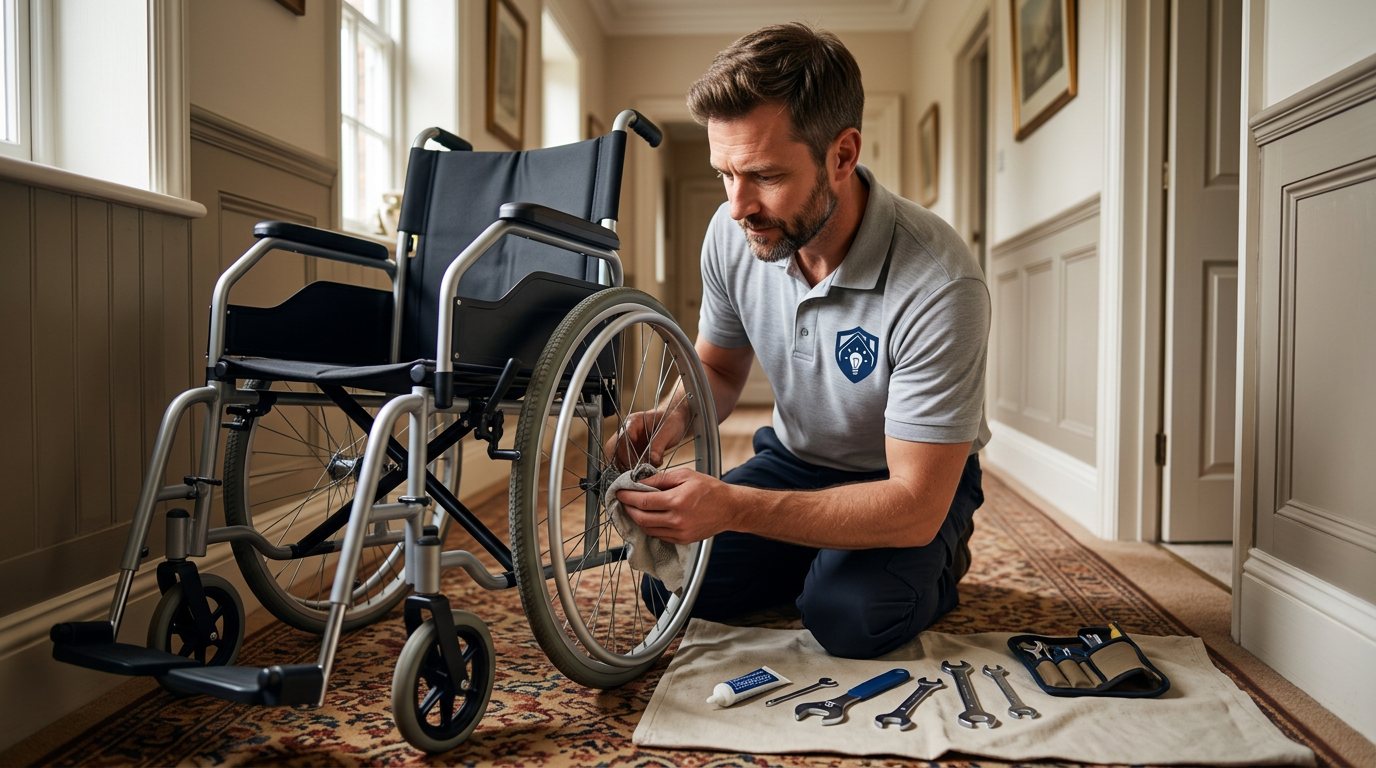
Loose Wheelchair Brakes Tightened and Properly Tested Under Load in Kenilworth
We adjust and secure slack wheelchair brakes, check why they loosened, and prove they hold under real load before we leave.
Booking fee plus hourly labour — the price is confirmed before any work starts.
What this costs
| Booked 14+ days ahead | £25 booking fee £85 per hour |
|---|---|
| Booked within 48 hours | £100 booking fee £65 per hour |
| Same-day call-out | £220 booking fee £45 per hour |
The booking fee secures the visit. Labour is then charged by the hour, so you only pay for the time the job actually takes.
Booking fee £25–£220
£25 + £85/hr booked 14+ days ahead, £100 + £65/hr inside 48 hours, £220 + £45/hr same day. Agreed before we arrive.
Covered under Wheelchairs & Accessories
Mobility & Accessibility › Wheelchairs & Accessories — one of 23 documented jobs in this section.
Same-day loose wheelchair brakes
Urgent jobs can often be booked for today. Ask when you book and we will confirm the slot before you pay anything.
15 service areas
Birmingham, Coventry, Dorridge and 12 more across the West Midlands.
Loose brakes creep up on wheelchair owners quietly. The lever still flips over, the chair still stops for gentle use, and it is only when someone transfers quickly, or the chair is parked on a slope, that the slack shows itself — the chair shifts an inch or two under load and gives everyone a fright. Because the mechanism rarely breaks suddenly, this is one of the most fixable brake problems there is, provided it is set up correctly rather than just squeezed tighter by hand. This page covers what makes brakes loosen, how we set them right, and how to keep them tight.
Why brakes work loose
The mechanisms that operate wheel locks are linked — levers, rods, pivots and pads — and daily use slowly takes up play in those linkages. Tyre wear contributes: as a tyre thins, its diameter changes, and the brake pad that used to bite firmly now sits a little wrong. Wheels that are removed and refitted — for transport, cleaning or tyre repairs — often come back sitting fractionally differently, shifting the pad's contact point. And simple vibration over months loosens nuts and pivots that were once snug.
On powered chairs, "loose brakes" usually means something else: the electromagnetic brakes inside the drive units are not engaging or releasing as they should, showing up as creep or drag. That is a different diagnosis, and we treat it as such rather than twisting a lever that has nothing behind it.
How we set brakes properly
We start by understanding why the brakes loosened, because tightening without finding the cause just resets the clock. We check the tyre condition and pressure first — a worn or soft tyre changes the brake's contact geometry. Then we inspect the lever, linkage, pivots and pads for wear, secure anything loose, and set the pad to bite correctly on the tyre at the right height and angle. If a pad or linkage component is worn beyond adjustment, we say so and quote a replacement with manufacturer-approved parts.
Then comes the part that matters: testing. A brake adjustment is not finished until it has been proved — the lock engaged, the chair loaded, and the brake asked to hold under realistic conditions. We would rather spend ten minutes proving the brakes than hand back a chair that passes the eyeball test and fails the transfer test.
What you can do yourself
If your manual describes adjusting the wheel locks, careful DIY adjustment is reasonable — the test is whether the locked brake firmly stops a loaded wheel, not whether the lever flips over. Check the locks whenever a wheel has been off, and whenever tyres are changed or noticeably worn. What we would not advise is bending or shimming mechanisms by eye without understanding the geometry; a brake that looks engaged but misses the tyre's crown is exactly how loose brakes become failed brakes.
When loose means more than loose
If the brakes will not hold even after adjustment, or if the linkage is bent, cracked or worn out, that is a replacement job rather than a tweak, and we will say so plainly. If the loosening keeps recurring, something is wearing that should not be — often the tyres or the wheel position — and we will find that rather than adjusting the same brake every few months. On powered chairs, any creep or drag is a drive-unit brake question, diagnosed through the controller and repaired as engineer work.
Aftercare
Build the brakes into your routine: every transfer, confirm the lock bites before weight goes onto the chair. After any wheel removal, re-check. As tyres wear, expect the contact point to shift and have the locks reset. Ten seconds of checking is cheaper than any fall.
Booking
Tell us the make and model, whether the chair is manual or powered, and what "loose" looks like — the lever flips but the chair still moves, the brakes slip on slopes, or the chair creeps when parked. You pay a booking fee when you book, labour is hourly at a rate depending on how soon you need us, and the full cost of the work is quoted and approved before we start.
How the price works
We charge a booking fee to hold your slot, then an hourly rate for the work itself. The fee changes with how soon you need us; the hourly rate changes with the slot you choose. You approve the price before we start, so there is no surprise on the invoice.
Booked 14+ days ahead
£25 booking fee
then £85 per hour of labour
Best value. Book the slot now, pay the smallest booking fee.
Booked within 48 hours
£100 booking fee
then £65 per hour of labour
For jobs that can wait a day or two but not a fortnight.
Same-day call-out
£220 booking fee
then £45 per hour of labour
Urgent problems: standing water, no heat, no power, leaks.
Book the slot
Choose the window that suits you and pay the booking fee. That holds your place in the diary.
We diagnose on site
The engineer confirms the cause and tells you what the job involves and how long it should take.
You approve, we work
Nothing goes ahead until you agree the price. Labour is then charged per hour at your slot rate.
Brakes that have worked loose are the wheelchair problem people most often put off — the chair still works, after all. But a slack brake is a brake waiting to fail at the worst moment, usually during a transfer. We find why the brakes loosened, set them correctly, and test that they actually hold rather than just look engaged.
What our customers say about our mobility & accessibility service
4.5 out of 5 from 8 reviews
Proper job, no upselling
Turned up in the window they promised, walked me through the options (turns out the old fitting was seized and needed careful removal), then cracked on. Everything was tested before they left. No mess, no drama, no surprise on the bill.
Job: Loose or Faulty Brakes
Fine in the end
The problem is fixed, which is the main thing, and the engineer clearly knew what they were doing. It took a fair bit longer than the estimate on the phone and I had to ask twice for a breakdown of the hours.
Job: Stair Lift Service
Would use again
What I appreciated was being told what was actually wrong before anyone started. Sorted in under 70 minutes and the invoice matched the quote to the penny.
Job: Control Panel Fault
Book Loose Wheelchair Brakes
Tell us what is happening and choose a slot. If you are not sure this is the right job, use the diagnosis panel — it narrows the problem down before you book.
- Booking fee confirmed up front
- Hourly labour, agreed before work starts
- Same-day slots for urgent problems






Questions people ask about loose wheelchair brakes
Straight answers to the things customers ask most often before booking.
Is adjusting loose wheelchair brakes a DIY job?
It can be, if your manual covers it and you test the result properly — the proof is a locked brake firmly stopping a loaded wheel, not just a lever that flips. If you are not confident, or the adjustment will not hold, that is exactly what we do, with a load test before we leave.
What causes brakes to loosen in the first place?
Usually a combination: daily use taking up play in the linkage, tyre wear changing the pad's contact point, wheels refitted slightly differently after removal, and vibration loosening pivots. We find the cause as well as tightening, or the looseness simply returns.
Are loose brakes dangerous?
They are the quiet danger on a wheelchair: the chair seems fine until a transfer or a slope, when a brake that has not really engaged lets the chair move under load. We would advise not using the chair for unaided transfers until the brakes are properly set and tested.
My powered chair creeps when parked — is that loose brakes too?
Not in the mechanical sense. Powered chairs brake electromagnetically inside the drive units, so creep points to a brake or controller issue rather than a lever to tighten. That needs a diagnostic visit and engineer-grade repair, and we will not pretend a spanner fixes it.
What will this cost me?
A booking fee is paid when you book, and labour is charged hourly at a rate that depends on how soon you need the visit. The full cost of the adjustment or repair is quoted and approved before work starts, and any replacement parts are quoted separately.
Need loose wheelchair brakes sorted in Kenilworth?
Book a slot in the diary and pay only the booking fee up front. We confirm the rest before we start.