
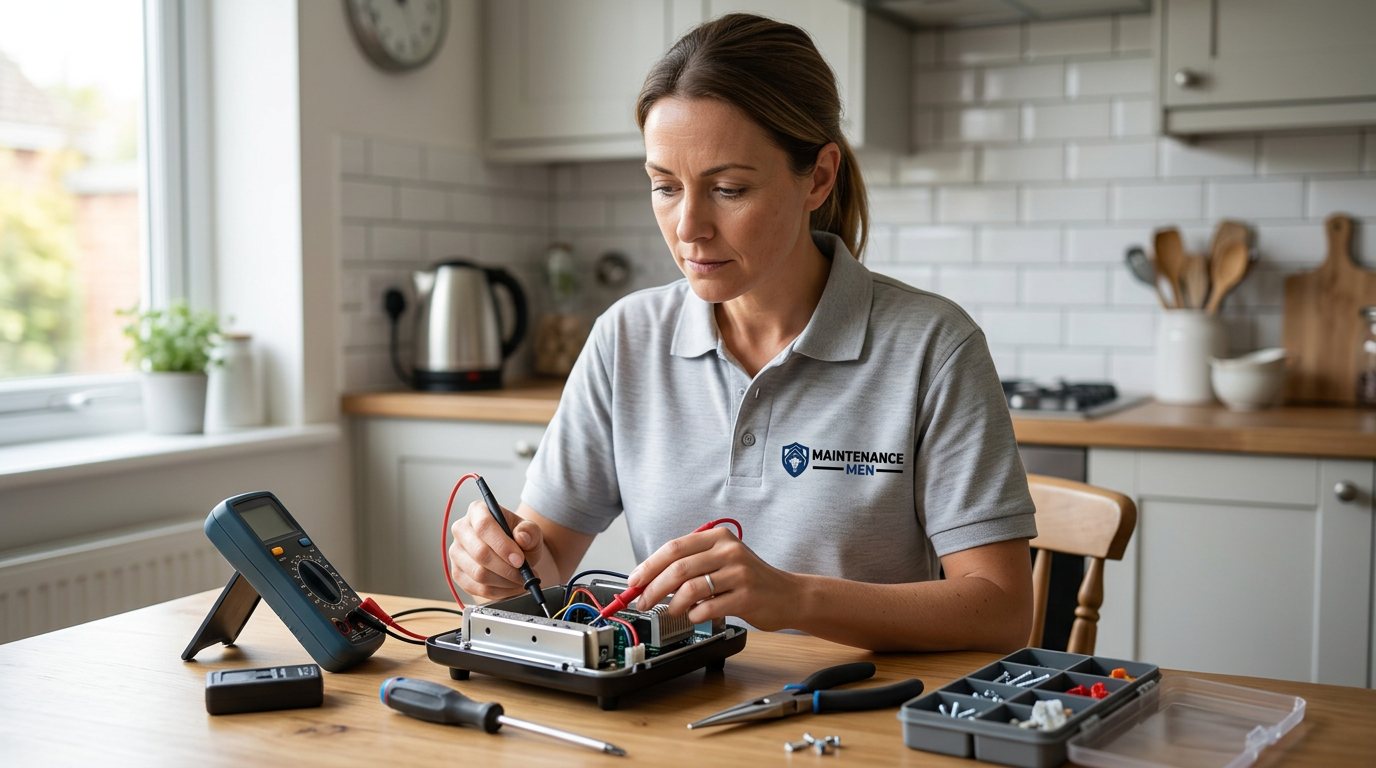
Small appliance dead? We trace the power fault properly in Kenilworth
We test the plug, flex, switch and internal supply path to establish why the appliance has stopped responding, then explain the repair options in plain terms.
Booking fee plus hourly labour — the price is confirmed before any work starts.
What this costs
| Booked 14+ days ahead | £25 booking fee £85 per hour |
|---|---|
| Booked within 48 hours | £100 booking fee £65 per hour |
| Same-day call-out | £220 booking fee £45 per hour |
The booking fee secures the visit. Labour is then charged by the hour, so you only pay for the time the job actually takes.
Booking fee £25–£220
£25 + £85/hr booked 14+ days ahead, £100 + £65/hr inside 48 hours, £220 + £45/hr same day. Agreed before we arrive.
Covered under Small Appliances
Home Appliances › Small Appliances — one of 20 documented jobs in this section.
Same-day small appliance not turning on
Urgent jobs can often be booked for today. Ask when you book and we will confirm the slot before you pay anything.
15 service areas
Birmingham, Coventry, Dorridge and 12 more across the West Midlands.
A small appliance that shows no sign of life is frustrating, especially when it is the kettle at breakfast or the food processor halfway through preparing a meal. The encouraging part is that a total failure to switch on is often a simple fault: a blown fuse in the plug, a damaged flex, a failed rocker switch or an internal thermal fuse that has done its job. The less welcome possibility is a control board, motor or heating element that has failed, which can cost more to put right than the appliance is worth. A proper diagnosis separates those outcomes before you spend anything on parts.
Why "dead" covers several different faults
From the outside, no light, no sound and no heat all look identical. Inside, they sit on completely different circuits. A plug fuse protects the flex and the appliance wiring; if it has blown, something downstream drew too much current and the fuse is a symptom, not the cause. A thermal fuse protects against overheating and will not reset, so its failure usually points to a blocked vent, a stuck thermostat or a cooling fan that stopped turning. A switch can fail mechanically with the contacts simply worn away, and a control board can lose its low-voltage supply while everything else remains sound. Treating any of these as "the appliance is broken" without testing is how people end up buying the wrong part twice.
What we check, and in what order
The visit starts at the socket, because a dead circuit, a switched spur left off or a socket that has lost its earth is not an appliance fault at all. From there we work along the flex looking for crush damage, heat marks at the strain relief and cracked insulation near the plug. The plug itself is opened where it is a rewirable type, and the fuse rating is checked against the appliance's stated load rather than whatever was in the drawer. Only then do we move inside the appliance to test the on/off switch, the door or lid interlock if there is one, the internal fuse and the supply to the control board. Each step is a measurement, not an assumption.
Interlocks and safety switches catch people out
Many small appliances will not start unless a lid, jug, hopper or brew drawer is seated correctly. A tiny plastic tab on the lid pushes a microswitch, and when that tab cracks or the spring weakens, the appliance behaves exactly as though it were dead. This is one of the most common causes we find on blenders, food processors and some coffee machines, and it is a genuinely inexpensive repair. It is also the reason we ask you to bring the complete appliance with all its parts and accessories to the visit rather than the base unit alone.
Repair, replace or refer
Once the faulty stage is identified, we tell you what the part is, whether it is still available for your model and roughly what the work involves. Some fixes are quick: a plug, a flex, a switch or an interlock. Others are uneconomic on a low-cost appliance, and we will say so plainly rather than talk you into a repair. If the fault sits in a sealed control module that the manufacturer no longer supplies, replacement of the appliance is usually the sensible answer. Where a fault involves a high-voltage section, such as a microwave's capacitor circuit, we do not open the casing: those units are referred on and handled by a competent specialist.
Before we arrive
Unplug the appliance and leave it unplugged. Do not open the casing yourself, and do not replace a fuse with a higher rating to "get it going" — that removes the protection the appliance was designed with. If the plug or flex is visibly scorched, or the socket itself shows burn marks, stop using that socket and mention it when you book, because the fault may be in the fixed wiring rather than the appliance. Have the brand, model number and a short description of what happens, or does not happen, when you switch it on.
Booking the visit
Book online with the appliance type, make and model, and what you have already noticed. The booking fee is paid when you book, and the hourly labour rate depends on how soon you need the visit. We confirm the full cost and you approve it before any work starts, and any parts are identified and quoted separately once we know what has failed.
How the price works
We charge a booking fee to hold your slot, then an hourly rate for the work itself. The fee changes with how soon you need us; the hourly rate changes with the slot you choose. You approve the price before we start, so there is no surprise on the invoice.
Booked 14+ days ahead
£25 booking fee
then £85 per hour of labour
Best value. Book the slot now, pay the smallest booking fee.
Booked within 48 hours
£100 booking fee
then £65 per hour of labour
For jobs that can wait a day or two but not a fortnight.
Same-day call-out
£220 booking fee
then £45 per hour of labour
Urgent problems: standing water, no heat, no power, leaks.
Book the slot
Choose the window that suits you and pay the booking fee. That holds your place in the diary.
We diagnose on site
The engineer confirms the cause and tells you what the job involves and how long it should take.
You approve, we work
Nothing goes ahead until you agree the price. Labour is then charged per hour at your slot rate.
A kettle, mixer or coffee grinder that does nothing at all usually has a fault somewhere between the wall socket and the control board, and finding which one takes methodical testing rather than guesswork. Our visit covers that testing: supply, plug, flex, switch gear and the internal fuse or board, with a clear explanation of what has failed. You get an honest view of whether a repair makes sense or whether replacement is the better spend.
What our customers say about our home appliances service
4.8 out of 5 from 14 reviews
Exactly what was quoted
What I appreciated was being told what was actually wrong before anyone started. Sorted in under 27 minutes and the invoice matched the quote to the penny.
Job: Tumble Dryer Not Starting Cycle
Good job, slightly late
Solid work. Hourly rate feels fair for the amount of work involved and everything was tested before they left. Would book again.
Job: Toaster Not Working
No mess left behind
Really straightforward. It had been bothering us for weeks; diagnosed properly, fixed the same visit, and the price was exactly what was explained when booking. Can not fault it.
Job: Microwave Button Repair
Book Small Appliance Not Turning On
Tell us what is happening and choose a slot. If you are not sure this is the right job, use the diagnosis panel — it narrows the problem down before you book.
- Booking fee confirmed up front
- Hourly labour, agreed before work starts
- Same-day slots for urgent problems







Questions people ask about small appliance not turning on
Straight answers to the things customers ask most often before booking.
Can I just replace the fuse in the plug and try again?
You can, and it is a reasonable first step if you have the correct rated fuse to hand. If the replacement blows straight away, stop and book a visit rather than fitting a bigger fuse, because a repeat failure means current is going somewhere it should not.
What does the engineer actually test during the visit?
The socket and supply, the plug and flex, the on/off switch, any lid or door interlock, the internal fuse and the supply to the control board. Each stage is measured so the fault is located rather than guessed at. The appliance is unplugged before any of this is done, and each check follows from the last.
Is it safe to keep using the appliance if it sometimes works?
An intermittent fault on a heating appliance is worth treating with caution, so unplug it when it is not in use until it has been checked. If you notice scorching, a burning smell or the plug feeling hot, stop using it altogether.
My blender only works with the lid pressed down hard. Can that be fixed?
Usually yes. That behaviour points to a worn or misaligned interlock switch or a cracked tab on the lid, both of which are replaceable. Bring the lid with the base so both halves can be checked together.
How is the cost worked out?
The booking fee is paid when you book, and the hourly labour rate depends on how soon you need the visit. We quote the full cost and you approve it before work begins; any parts needed are identified and quoted separately, with no figures invented in advance.
Need small appliance not turning on sorted in Kenilworth?
Book a slot in the diary and pay only the booking fee up front. We confirm the rest before we start.