
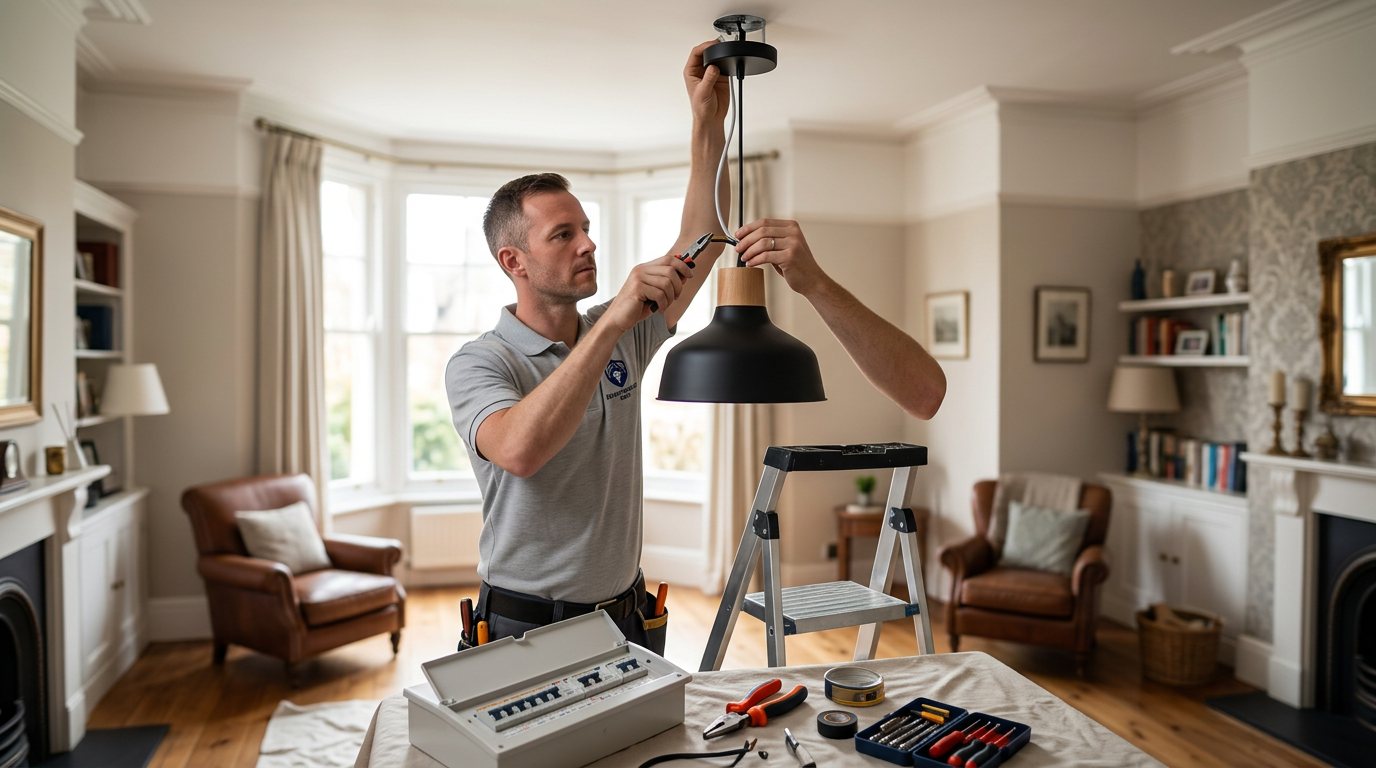
Is Your Light Fitting Running Hot? Let's Cool It Down
An overheating fitting is quietly shortening its own life and risking the ceiling above it — we find the heat source and put it right.
Booking fee plus hourly labour — the price is confirmed before any work starts.
What this costs
| Booked 14+ days ahead | £25 booking fee £85 per hour |
|---|---|
| Booked within 48 hours | £100 booking fee £65 per hour |
| Same-day call-out | £220 booking fee £45 per hour |
The booking fee secures the visit. Labour is then charged by the hour, so you only pay for the time the job actually takes.
Booking fee £25–£220
£25 + £85/hr booked 14+ days ahead, £100 + £65/hr inside 48 hours, £220 + £45/hr same day. Agreed before we arrive.
Covered under Lighting
Electrical › Lighting — one of 20 documented jobs in this section.
Same-day light overheating
Urgent jobs can often be booked for today. Ask when you book and we will confirm the slot before you pay anything.
15 service areas
Birmingham, Coventry, Dorridge and 12 more across the West Midlands.
Light fittings are meant to run warm. Bulbs, particularly halogen and incandescent ones, produce heat as an unavoidable by-product, and a well-designed fitting disperses it. What isn't normal is a fitting that's too hot to hold, that scorches the ceiling around it, or that you can smell when the room heats up. If you've noticed any of those, there's a reason — and it's almost always one of a short list of causes.
Where the Heat Comes From
The most frequent culprit is the bulb itself. Every fitting has a maximum wattage rating — usually printed inside on a label — and exceeding it doesn't make the room brighter in any useful way, it just makes the holder, the wiring and the ceiling hotter. A 60W-rated fitting with a 100W bulb in it has been slowly cooking since the day that bulb went in.
Insulation is the second major cause, and it's a sneaky one. Downlights especially are often installed surrounded by loft insulation, and when insulation is pushed up against or draped over a fitting designed to shed heat into open air, the heat has nowhere to go. The fitting runs hotter every hour it's on.
The third cause is the fitting itself failing: a lamp holder with tired, high-resistance contacts generates its own heat, an LED driver or low-voltage transformer working beyond its design runs hot, and a poorly made fitting with undersized internal wiring simply can't shift the heat its bulb produces.
What Heat Does Over Time
Heat is patient. It makes plastic lamp holders brittle and discoloured, dries out insulation on conductors until it cracks, and loosens terminals through repeated expansion and contraction. Over months and years, a fitting that ran merely warm becomes one that smells, then one that scorches, then — occasionally — one that starts a fire in the ceiling void where nobody can see it happening. The burning-smell light fittings we're called to rarely arrived there suddenly; they climbed there slowly.
How We Diagnose the Heat
Our engineer starts with the rating label on the fitting and the actual bulb in it — the mismatch test takes a minute and catches the most common cause. We then check the lamp holder for signs of heat stress, test the connections for resistance and tightness, and feel-check, safely and with the circuit isolated, how heat is behaving in the fitting. For downlights in an upstairs ceiling, we look in the loft: how much insulation is packed against the fitting, whether there's any clearance at all, and whether a fire-rated hood or better positioning would solve it. We also consider what type of lamps the fitting uses, because switching halogen to LED transforms the heat output of the same fitting.
How We Fix It
The fix depends on the diagnosis, and most fixes are small. Right-sizing the bulb costs pennies and removes the entire problem when over-wattage was the cause. Clearing insulation away from downlights and fitting the appropriate hoods restores their designed cooling. A heat-stressed lamp holder gets replaced before it fails spectacularly rather than after. Where the fitting itself is underspecified for the job it's doing — a cheap fitting expected to run eight hours a day, for example — we'll say so and recommend something properly rated, and can fit it there and then.
Prevention and Aftercare
Once we've put it right, you'll know the rating your fitting can take and the lamps that suit it. If you're replacing bulbs yourself in future, stay within those limits and favour LED, which wastes most of its energy as light rather than heat. And if any fitting ever smells warm or the ceiling above it starts to discolour, that's a check-it-now signal, not a keep-an-eye-on-it one.
When to Call Us
Book a visit if a fitting is too hot to keep your hand on, if the ceiling above a light has started to brown, if bulb holders seem to fail repeatedly, or if you've just moved into a property and the downlights sit under a heavily insulated loft. Heat problems are cheap to fix early and expensive to fix late.
Book Your Overheating Fitting Check Today
A hot fitting is a solvable problem, usually inside an hour. Call Maintenance Men or book online — qualified electricians, fully insured, covering the West Midlands, and a clear explanation of what was generating the heat and what we did about it.
How the price works
We charge a booking fee to hold your slot, then an hourly rate for the work itself. The fee changes with how soon you need us; the hourly rate changes with the slot you choose. You approve the price before we start, so there is no surprise on the invoice.
Booked 14+ days ahead
£25 booking fee
then £85 per hour of labour
Best value. Book the slot now, pay the smallest booking fee.
Booked within 48 hours
£100 booking fee
then £65 per hour of labour
For jobs that can wait a day or two but not a fortnight.
Same-day call-out
£220 booking fee
then £45 per hour of labour
Urgent problems: standing water, no heat, no power, leaks.
Book the slot
Choose the window that suits you and pay the booking fee. That holds your place in the diary.
We diagnose on site
The engineer confirms the cause and tells you what the job involves and how long it should take.
You approve, we work
Nothing goes ahead until you agree the price. Labour is then charged per hour at your slot rate.
Most people never touch a light fitting, so it's easy to miss that one is running far hotter than it should. Heat like that doesn't fix itself; it slowly cooks insulation, lamp holders and the plasterboard around them. We identify exactly why your fitting is generating too much heat and correct it, from the bulb that's too powerful to the insulation packed wrongly above it.
What our customers say about our electrical service
4.6 out of 5 from 11 reviews
Does what it says on the tin
No complaints about the work itself — clear explanation, sensible advice, fair price. Booking online was easy enough once I found the right job page.
Job: Smoke Alarm Replacement
Fixed it, but took longer than expected
Work itself was fine and tidy. Communication beforehand was patchy — I did not get the confirmation message and had to ring to check the slot. Would still use again.
Job: Flickering Outdoor Lights
Turned up when they said
Third time we have used Maintenance Men, and the same experience each time: agreed price, proper explanation, job done in one visit. The hourly rate is fair for the standard of work.
Job: Appliance Causing Power Trip
Book Light Overheating
Tell us what is happening and choose a slot. If you are not sure this is the right job, use the diagnosis panel — it narrows the problem down before you book.
- Booking fee confirmed up front
- Hourly labour, agreed before work starts
- Same-day slots for urgent problems







Questions people ask about light overheating
Straight answers to the things customers ask most often before booking.
What does an overheating-fitting visit cost?
Booking involves a booking fee, and after that labour is hourly — the rate depends on how quickly you need us to attend. The engineer diagnoses the cause first, quotes the complete repair price, and you approve it before we carry out any of the work. Most heat problems are resolved within the first hour.
Can I check anything myself?
Yes — with the light switched off and the bulb cool, take the bulb out and compare its wattage against the rating label inside the fitting. That single check finds the most common cause. Beyond that, stop: investigating the holder, connections or loft void around a fitting involves live parts and hot surfaces that shouldn't be touched.
What will the engineer check for?
Bulb wattage against the fitting's rating, the condition of the lamp holder, the tightness and resistance of connections, how insulation sits around the fitting in the loft above, and the health of any transformer or driver inside. Together those cover the overwhelming majority of overheating causes.
How risky is an overheating light fitting?
It's a slow-burn risk, literally. Heat degrades insulation and plastic gradually, and the failure point often arrives in a ceiling void you can't see. Most fittings run hot for a long time without incident, but the condition never improves on its own — it only deepens — so it's worth fixing while the fix is still small.
Would switching to LED stop the overheating?
In many cases, yes — LED lamps convert most of their energy to light rather than heat, so the same fitting runs dramatically cooler. But LED isn't a blanket cure: drivers inside fittings can still fail and run hot, and insulation packed against a fitting still restricts cooling. We'll tell you honestly whether LED solves your particular case or only part of it.
Need light overheating sorted?
Book a slot in the diary and pay only the booking fee up front. We confirm the rest before we start.