
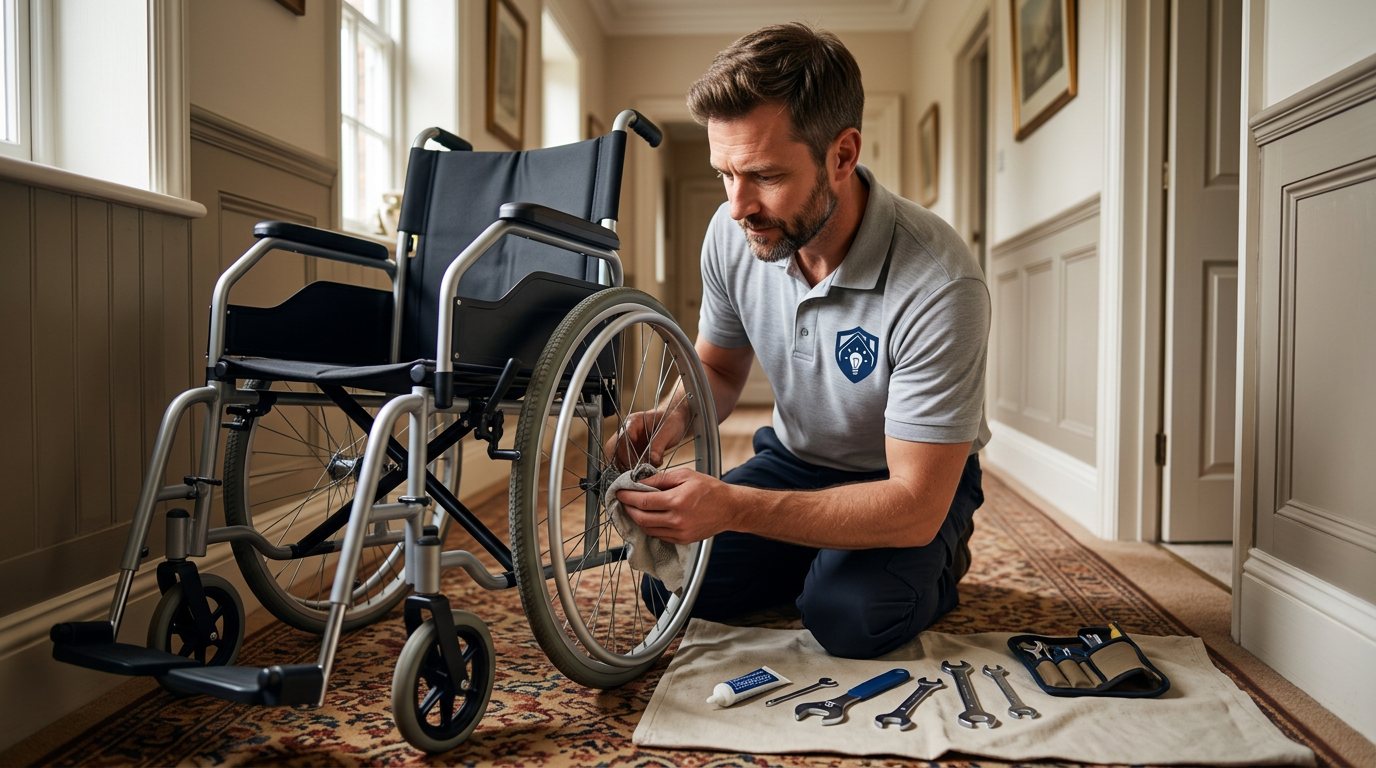
Wheelchair Pulling or Wobbling? We'll Straighten It Out in Edgbaston
We diagnose why a wheelchair pulls to one side, wobbles or tracks badly — wheels, axles, alignment and frame — and correct what we find.
Booking fee plus hourly labour — the price is confirmed before any work starts.
What this costs
| Booked 14+ days ahead | £25 booking fee £85 per hour |
|---|---|
| Booked within 48 hours | £100 booking fee £65 per hour |
| Same-day call-out | £220 booking fee £45 per hour |
The booking fee secures the visit. Labour is then charged by the hour, so you only pay for the time the job actually takes.
Booking fee £25–£220
£25 + £85/hr booked 14+ days ahead, £100 + £65/hr inside 48 hours, £220 + £45/hr same day. Agreed before we arrive.
Covered under Wheelchairs & Accessories
Mobility & Accessibility › Wheelchairs & Accessories — one of 23 documented jobs in this section.
Same-day wheel alignment issue
Urgent jobs can often be booked for today. Ask when you book and we will confirm the slot before you pay anything.
15 service areas
Birmingham, Coventry, Dorridge and 12 more across the West Midlands.
A wheelchair should roll straight and true on flat ground with no more than a feather's correction. When it pulls persistently to one side, wobbles, or seems to fight itself, something in the wheels or alignment has changed — and because wheelchairs are used daily by people who depend on them, that something is worth finding properly. This page covers the usual causes of a pulling or wobbling chair and how we track them down.
Why chairs pull or wobble
The commonest cause of a pull is uneven rolling resistance between the two sides: a dragging brake on one wheel, a bearing that has roughened on one side, debris wound round one axle, or one tyre softer or more worn than the other. A caster that has seized or flat-spotted produces the same effect, since the casters steer the chair.
Wobbling points at different suspects. A bent axle or a bent wheel rim makes a wheel hop as it turns. Loose spokes make a wheel ring uneven and wander. A loose wheel nut or axle bolt lets the whole wheel rock. On powered chairs, alignment problems can also come from the mounting of the drive units or from wear in their fittings, and a caster fork that has been knocked out of true will make the chair scrub sideways.
There is a category that matters more: if the frame itself is bent — from a fall down steps, a collision with a car or a heavy knock — the wheels cannot be aligned onto a crooked baseline. That is a structural question, and we treat it as one rather than pretending a spanner can fix it.
How we diagnose it
We start with a controlled roll test on level ground, watching which way the chair drifts and where the wobble shows. Then we lift each wheel in turn and spin it, watching for hop and listen for roughness in the bearings. We check tyre pressures and wear on both sides, confirm both brakes release fully and evenly, examine axles and axle nuts for bend and looseness, check spoke tension where the wheels are spoked, and inspect the casters and their forks. On powered chairs we also check the drive unit mountings.
What we find determines the conversation. A dragging brake or a soft tyre is an adjustment. A rough bearing is a modest parts job. A bent axle or wheel is a replacement. A bent frame is a structural assessment, quoted separately, and we will say plainly if a frame has reached the point where repair is not the sensible option.
Fixes and honest limits
Wheel trueing, bearing replacement, brake adjustment, axle replacement, caster replacement and tyre replacement all fall comfortably within a normal visit, and the improvement is usually immediate and satisfying. We use manufacturer-approved parts where the design requires specific components. What we cannot do is promise perfect tracking on every surface — cambered pavements make every chair drift slightly, and that is the road, not the chair.
Safety boundary
If the chair ever had a significant impact, or if a weld looks cracked, the frame is suspect regardless of how the wheels behave. Do not keep using a chair with a cracked weld, and tell us when you book — frame work is assessed and, where necessary, referred rather than bodged.
Aftercare
Keep both tyres at the same pressure, keep hair and thread off the axles, and listen for roughness when you spin the wheels during cleaning — catching a bearing early stops the pull returning. After any knock or drop down a kerb, have the wheels checked even if everything still looks fine.
Booking
Tell us the make and model, whether the chair pulls, wobbles or both, which direction, and whether anything happened that might have caused it — kerbs, impacts, a recent tyre change. You pay a booking fee when you book, labour is hourly at a rate depending on how soon you need us, and the full cost of the work is quoted and approved before we begin.
How the price works
We charge a booking fee to hold your slot, then an hourly rate for the work itself. The fee changes with how soon you need us; the hourly rate changes with the slot you choose. You approve the price before we start, so there is no surprise on the invoice.
Booked 14+ days ahead
£25 booking fee
then £85 per hour of labour
Best value. Book the slot now, pay the smallest booking fee.
Booked within 48 hours
£100 booking fee
then £65 per hour of labour
For jobs that can wait a day or two but not a fortnight.
Same-day call-out
£220 booking fee
then £45 per hour of labour
Urgent problems: standing water, no heat, no power, leaks.
Book the slot
Choose the window that suits you and pay the booking fee. That holds your place in the diary.
We diagnose on site
The engineer confirms the cause and tells you what the job involves and how long it should take.
You approve, we work
Nothing goes ahead until you agree the price. Labour is then charged per hour at your slot rate.
A wheelchair that drifts sideways or wobbles makes every journey harder and, over time, puts uneven strain on the frame and the user's arms. The causes are usually small and mechanical, but they need tracing properly rather than being chased with guesswork adjustments. We diagnose first, explain the findings, and quote before correcting anything.
What our customers say about our mobility & accessibility service
4.5 out of 5 from 8 reviews
Proper job, no upselling
Turned up in the window they promised, walked me through the options (turns out the old fitting was seized and needed careful removal), then cracked on. Everything was tested before they left. No mess, no drama, no surprise on the bill.
Job: Loose or Faulty Brakes
Fine in the end
The problem is fixed, which is the main thing, and the engineer clearly knew what they were doing. It took a fair bit longer than the estimate on the phone and I had to ask twice for a breakdown of the hours.
Job: Stair Lift Service
Would use again
What I appreciated was being told what was actually wrong before anyone started. Sorted in under 70 minutes and the invoice matched the quote to the penny.
Job: Control Panel Fault
Book Wheel Alignment Issue
Tell us what is happening and choose a slot. If you are not sure this is the right job, use the diagnosis panel — it narrows the problem down before you book.
- Booking fee confirmed up front
- Hourly labour, agreed before work starts
- Same-day slots for urgent problems


Questions people ask about wheel alignment issue
Straight answers to the things customers ask most often before booking.
Can I true up a pulling wheelchair myself?
You can do the basics: equalise the tyre pressures, confirm both brakes release fully, and clear debris from the axles and casters. If the pull persists after that, the cause is probably a bearing, a bent axle or a wheel out of true, which needs proper tools and a diagnosis rather than trial-and-error adjustment.
What do you check for a pulling or wobbling chair?
A roll test on level ground, then each wheel spun and inspected for hop, bearing roughness, tyre wear and pressure, brake release, axle condition, spokes, casters and their forks, and on powered chairs the drive unit mountings. You get the findings and a quote before any work starts.
The chair was knocked by a car recently but seems fine — should I worry?
Yes, get it checked. Impacts can bend axles, forks or the frame in ways that are not obvious, and a wheel that looks fine can be running out of true. If you ever see a cracked weld, stop using the chair and tell us when you book — that becomes a structural assessment.
Why does my wheelchair still drift on cambered pavements?
Cambered and sloped surfaces make every wheelchair drift to the low side — that is the pavement, not a fault. What we correct is a chair that pulls on genuinely flat ground, and we test it that way, so you know the difference is the surface rather than the chair.
What does the visit cost?
You pay a booking fee when you book, and labour is charged hourly at a rate that depends on how soon you need the visit. After diagnosis, the full cost of the work is quoted and approved before we start, with any parts quoted separately.
Need wheel alignment issue sorted in Edgbaston?
Book a slot in the diary and pay only the booking fee up front. We confirm the rest before we start.