
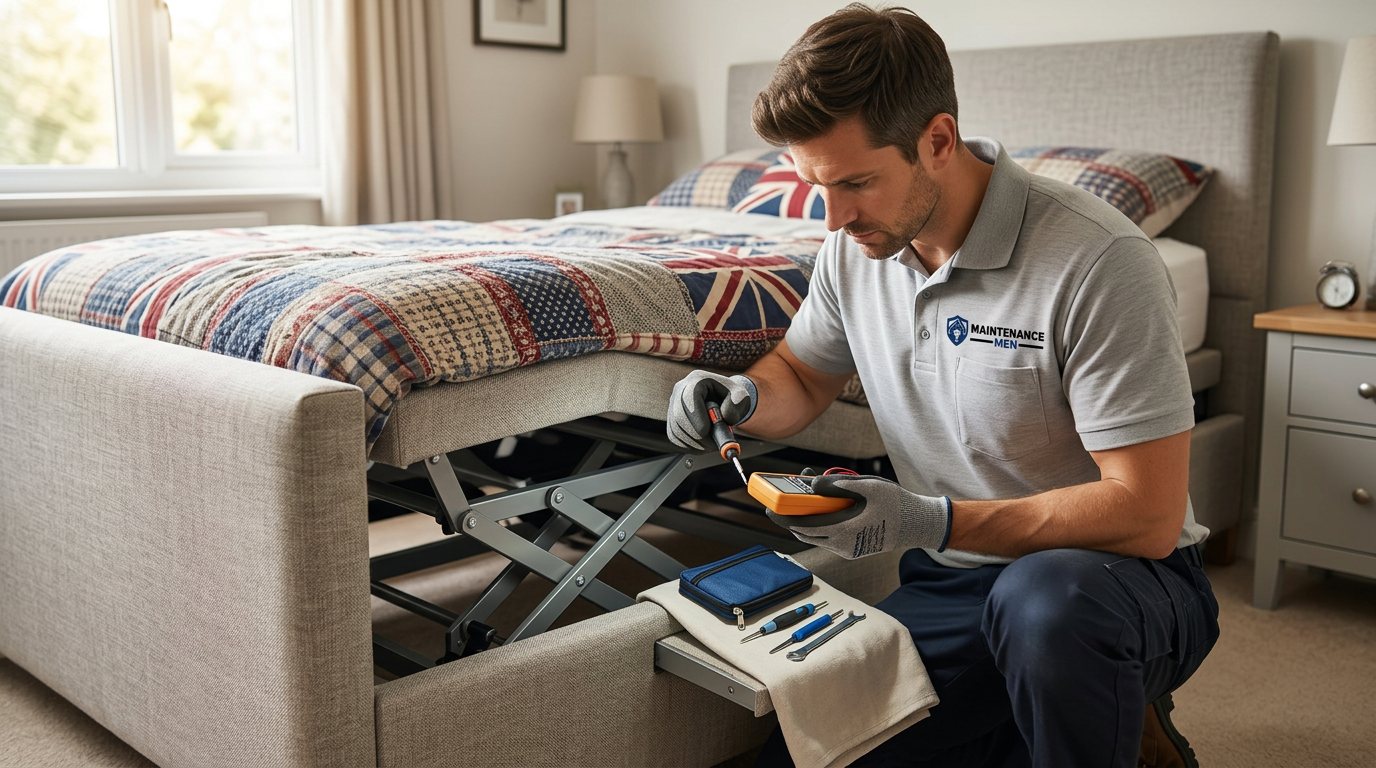
Safety Lock Stuck On? We'll Get Your Furniture Moving Again in Edgbaston
We identify which lock or cut-out is holding the furniture still, release it the way the manufacturer intends, and check whether a genuine fault is hiding behind it.
Booking fee plus hourly labour — the price is confirmed before any work starts.
What this costs
| Booked 14+ days ahead | £25 booking fee £85 per hour |
|---|---|
| Booked within 48 hours | £100 booking fee £65 per hour |
| Same-day call-out | £220 booking fee £45 per hour |
The booking fee secures the visit. Labour is then charged by the hour, so you only pay for the time the job actually takes.
Booking fee £25–£220
£25 + £85/hr booked 14+ days ahead, £100 + £65/hr inside 48 hours, £220 + £45/hr same day. Agreed before we arrive.
Covered under Electric Adjustable Furniture
Mobility & Accessibility › Electric Adjustable Furniture — one of 17 documented jobs in this section.
Same-day safety lock engaged
Urgent jobs can often be booked for today. Ask when you book and we will confirm the slot before you pay anything.
15 service areas
Birmingham, Coventry, Dorridge and 12 more across the West Midlands.
Modern adjustable furniture carries several safety devices, and each of them can leave the furniture apparently dead. Understanding which one is holding you up saves time, money and a lot of button pressing.
The Devices That Lock Furniture
- Child lock. A button combination on the handset, or a dedicated lock button, that stops all movement. Often engaged accidentally by a child, a cleaner or something pressing against the handset in a drawer.
- Key switch. Some care and rise chairs have a physical key that isolates the controls, fitted so that a person who should not adjust the furniture cannot do so unsupervised.
- Travel or transport lock. Fitted so the furniture cannot move while being delivered or shifted. Occasionally left engaged after installation or a house move.
- Thermal cut-out. Trips when motors have been run repeatedly, or when they are working harder than they should. It resets after a rest — or, if the motor is faulty, it keeps tripping.
- Control box lock-out. After detecting an error or an overload, some systems refuse input until they are reset in a specific sequence.
- Battery backup mode. With a flat backup pack connected, some systems will not run on mains at all.
Telling a Lock From a Fault
A lock usually leaves the furniture completely unresponsive but otherwise normal — no noise, no smell, no heat. A fault tends to show itself: a motor that hums and does not move, a control box that clicks repeatedly, a section that runs one way only, a fuse that blows.
The distinction matters. If a thermal cut-out keeps tripping, releasing it and carrying on is not a fix — something is making the motor work too hard, and the cut-out is the only thing standing between that and a burnt-out actuator.
How We Release Them Properly
For a child lock or travel lock, we follow the manufacturer's documented sequence exactly: usually a long press on a pair of buttons, or a hold on the lock button until an indicator changes. We will show you the sequence so you can do it yourself next time, and we will write it down.
For a key switch, we confirm the key is present and turned to the operating position. If the key is lost, the switch can be replaced — we will not bypass it.
For a thermal cut-out, we let the motors cool and test whether the furniture then runs normally, watching current draw and listening for labouring. If it trips again quickly, we treat it as a motor or mechanism fault and say so.
What We Will Not Do
We will not disable a safety lock, remove a key switch, bypass a thermal cut-out or fit a fuse of a higher rating to stop nuisance tripping. Those devices exist because furniture that carries people can hurt someone if it moves when it should not, and because a motor driven past its limit is a fire risk.
If a lock is engaged because a carer or family member set it deliberately, we will not override it without their agreement. That is a conversation for the household, not for us.
If Someone Is Stuck
A lock engaged with someone on the furniture is uncomfortable rather than dangerous, provided they can be helped out. Help them to stand or to a safe position; do not force the mechanism. Manual release or emergency lowering applies only where the manufacturer provides it and describes how to use it, and only for someone confident to do it.
If the person is in pain or distressed and cannot be moved, call 999.
The Lock That Keeps Coming Back
If a lock re-engages on its own, or the handset locks itself after a few seconds, the cause is usually a failing handset or a control box with a fault in its input circuit. That is a repair, not a habit to live with. Repeatedly unlocking it is fine as a stopgap but the underlying fault should be found.
After We Have It Moving
We test every function through its full range, confirm the lock behaves as it should, and explain the sequence for releasing it. If the furniture has a key switch, we will check the key operates cleanly and discuss a replacement if it is worn. We will also tell you whether anything we saw suggests the lock was doing its job — that is, whether a genuine fault is being masked.
Booking
Tell us what the furniture does and does not do, whether a symbol or code is showing, and whether anyone else in the household uses a lock deliberately. Booking fee at booking, hourly labour at a rate depending on how soon you need us, full cost quoted and approved before work begins.
How the price works
We charge a booking fee to hold your slot, then an hourly rate for the work itself. The fee changes with how soon you need us; the hourly rate changes with the slot you choose. You approve the price before we start, so there is no surprise on the invoice.
Booked 14+ days ahead
£25 booking fee
then £85 per hour of labour
Best value. Book the slot now, pay the smallest booking fee.
Booked within 48 hours
£100 booking fee
then £65 per hour of labour
For jobs that can wait a day or two but not a fortnight.
Same-day call-out
£220 booking fee
then £45 per hour of labour
Urgent problems: standing water, no heat, no power, leaks.
Book the slot
Choose the window that suits you and pay the booking fee. That holds your place in the diary.
We diagnose on site
The engineer confirms the cause and tells you what the job involves and how long it should take.
You approve, we work
Nothing goes ahead until you agree the price. Labour is then charged per hour at your slot rate.
A lock that will not release looks exactly like a broken bed, and it is one of the easier things to resolve once you know what you are dealing with. Child locks, key switches, travel locks and thermal cut-outs all stop the furniture moving on purpose. The trick is telling a lock apart from a fault — and making sure that whatever is released is released safely.
What our customers say about this job
3 out of 5 from 1 reviews
Fine in the end
The problem is fixed, which is the main thing, and the engineer clearly knew what they were doing. It took a fair bit longer than the estimate on the phone and I had to ask twice for a breakdown of the hours.
Job: Safety Lock Engaged
Book Safety Lock Engaged
Tell us what is happening and choose a slot. If you are not sure this is the right job, use the diagnosis panel — it narrows the problem down before you book.
- Booking fee confirmed up front
- Hourly labour, agreed before work starts
- Same-day slots for urgent problems


Questions people ask about safety lock engaged
Straight answers to the things customers ask most often before booking.
How do I know if it is a lock or an actual fault?
A lock normally leaves the furniture completely silent and unresponsive, with no heat or smell. A fault usually shows something: a humming motor, repeated clicking, one direction working, a fuse blowing. Note exactly what happens when you press a button — that detail is often enough for us to tell you before we arrive.
What will you do on the visit?
We identify which device is holding the furniture — child lock, key switch, travel lock, thermal cut-out or control box lock-out — and release it using the manufacturer's documented sequence. Then we test every function through its range to confirm nothing else is wrong and explain the sequence so you can do it yourself.
Will you disable the lock so it cannot happen again?
No. Locks and cut-outs exist because furniture that carries people can cause injury if it moves when it should not, and because a motor driven past its limit is a fire risk. We will show you how to release the lock properly, but we will not bypass or remove a safety device.
The cut-out keeps tripping — is that just the lock being sensitive?
No, and it should not be ignored. A thermal cut-out that trips repeatedly is reporting a motor working too hard, usually because of a failing actuator, a binding mechanism or excess load. Releasing it and carrying on risks the actuator and, in the worst case, the control box.
What will it cost to sort out?
You pay a booking fee when you book, and the hourly labour rate depends on how soon you need the visit. We diagnose first, then quote the full cost of the work and you approve it before we start. If a handset, key switch or control box is needed, that part is quoted separately.
Need safety lock engaged sorted in Edgbaston?
Book a slot in the diary and pay only the booking fee up front. We confirm the rest before we start.