
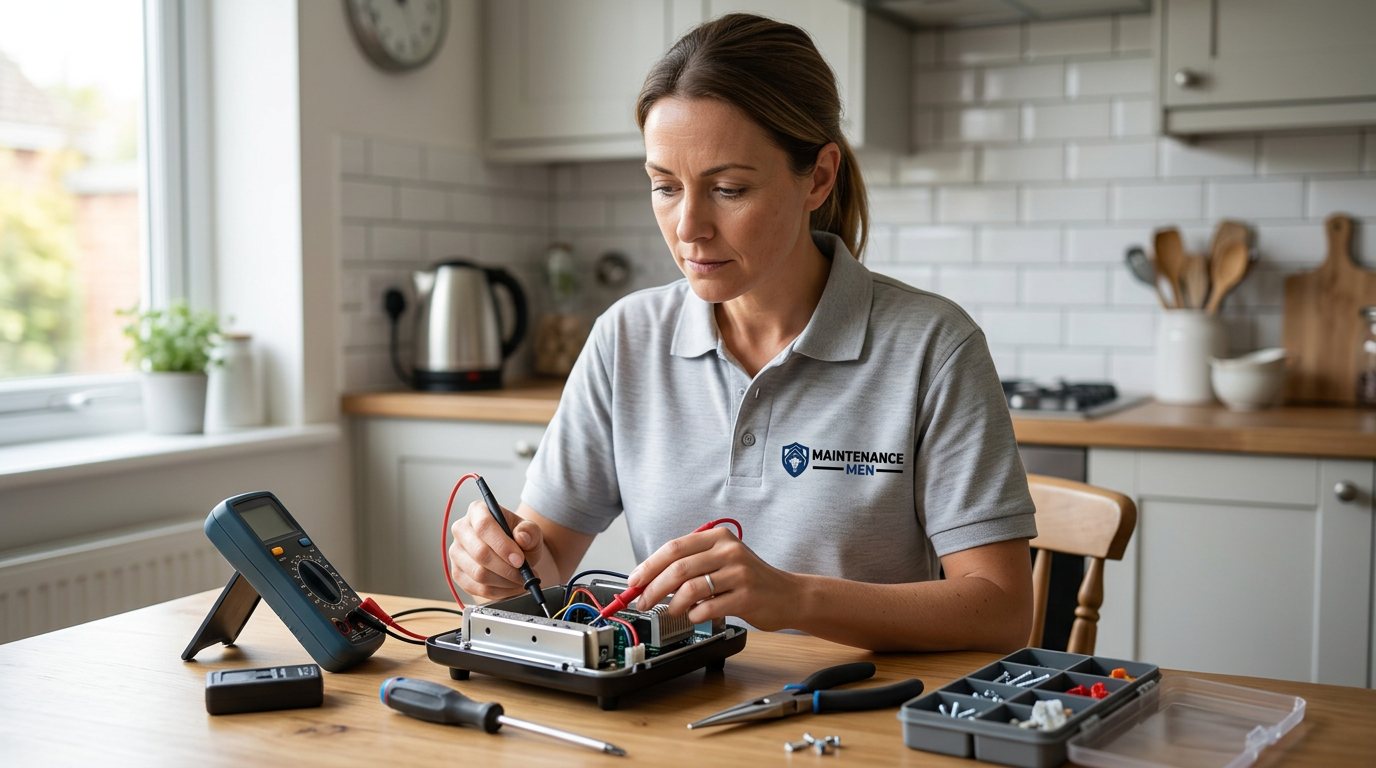
New rattle, grinding or whine? We trace where it starts in Dudley
We identify whether the noise comes from a bearing, fan, pump, drive or loose housing, and whether it signals wear that needs attention.
Booking fee plus hourly labour — the price is confirmed before any work starts.
What this costs
| Booked 14+ days ahead | £25 booking fee £85 per hour |
|---|---|
| Booked within 48 hours | £100 booking fee £65 per hour |
| Same-day call-out | £220 booking fee £45 per hour |
The booking fee secures the visit. Labour is then charged by the hour, so you only pay for the time the job actually takes.
Booking fee £25–£220
£25 + £85/hr booked 14+ days ahead, £100 + £65/hr inside 48 hours, £220 + £45/hr same day. Agreed before we arrive.
Covered under Small Appliances
Home Appliances › Small Appliances — one of 20 documented jobs in this section.
Same-day unusual noise from appliance
Urgent jobs can often be booked for today. Ask when you book and we will confirm the slot before you pay anything.
15 service areas
Birmingham, Coventry, Dorridge and 12 more across the West Midlands.
Every appliance has a normal sound. A fridge hums, a washing machine whooshes, a kettle rumbles as it approaches boiling. What matters is the change: the new rattle, the grind that appeared last week, the whine that rises with speed. Noise is one of the most useful diagnostic signals an appliance gives, because the type of sound usually points to the mechanism producing it.
Reading the sound
A high-pitched squeal that rises and falls with motor speed is characteristic of a dry or failing bearing, or of a belt slipping. A rhythmic knock or thud suggests something rotating out of balance — a bent fan blade, a worn coupling, a foreign object in an impeller. A grinding rasp is usually metal on metal, which means a bearing has collapsed or a part has come loose and is contacting the housing. A rattle that appears only at certain speeds is often a loose panel, a clip that has sprung or a component that has vibrated free of its mount. A gurgling or scraping from a pump points at the impeller or an obstruction.
Why the location matters as much as the sound
Where the noise comes from narrows things quickly. Noise at the base of a machine usually means the motor or gearbox; noise at the top often means a fan or a lid assembly. Noise that changes when you press a panel tells you the panel is the source, not the mechanism. Noise that stops when the appliance is tilted or the load is removed points to the drive. We listen with the appliance running where it is safe to do so, then isolate the power before opening anything.
Common causes we find
Loose debris is more common than people expect: a piece of grit or a small object inside a fan housing, a stone in a vacuum brush bar, a stray piece of packaging behind a panel. Worn bearings follow, especially on appliances that run for long periods. Fan blades that have collected dust become unbalanced and start to vibrate, which then loosens fixings and creates a rattle elsewhere. Drive belts harden and slip, producing a squeal under load. Pump impellers wear or pick up scale. And housing screws work loose over years of vibration, which is the cheapest possible cause and often the actual one.
Repair options
Once the source is known, the repair is usually specific and modest: reseat or replace a fan, fit a new belt, replace a worn bearing where the motor allows it, clear an obstruction, or tighten and refit a housing. Bearings pressed into sealed motor units are the difficult case, because the motor is often supplied as a complete unit and the part may not be economic on an older appliance. We tell you which situation you are in, with the part identified and quoted separately.
When noise is a warning rather than an annoyance
A grinding noise from a motor or a scraping from a pump should not be lived with. Metal contact generates heat and debris, and a bearing that collapses can damage the shaft it supports, turning a small repair into a replacement. If the noise comes with a burning smell, visible smoke, sparks or a hot casing, stop using the appliance and unplug it. Noise on a heating appliance that also runs hot is worth treating as urgent.
Safety and scope
Unplug before inspection, and let the appliance cool if it has been running hot. Do not run an appliance with panels removed to listen more closely: belts, fans and terminals are exposed and the risk is real. Do not lubricate a bearing with household oil as a quick fix — it attracts dust and can damage sealed bearings. Microwave internals and gas components are outside what we open.
Helping us find it
Note when the noise occurs: at start-up, at a particular speed, under load, on one programme only, or continuously. Record a short video with sound if you can, because the pitch and rhythm carry information that a description loses. Have the make, model and rough age ready, and mention anything that changed beforehand.
Booking
Book online with the appliance details and the noise description. The booking fee is paid when you book, and the hourly labour rate depends on how soon you need the visit. The full cost is quoted and approved before any work starts, with parts identified and priced separately.
How the price works
We charge a booking fee to hold your slot, then an hourly rate for the work itself. The fee changes with how soon you need us; the hourly rate changes with the slot you choose. You approve the price before we start, so there is no surprise on the invoice.
Booked 14+ days ahead
£25 booking fee
then £85 per hour of labour
Best value. Book the slot now, pay the smallest booking fee.
Booked within 48 hours
£100 booking fee
then £65 per hour of labour
For jobs that can wait a day or two but not a fortnight.
Same-day call-out
£220 booking fee
then £45 per hour of labour
Urgent problems: standing water, no heat, no power, leaks.
Book the slot
Choose the window that suits you and pay the booking fee. That holds your place in the diary.
We diagnose on site
The engineer confirms the cause and tells you what the job involves and how long it should take.
You approve, we work
Nothing goes ahead until you agree the price. Labour is then charged per hour at your slot rate.
Appliances are not silent, but they are consistent. When a familiar machine starts grinding, rattling or shrieking, the change is information: something has loosened, worn or come loose inside. Some noises are harmless and some are the sound of a part about to fail. Our visit works out which, without dismantling anything unnecessarily.
What our customers say about our home appliances service
4.8 out of 5 from 14 reviews
Exactly what was quoted
What I appreciated was being told what was actually wrong before anyone started. Sorted in under 27 minutes and the invoice matched the quote to the penny.
Job: Tumble Dryer Not Starting Cycle
Good job, slightly late
Solid work. Hourly rate feels fair for the amount of work involved and everything was tested before they left. Would book again.
Job: Toaster Not Working
No mess left behind
Really straightforward. It had been bothering us for weeks; diagnosed properly, fixed the same visit, and the price was exactly what was explained when booking. Can not fault it.
Job: Microwave Button Repair
Book Unusual Noise from Appliance
Tell us what is happening and choose a slot. If you are not sure this is the right job, use the diagnosis panel — it narrows the problem down before you book.
- Booking fee confirmed up front
- Hourly labour, agreed before work starts
- Same-day slots for urgent problems







Questions people ask about unusual noise from appliance
Straight answers to the things customers ask most often before booking.
Can I just live with a rattling appliance?
A rattle from a loose panel usually stays harmless. A grind or squeal that comes from a bearing or drive tends to get worse and can damage other parts, so it is worth identifying which you have.
How will you find the source of the noise?
By listening to the appliance running where safe, testing whether the noise changes with speed, load or panel pressure, then isolating the power and inspecting the likely mechanism. Removable parts are checked assembled first. The appliance is run only long enough to locate the noise, then isolated for inspection.
Is a noisy appliance dangerous?
It can be. Grinding from a motor, sparks, a hot casing or any burning smell alongside the noise means stop using it. Noise alone is usually wear rather than immediate danger.
The noise stops when I press the side panel. What does that mean?
That often means a fixing has loosened or a clip has sprung, so the panel is vibrating against the frame. It is usually a quick fix, but worth checking that nothing inside has come loose too.
How is the price calculated?
The booking fee is paid when you book, and the hourly labour rate depends on how soon you need the visit. We quote the full cost and you approve it before work starts; any parts are identified and priced separately.
Need unusual noise from appliance sorted in Dudley?
Book a slot in the diary and pay only the booking fee up front. We confirm the rest before we start.