
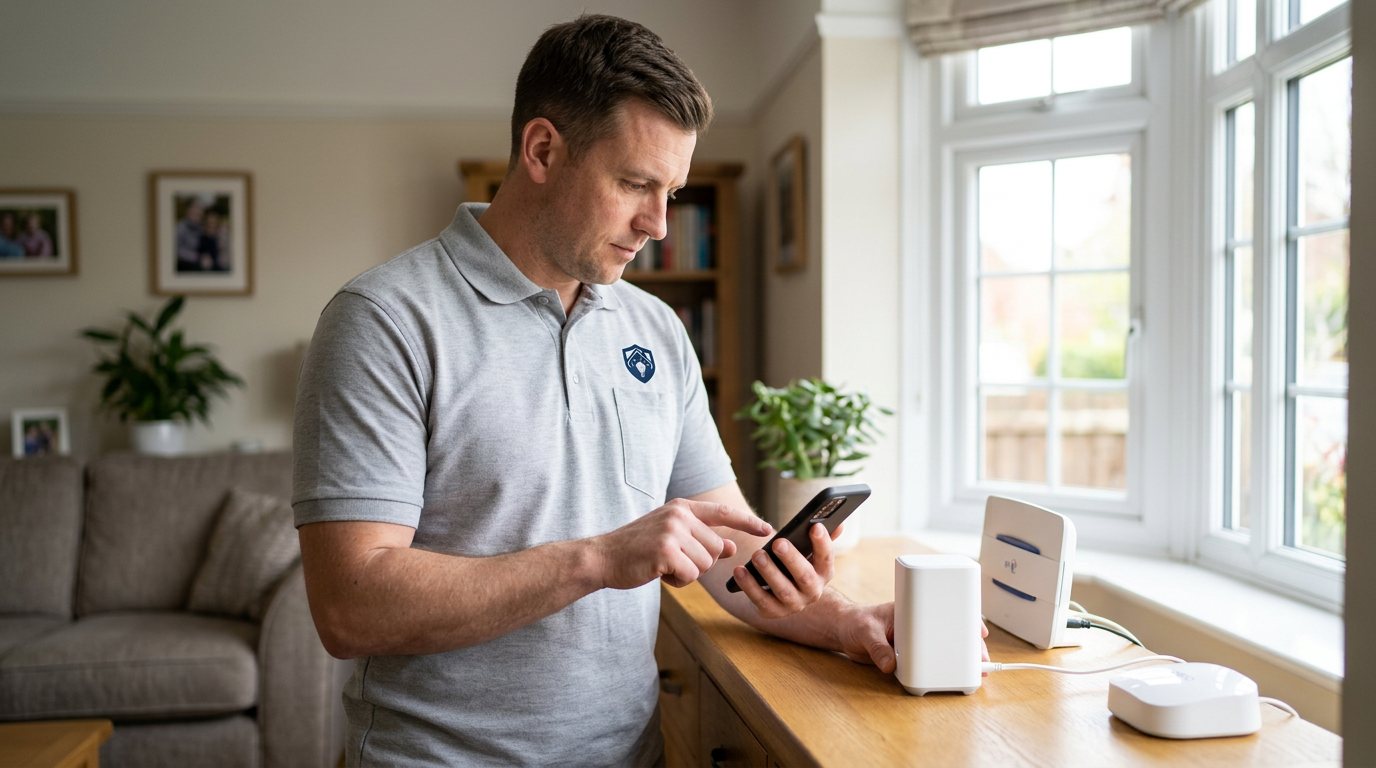
Security Alerts Arriving Late? We'll Speed Up What Matters in Dorridge
We find why alerts lag — phone restrictions, hub settings, signal or service delays — and tighten the chain.
Booking fee plus hourly labour — the price is confirmed before any work starts.
What this costs
| Booked 14+ days ahead | £25 booking fee £85 per hour |
|---|---|
| Booked within 48 hours | £100 booking fee £65 per hour |
| Same-day call-out | £220 booking fee £45 per hour |
The booking fee secures the visit. Labour is then charged by the hour, so you only pay for the time the job actually takes.
Booking fee £25–£220
£25 + £85/hr booked 14+ days ahead, £100 + £65/hr inside 48 hours, £220 + £45/hr same day. Agreed before we arrive.
Covered under Smart Security
Security & CCTV › Smart Security — one of 20 documented jobs in this section.
Same-day delayed security alerts
Urgent jobs can often be booked for today. Ask when you book and we will confirm the slot before you pay anything.
15 service areas
Birmingham, Coventry, Dorridge and 12 more across the West Midlands.
Notification delay is one of the most misunderstood smart security faults, because several different kinds of waiting get lumped together. There is the sensor noticing the event, the sensor telling the hub, the hub telling the cloud service, the cloud telling your phone, and your phone deciding to show it. A delay anywhere in that sequence produces the same user experience — late buzz — but completely different causes and fixes.
The common sources of delay
Phone power management is the leading culprit on modern smartphones: aggressive battery optimisation can hold an app's notifications back to save power, particularly on some Android models. Hub and app settings come next — some systems offer 'power saving' or 'interval' modes that trade instant alerts for battery life or bandwidth, and those modes are often enabled by default without anyone choosing them. Weak sensor signal causes retries: a sensor at the edge of range will eventually report, but only after several attempts. Cloud service load and mobile network congestion can add their own delays, which we can identify but not eliminate.
How we measure and diagnose
We time it. We trigger sensors deliberately and measure how long each stage takes — how quickly the hub reacts, how quickly the app's event log records the event, and how long the push notification takes to land on your phone. Splitting the timing like that tells us whether the delay is in your home, in the manufacturer's cloud, or in your phone's handling. We then check power-saving settings on both phone and hub, sensor signal strength, and battery health, because a struggling battery stretches every stage.
What we can fix
Most delays are fixable: excluding the security app from battery optimisation, adjusting hub polling or reporting settings, improving sensor placement or replacing weak batteries, and making sure the app and hub firmware are current. Where the residual delay comes from cloud services or mobile networks, we will say so honestly — those stages involve third-party services we cannot guarantee, and pretending otherwise would not help you.
What we will not do
We will not recommend disabling power-saving features wholesale, weakening authentication, or turning off other notifications to make security alerts arrive faster by brute force. The right fix is targeted: tell your phone this specific app matters, and configure the system to report promptly.
Why timing deserves attention
Alert latency quietly changes what a security system is for. Instant alerts let you react — check a camera, call a neighbour, decide whether something is wrong. Delayed alerts only let you review what already happened. Restoring speed restores the system's purpose, which is why we treat latency as a genuine fault rather than a quirk.
Aftercare
Re-test timing after phone operating system updates, because updates routinely reset battery optimisation settings and quietly reintroduce delays. A monthly two-minute test — trigger a sensor, check the alert lands within seconds — keeps the system honest.
Booking
Book through the website or by phone, and tell us roughly how long the delays are, which phone you use, and whether the delay affects all sensors or only some. If delays started after a phone update or a router change, mention that too — those dates often line up with the cause.
When the delay is the sensor, not the system
Some delays live entirely inside one device: a sensor with a weak battery, or one at the edge of range, will retry its report several times before the hub acknowledges it, and each retry adds seconds. If your timing tests show one slow sensor among otherwise prompt ones, that is the device to look at, and the fix is usually a battery, a re-pair or a reposition rather than anything system-wide. It is a good example of why we measure per device rather than accepting a single average — the average hides exactly the information that matters.
How the price works
We charge a booking fee to hold your slot, then an hourly rate for the work itself. The fee changes with how soon you need us; the hourly rate changes with the slot you choose. You approve the price before we start, so there is no surprise on the invoice.
Booked 14+ days ahead
£25 booking fee
then £85 per hour of labour
Best value. Book the slot now, pay the smallest booking fee.
Booked within 48 hours
£100 booking fee
then £65 per hour of labour
For jobs that can wait a day or two but not a fortnight.
Same-day call-out
£220 booking fee
then £45 per hour of labour
Urgent problems: standing water, no heat, no power, leaks.
Book the slot
Choose the window that suits you and pay the booking fee. That holds your place in the diary.
We diagnose on site
The engineer confirms the cause and tells you what the job involves and how long it should take.
You approve, we work
Nothing goes ahead until you agree the price. Labour is then charged per hour at your slot rate.
An alert that arrives minutes after the event is a strange half-failure: the system works, but too slowly to matter. If a door opens and your phone buzzes five minutes later, the value of the alert is mostly gone. Delays come from somewhere specific — phone power-saving, hub polling settings, weak sensor signal or cloud service lag — and each has a different fix. We diagnose which one is slowing your alerts down.
What our customers say about our Security & CCTV service
5 out of 5 from 7 reviews
Would use again
Third time we have used Maintenance Men, and the same experience each time: agreed price, proper explanation, job done in one visit. The hourly rate is fair for the standard of work.
Job: CCTV Installation
Second time we have used them
I had put off sorting this for months because I expected a runaround. Quoted the booking fee plus hourly rate upfront, stuck to it, and actually found the underlying cause rather than just clearing the symptom. Worked neatly and hoovered up afterwards.
Job: Backup Battery Fault
Exactly what was quoted
What I appreciated was being told what was actually wrong before anyone started. Sorted in under 56 minutes and the invoice matched the quote to the penny.
Job: Alarm Repair Service
Book Delayed Security Alerts
Tell us what is happening and choose a slot. If you are not sure this is the right job, use the diagnosis panel — it narrows the problem down before you book.
- Booking fee confirmed up front
- Hourly labour, agreed before work starts
- Same-day slots for urgent problems


Questions people ask about delayed security alerts
Straight answers to the things customers ask most often before booking.
Why are my security alerts slower than other app notifications?
Security apps are frequent targets of phone battery optimisation, because they run in the background waiting for events. Excluding the app from battery saving usually helps, but delays can also come from hub settings or sensor signal, so a timed diagnosis is worth having if the delay persists.
What do you test during the visit?
We trigger sensors and time each stage — sensor to hub, hub to cloud, cloud to your phone — then check power-saving settings, sensor signal and battery health. That tells us exactly which stage is slow, rather than guessing from the app alone.
Could the delay be the manufacturer's service rather than my setup?
It can be, and we will tell you if so. Cloud services and mobile networks can add delays outside anyone's on-site control, and we cannot guarantee third-party service performance. What we can do is remove every delay that is yours to remove, so what remains is honestly theirs.
Only one sensor alerts slowly — does that matter?
Yes, it is a useful clue. A single slow sensor usually points to weak signal or a weak battery at that device rather than a system-wide setting, so the fix is likely local: repositioning, a fresh battery or a re-pair rather than a system change.
How much does it cost to fix delayed alerts?
You pay a booking fee when you book, and labour is charged hourly at a rate that depends on how soon you need the visit. The full cost of the work is quoted and approved by you before we start, with any parts quoted separately.
Need delayed security alerts sorted in Dorridge?
Book a slot in the diary and pay only the booking fee up front. We confirm the rest before we start.