
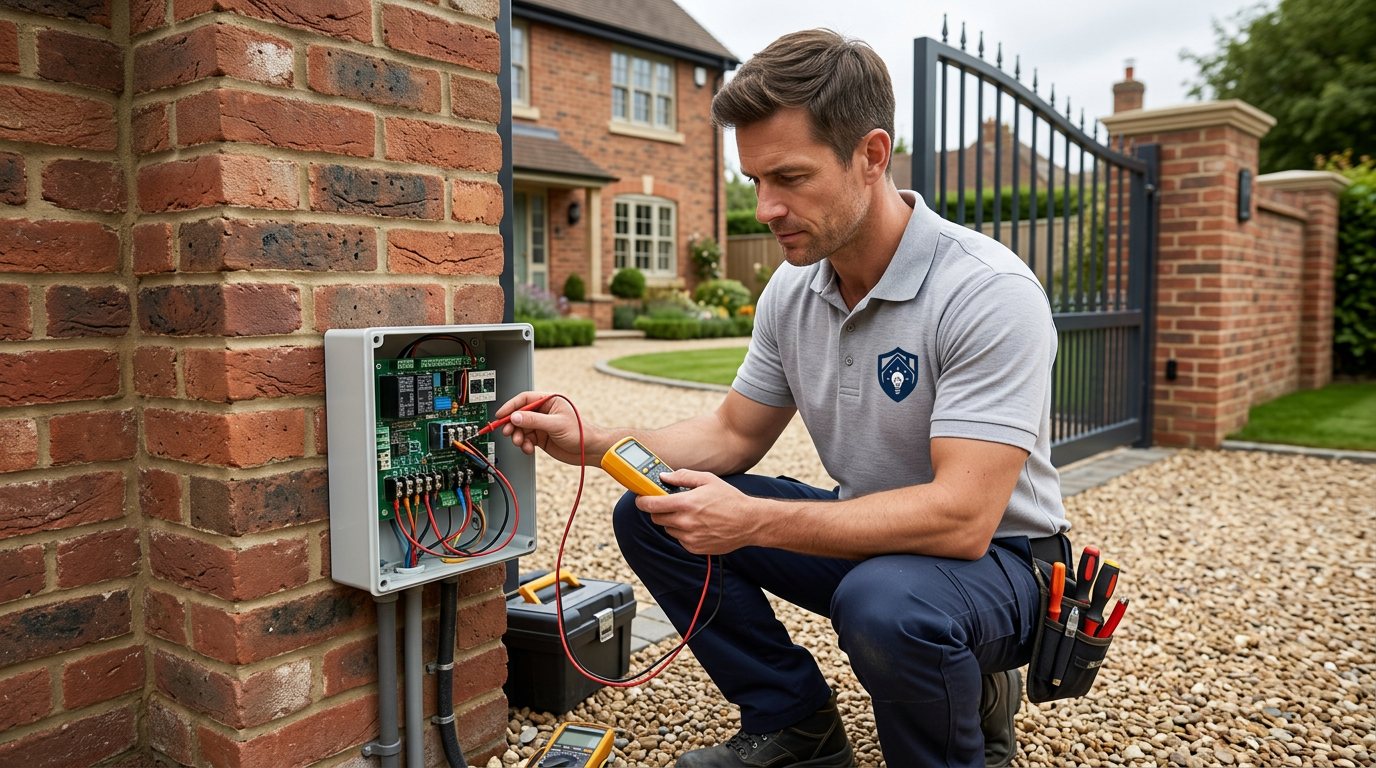
Gate Not Detecting Obstacles? Restoring the Protection Your Family Relies On in Coventry
We test and repair the obstruction detection that stops your gate striking people and property, restoring it to full specification.
Booking fee plus hourly labour — the price is confirmed before any work starts.
What this costs
| Booked 14+ days ahead | £25 booking fee £85 per hour |
|---|---|
| Booked within 48 hours | £100 booking fee £65 per hour |
| Same-day call-out | £220 booking fee £45 per hour |
The booking fee secures the visit. Labour is then charged by the hour, so you only pay for the time the job actually takes.
Booking fee £25–£220
£25 + £85/hr booked 14+ days ahead, £100 + £65/hr inside 48 hours, £220 + £45/hr same day. Agreed before we arrive.
Covered under Electric Gates
Security & CCTV › Electric Gates — one of 20 documented jobs in this section.
Same-day obstacle detection failure
Urgent jobs can often be booked for today. Ask when you book and we will confirm the slot before you pay anything.
15 service areas
Birmingham, Coventry, Dorridge and 12 more across the West Midlands.
Obstacle detection is what allows a heavy gate to share a driveway with people. It is a combination of devices — photocells watching the path, safety edges on the leading surfaces, and the motor's force limits sensing unexpected resistance — and when any part of it fails, the gate will keep moving where it should have stopped. A gate whose obstacle detection has failed is not just faulty; it is unsafe to use until it is repaired.
Why This Repair Cannot Wait
A family car bumper is the cheap casualty in a gate strike. A leg, an arm or a pet is the serious one. Gates are heavy moving machinery, and the protection that stops them hurting anything is not optional equipment — it is fundamental. That is why our first advice is always to limit use of the gate until detection is restored, keep everyone clear while it moves, and never, under any circumstances, disable or bypass safety edges, photocells or force limits to make the gate run normally in the meantime. Defeating the protection does not fix the fault; it removes the only thing standing between the machinery and harm.
The Three Layers of Detection
Photocells detect anything crossing the invisible beam across the gateway before and during movement. Safety edges — rubber profiles with an internal sensor along the gate's leading edge — detect contact at the moment it happens. Force limits in the control board detect resistance the other two miss: if the motor suddenly has to work harder than expected, the board stops and reverses. A gate with only one layer working is a gate with most of its protection missing, and we test all three.
How Detection Fails
Photocells fail through misalignment, dirt on the lenses, water ingress, wiring faults and component age. Safety edges fail when the rubber profile is damaged, the internal sensor fails, or the edge's wiring is broken — sometimes invisibly, inside the profile. Force limits fail less often themselves and more often get mis-set: turned up to push past a stiff gate, or reset wrongly after battery or board work. Any of these leaves the gate moving when it should not.
How We Test Detection Properly
We test each layer deliberately rather than trusting a gate that seems to reverse sometimes. The photocell beam is broken during a closing cycle to confirm the gate responds. The safety edges are tested per the manufacturer's method with a controlled contact during movement. Force limits are checked against the manufacturer's specification using measured settings rather than feel. Then we test the whole system together, because layers can individually pass while the combination is wrong — a board set to ignore a triggered edge, for example, or photocells wired to a dead input.
What We Repair
Alignment, cleaning and wiring faults are straightforward repairs. Damaged safety edges are replaced with the correct profile for your gate — edges are not interchangeable, and the wrong type can be both ineffective and non-compliant with how the system was designed. Failed photocell units are replaced as matched pairs where needed. Mis-set force limits are restored to specification, not simply increased. On older systems lacking modern safety devices, we will explain honestly what can be added and what it involves. Parts are quoted separately and the full cost is approved by you before work starts.
The Honest Limits
Detection systems detect — they reduce risk, they do not eliminate it, and no gate can be made incapable of harming a person who behaves carelessly around it. We will tell you what your system can and cannot achieve after repair, including whether older equipment can realistically be brought up to a good standard or whether an upgrade makes more sense.
Aftercare
Detection equipment repays simple attention: keep photocell lenses clean, report knocks to units or bent edges promptly, and have the system serviced periodically so force limits and safety devices are tested against specification rather than memory. If the gate ever feels different — faster, harder, less willing to reverse — book a check rather than waiting.
When to Call Us
Call if the gate has ever failed to reverse for an object or person, if a safety edge has been knocked or damaged, if the gate feels more forceful than it used to, or after any board, battery or motor work by anyone else. Tell us the make and model, what happened, and whether the gate currently reverses at all.
Booking Your Visit
You pay a booking fee when you book, and labour is charged hourly at a rate that depends on how soon you need the visit. The full cost of the repair is quoted and approved before we start, with parts quoted separately. Same-day visits may be available — safety faults on gates are prioritised.
How the price works
We charge a booking fee to hold your slot, then an hourly rate for the work itself. The fee changes with how soon you need us; the hourly rate changes with the slot you choose. You approve the price before we start, so there is no surprise on the invoice.
Booked 14+ days ahead
£25 booking fee
then £85 per hour of labour
Best value. Book the slot now, pay the smallest booking fee.
Booked within 48 hours
£100 booking fee
then £65 per hour of labour
For jobs that can wait a day or two but not a fortnight.
Same-day call-out
£220 booking fee
then £45 per hour of labour
Urgent problems: standing water, no heat, no power, leaks.
Book the slot
Choose the window that suits you and pay the booking fee. That holds your place in the diary.
We diagnose on site
The engineer confirms the cause and tells you what the job involves and how long it should take.
You approve, we work
Nothing goes ahead until you agree the price. Labour is then charged per hour at your slot rate.
Obstacle detection is the quiet safeguard between a moving gate and everything in its path — people, pets, cars. When it stops working, the gate becomes genuinely dangerous, and this is one repair where we will never take shortcuts.
What our customers say about our Security & CCTV service
5 out of 5 from 7 reviews
Would use again
Third time we have used Maintenance Men, and the same experience each time: agreed price, proper explanation, job done in one visit. The hourly rate is fair for the standard of work.
Job: CCTV Installation
Second time we have used them
I had put off sorting this for months because I expected a runaround. Quoted the booking fee plus hourly rate upfront, stuck to it, and actually found the underlying cause rather than just clearing the symptom. Worked neatly and hoovered up afterwards.
Job: Backup Battery Fault
Exactly what was quoted
What I appreciated was being told what was actually wrong before anyone started. Sorted in under 56 minutes and the invoice matched the quote to the penny.
Job: Alarm Repair Service
Book Obstacle Detection Failure
Tell us what is happening and choose a slot. If you are not sure this is the right job, use the diagnosis panel — it narrows the problem down before you book.
- Booking fee confirmed up front
- Hourly labour, agreed before work starts
- Same-day slots for urgent problems





Questions people ask about obstacle detection failure
Straight answers to the things customers ask most often before booking.
Is there any DIY check for obstacle detection?
You can safely test whether the gate reverses by breaking the photocell beam with a cardboard box during a close cycle, and you can clean the sensor lenses. What you must never do is bypass, disable or tape over any safety device, or adjust force settings — that converts a fault into a hazard. Everything beyond cleaning is engineer work.
What do you actually test on the visit?
We test all three detection layers deliberately: the photocell beam during movement, the safety edges with a controlled contact test, and the force limits against the manufacturer's specification. Then we test the system as a whole, because individual parts can pass while the combination is unsafe.
The gate only reverses sometimes — is that still dangerous?
Yes. Intermittent protection is worse than none, because everyone behaves as though the gate is safe right up until the moment it is not. An intermittent reversal usually means a marginal photocell, a failing edge or a mis-set force limit, and we will find which before returning the gate to use.
My old gate has no safety edges — can they be added?
Often, yes, depending on the operator and gate design — some older control boards cannot support edges, and in those cases we will explain what the system can and cannot achieve honestly. Any addition is quoted after we have assessed the equipment, with the full cost approved before work begins.
How much does the repair cost?
You pay a booking fee when you book. Labour is charged hourly at a rate that depends on how soon you need us, and the full cost is quoted and approved before work starts. Parts such as safety edges or photocell units are quoted separately.
Need obstacle detection failure sorted in Coventry?
Book a slot in the diary and pay only the booking fee up front. We confirm the rest before we start.