
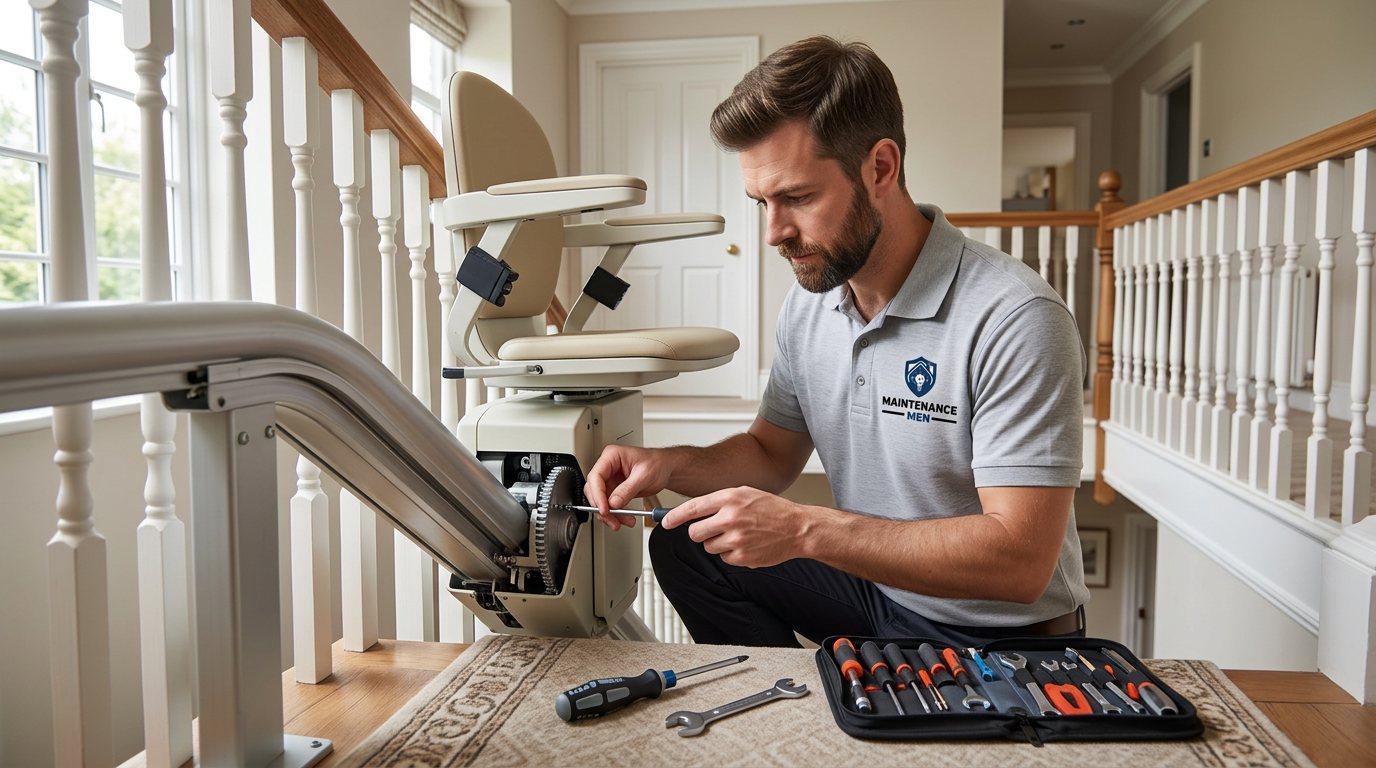
Stair Lift Not Charging? Batteries and Contacts Sorted Properly in Coventry
We test the charging system end to end — batteries, contacts and supply — then quote the fix before any work is carried out.
Booking fee plus hourly labour — the price is confirmed before any work starts.
What this costs
| Booked 14+ days ahead | £25 booking fee £85 per hour |
|---|---|
| Booked within 48 hours | £100 booking fee £65 per hour |
| Same-day call-out | £220 booking fee £45 per hour |
The booking fee secures the visit. Labour is then charged by the hour, so you only pay for the time the job actually takes.
Booking fee £25–£220
£25 + £85/hr booked 14+ days ahead, £100 + £65/hr inside 48 hours, £220 + £45/hr same day. Agreed before we arrive.
Covered under Stair Lifts
Mobility & Accessibility › Stair Lifts — one of 24 documented jobs in this section.
Same-day stair lift not charging
Urgent jobs can often be booked for today. Ask when you book and we will confirm the slot before you pay anything.
15 service areas
Birmingham, Coventry, Dorridge and 12 more across the West Midlands.
Modern stair lifts mostly run on rechargeable batteries rather than a cable trailing up the stairs, charging through contacts that meet when the lift parks at the top or bottom. That design is safer and tangle-free, but it means a lift's reliability depends entirely on its charging system staying clean, aligned and healthy. When charging fails, the batteries run down silently over a day or two and the lift simply stops.
How stair lift charging works, briefly
Two charge contacts on the lift carriage press against mating contacts or pads on the rail at the park position. A small charger unit — sometimes on the lift, sometimes at the foot of the rail — keeps the batteries topped up. For this to work, the lift must park fully and squarely on its charge points, the contacts must touch cleanly, and the batteries themselves must still accept charge. A failure in any of those three areas produces the same symptom: a lift that is low or dead each morning despite being parked.
Common causes of charging failure
The most frequent is simply a parking habit problem — the lift left a few inches off its park position, or the seat swivelled and stopped the carriage seating fully. Next come dirty, corroded or bent contacts, which wipe clean easily but sometimes need adjustment. A failed charger or a blown fuse in the charger supply stops charging entirely. And the most common genuine component failure is the batteries themselves: stair lift batteries age, typically lasting a few years depending on use and climate, and as they wear they accept less charge each night. Batteries are a normal consumable and replacing them is routine work with manufacturer-approved parts.
What you can check yourself
Park the lift precisely on its charge points and confirm any charging indicator light comes on — your manual will show what it looks like. Look at the contacts on the carriage and rail for dirt or discolouration and, with the lift switched off or isolated as the manual directs, wipe them gently with a dry cloth. Check the charger's plug and any socket switch is on, and that nothing has tripped. If the lift still will not hold charge, stop there: battery testing under load, charger output testing and contact adjustment need the right tools and knowledge.
What we do on a charging-fault visit
We measure the battery voltage before and after a charge attempt, test the charger's output, check continuity through the charging contacts, and load-test the batteries to see whether they hold charge the way healthy ones should. If batteries have failed we replace them with manufacturer-approved parts and recycle the old ones responsibly. If the charger, contacts or wiring are at fault we quote that repair separately. Every cost is quoted in full and approved by you before work starts — no surprises mid-job.
Warning signs not to ignore
A lift that has run completely flat should be recharged properly before use, not run briefly on a dying battery. If the lift has behaved erratically, tripped the electrics or smelled of burning, do not use it or attempt charging until it has been checked. And if the batteries are swollen, leaking or noticeably hot, stop using the lift and book a visit — damaged batteries should only be handled by an engineer.
Aftercare
Make parking on the charge points a firm habit — a chime or light confirms it on most models. Keep the rail park area clean and dry. Consider an annual service, where we check battery health, contacts and charger output together; catching a weakening battery before it dies keeps the lift dependable, and a serviced lift is far less likely to strand anyone between floors.
Booking
Tell us the make and model, whether a charging light shows when parked, and how long the problem has been building. You pay a booking fee when you book, labour is hourly at a rate that depends on how soon you need the visit, and the full cost is quoted and approved before any work starts, with parts quoted separately.
How the price works
We charge a booking fee to hold your slot, then an hourly rate for the work itself. The fee changes with how soon you need us; the hourly rate changes with the slot you choose. You approve the price before we start, so there is no surprise on the invoice.
Booked 14+ days ahead
£25 booking fee
then £85 per hour of labour
Best value. Book the slot now, pay the smallest booking fee.
Booked within 48 hours
£100 booking fee
then £65 per hour of labour
For jobs that can wait a day or two but not a fortnight.
Same-day call-out
£220 booking fee
then £45 per hour of labour
Urgent problems: standing water, no heat, no power, leaks.
Book the slot
Choose the window that suits you and pay the booking fee. That holds your place in the diary.
We diagnose on site
The engineer confirms the cause and tells you what the job involves and how long it should take.
You approve, we work
Nothing goes ahead until you agree the price. Labour is then charged per hour at your slot rate.
A lift that never seems to hold charge gets worse quickly, often leaving it dead exactly when you need it. Charging problems are usually straightforward to diagnose, and this page explains how the system works and what our visit involves.
What our customers say about our mobility & accessibility service
4.5 out of 5 from 8 reviews
Proper job, no upselling
Turned up in the window they promised, walked me through the options (turns out the old fitting was seized and needed careful removal), then cracked on. Everything was tested before they left. No mess, no drama, no surprise on the bill.
Job: Loose or Faulty Brakes
Fine in the end
The problem is fixed, which is the main thing, and the engineer clearly knew what they were doing. It took a fair bit longer than the estimate on the phone and I had to ask twice for a breakdown of the hours.
Job: Stair Lift Service
Would use again
What I appreciated was being told what was actually wrong before anyone started. Sorted in under 70 minutes and the invoice matched the quote to the penny.
Job: Control Panel Fault
Book Stair Lift Not Charging
Tell us what is happening and choose a slot. If you are not sure this is the right job, use the diagnosis panel — it narrows the problem down before you book.
- Booking fee confirmed up front
- Hourly labour, agreed before work starts
- Same-day slots for urgent problems


Questions people ask about stair lift not charging
Straight answers to the things customers ask most often before booking.
Can I replace stair lift batteries myself?
Some manufacturers design batteries as a user-replaceable item and describe the procedure in the manual — if yours does and you are confident, follow it exactly. If the manual does not cover it, or the batteries are swollen or leaking, leave it to an engineer. We fit manufacturer-approved batteries as routine work.
What does a charging fault visit actually involve?
We test battery voltage and load performance, check the charger's output and supply, inspect and test the charging contacts for dirt, alignment or damage, and confirm the lift seats properly on its park position. Then we quote any repair or battery replacement in full for your approval before starting.
Is it safe to keep using a lift that keeps going flat?
A lift that repeatedly runs low can stop at any point on the stairs, including with someone seated. If it does stop with a person aboard, keep them safe and comfortable, call 999 if they are in distress, and use a manual release only strictly per the manufacturer's instructions. Book the charging fault repaired rather than relying on luck.
Our lift is used only once or twice a day — should the batteries still wear out?
Yes. Stair lift batteries age with time and temperature as much as with use, and light use does not prevent them reaching the end of their service life. Batteries are treated as a consumable part across the industry, and replacement with the manufacturer's approved type is normal maintenance, not a sign the lift is failing.
What will the repair cost?
You pay a booking fee when you book, and labour is charged at an hourly rate that depends on how soon you need us. After diagnosis we quote the full cost of the work, which you approve before we start, and parts such as batteries or a charger are quoted separately.
Need stair lift not charging sorted in Coventry?
Book a slot in the diary and pay only the booking fee up front. We confirm the rest before we start.