
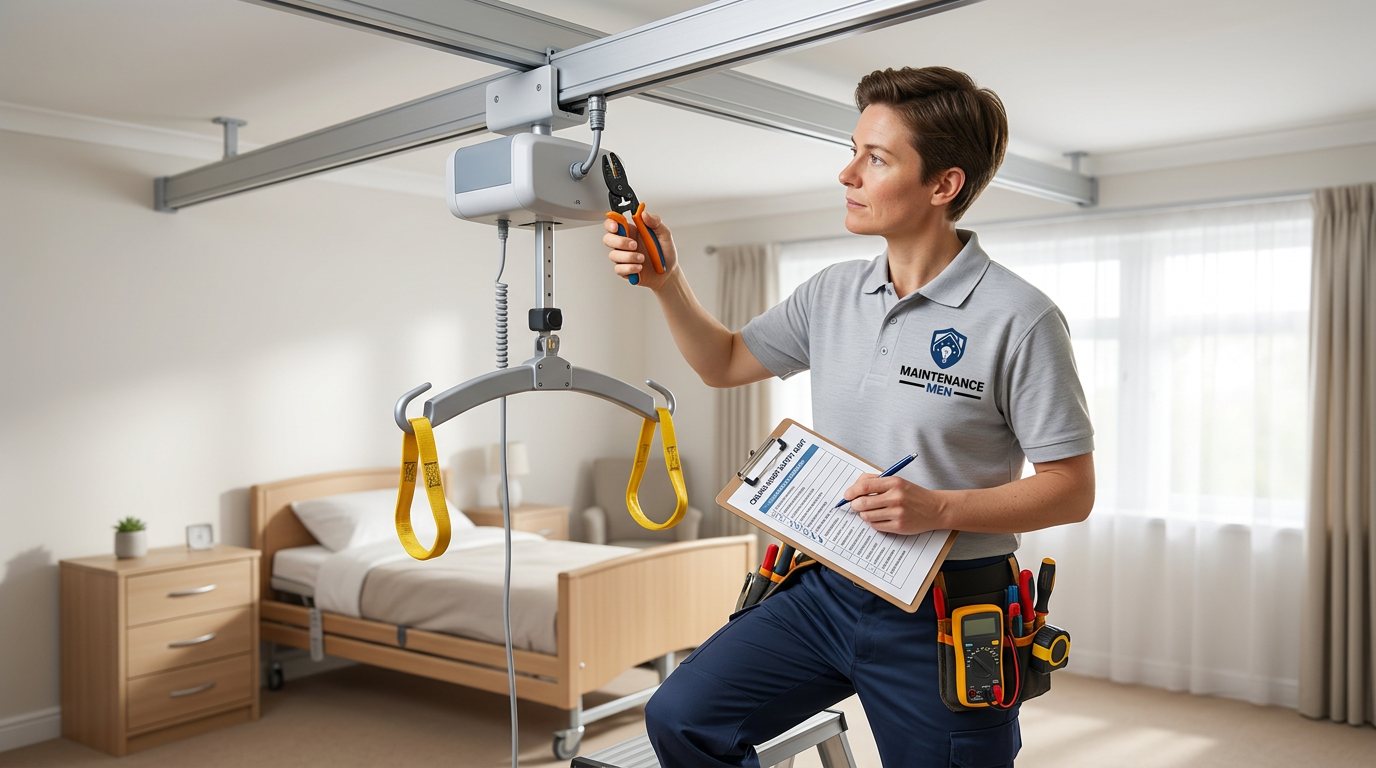
Emergency Stop Playing Up? That's a Stop-Using-It Fault We Take Seriously in Coventry
We test the stop button, its wiring and the control circuit, and we will not hand back a hoist whose emergency stop cannot be relied on.
Booking fee plus hourly labour — the price is confirmed before any work starts.
What this costs
| Booked 14+ days ahead | £25 booking fee £85 per hour |
|---|---|
| Booked within 48 hours | £100 booking fee £65 per hour |
| Same-day call-out | £220 booking fee £45 per hour |
The booking fee secures the visit. Labour is then charged by the hour, so you only pay for the time the job actually takes.
Booking fee £25–£220
£25 + £85/hr booked 14+ days ahead, £100 + £65/hr inside 48 hours, £220 + £45/hr same day. Agreed before we arrive.
Covered under Hoists & Lifting Equipment
Mobility & Accessibility › Hoists & Lifting Equipment — one of 22 documented jobs in this section.
Same-day emergency stop fault
Urgent jobs can often be booked for today. Ask when you book and we will confirm the slot before you pay anything.
15 service areas
Birmingham, Coventry, Dorridge and 12 more across the West Midlands.
An emergency stop is a safety function, not a convenience button. Its failure puts the hoist outside the condition its manufacturer intended it to be used in.
What a Fault Looks Like
- The button presses in but does not latch, so it pops straight back out.
- The button latches but the hoist continues to move.
- The button has been released and twisted, but the hoist still will not run.
- The hoist stops on its own without anyone touching the stop.
- The button feels loose, gritty, or does not travel its full distance.
- A pull-cord type stop on some units is frayed, detached or does not retract.
Any of these means the unit should come out of service until it has been checked, even if everything else seems fine.
Why These Fail
Emergency stops are mechanical switches pressed rarely and expected to work after years of sitting idle. Contacts oxidise. The latching mechanism collects dust and stiffens. The wiring behind the button is stressed each time the button is pressed, and a conductor can part inside the sheath. In bathrooms and wet rooms, moisture reaches terminals. On units where the stop is mounted on the handset, the cable carries both the stop circuit and the control signals, so a damaged cable can produce a stop that engages at random. Occasionally the fault is not the button at all but the control box's stop circuit, or a relay that has welded and no longer drops out.
How We Test It
We test the button as a switch: continuity across its contacts in both the latched and released states, and again while the handset or the wiring is flexed, because a fault that only appears when the cable moves is common and easily missed. We check the latching mechanism operates properly and needs a deliberate twist or pull to reset, as the manufacturer specifies. We test the stop circuit at the control box, and we confirm the unit actually stops when the button is pressed during a controlled lift — a functional test, not just an electrical one. We also test that releasing the stop restores normal operation without a power cycle.
Repairs
Replacing the stop button or the handset that carries it, repairing or replacing the section of cable, re-terminating corroded connections, and replacing a control box whose stop circuit has failed are all within scope. Every repair is finished with a functional test: press the stop during a controlled lift and confirm the unit stops and stays stopped until deliberately reset. If the correct part is not available, we will say so; we check availability rather than promising it.
What We Refuse to Do
We will not bypass an emergency stop, tape it in the released position, disconnect it so the hoist runs, or fit a substitute switch that is not approved for the unit. If a stop button is faulty and a customer wants the hoist working "just for now", the answer is no — and the reason is simple: the next time it is needed, someone will press a button that does nothing. We also cannot certify the hoist as suitable for an individual's needs; that is a matter for the user, their family and carers and the manufacturer's specification.
While It Is Out of Use
Switch off at the isolator or unplug the charger and take the unit out of service. Do not use it because "the stop only plays up sometimes" — an intermittent stop is the worst version. If someone is currently suspended and the hoist will not operate, keep them calm and comfortable, call 999 if they are in pain or distress, and use the emergency lowering only exactly as the manufacturer's instructions describe, from a stable position, never by climbing under the load.
Preventing the Next One
Have the stop tested at every service rather than waiting for it to fail, keep the handset clean and dry, avoid hanging the handset by its cable, and check before each use that the button is fully released and the unit responds. It takes seconds and catches most problems early.
Booking
Tell us the make and model, what the stop does when pressed, whether the hoist runs at all afterwards, and whether the fault is constant or occasional. You pay a booking fee when you book, the hourly labour rate depends on how soon you need the visit, and the full cost is quoted and approved before work begins.
How the price works
We charge a booking fee to hold your slot, then an hourly rate for the work itself. The fee changes with how soon you need us; the hourly rate changes with the slot you choose. You approve the price before we start, so there is no surprise on the invoice.
Booked 14+ days ahead
£25 booking fee
then £85 per hour of labour
Best value. Book the slot now, pay the smallest booking fee.
Booked within 48 hours
£100 booking fee
then £65 per hour of labour
For jobs that can wait a day or two but not a fortnight.
Same-day call-out
£220 booking fee
then £45 per hour of labour
Urgent problems: standing water, no heat, no power, leaks.
Book the slot
Choose the window that suits you and pay the booking fee. That holds your place in the diary.
We diagnose on site
The engineer confirms the cause and tells you what the job involves and how long it should take.
You approve, we work
Nothing goes ahead until you agree the price. Labour is then charged per hour at your slot rate.
The emergency stop is the one control you hope never to use and the one that must work perfectly if you do. When it will not latch, will not release, or trips the hoist without being touched, the unit is not safe to operate — however well it behaves the rest of the time. This is a fault to switch off and report, not one to work around.
What our customers say about our mobility & accessibility service
4.5 out of 5 from 8 reviews
Proper job, no upselling
Turned up in the window they promised, walked me through the options (turns out the old fitting was seized and needed careful removal), then cracked on. Everything was tested before they left. No mess, no drama, no surprise on the bill.
Job: Loose or Faulty Brakes
Fine in the end
The problem is fixed, which is the main thing, and the engineer clearly knew what they were doing. It took a fair bit longer than the estimate on the phone and I had to ask twice for a breakdown of the hours.
Job: Stair Lift Service
Would use again
What I appreciated was being told what was actually wrong before anyone started. Sorted in under 70 minutes and the invoice matched the quote to the penny.
Job: Control Panel Fault
Book Emergency Stop Fault
Tell us what is happening and choose a slot. If you are not sure this is the right job, use the diagnosis panel — it narrows the problem down before you book.
- Booking fee confirmed up front
- Hourly labour, agreed before work starts
- Same-day slots for urgent problems






Questions people ask about emergency stop fault
Straight answers to the things customers ask most often before booking.
The stop button is stuck down and the hoist won't run. Can I free it myself?
You can check whether it needs a deliberate twist or pull to release, as most do, and whether anything is physically jammed against it. Do not prise it apart, disconnect it or bypass it to get the hoist running. If it will not release properly or the hoist still will not run, leave it switched off and call us.
What do you test?
Continuity across the stop contacts in both latched and released states, the latching mechanism, the wiring while it is flexed, and the stop circuit at the control box. Then we do a functional test — pressing the stop during a controlled lift to confirm the unit actually stops and stays stopped until it is deliberately reset.
Can you disconnect the stop temporarily so we can use the hoist?
No. An emergency stop that has been bypassed is worse than no stop at all, because the operator believes it will work. If the button is faulty the hoist stays out of service until it is properly repaired with the correct part.
It only plays up occasionally. Is that less of a problem?
It is more of a problem. An intermittent stop can leave someone suspended at the exact moment it is needed, and intermittent faults in this circuit usually get worse quickly. Please stop using the hoist until it has been tested.
What will it cost?
You pay a booking fee when you book, and the hourly labour rate depends on how soon you need the visit. We quote the full cost of the work and you approve it before we start, with any parts such as a replacement stop button or handset quoted separately.
Need emergency stop fault sorted in Coventry?
Book a slot in the diary and pay only the booking fee up front. We confirm the rest before we start.