
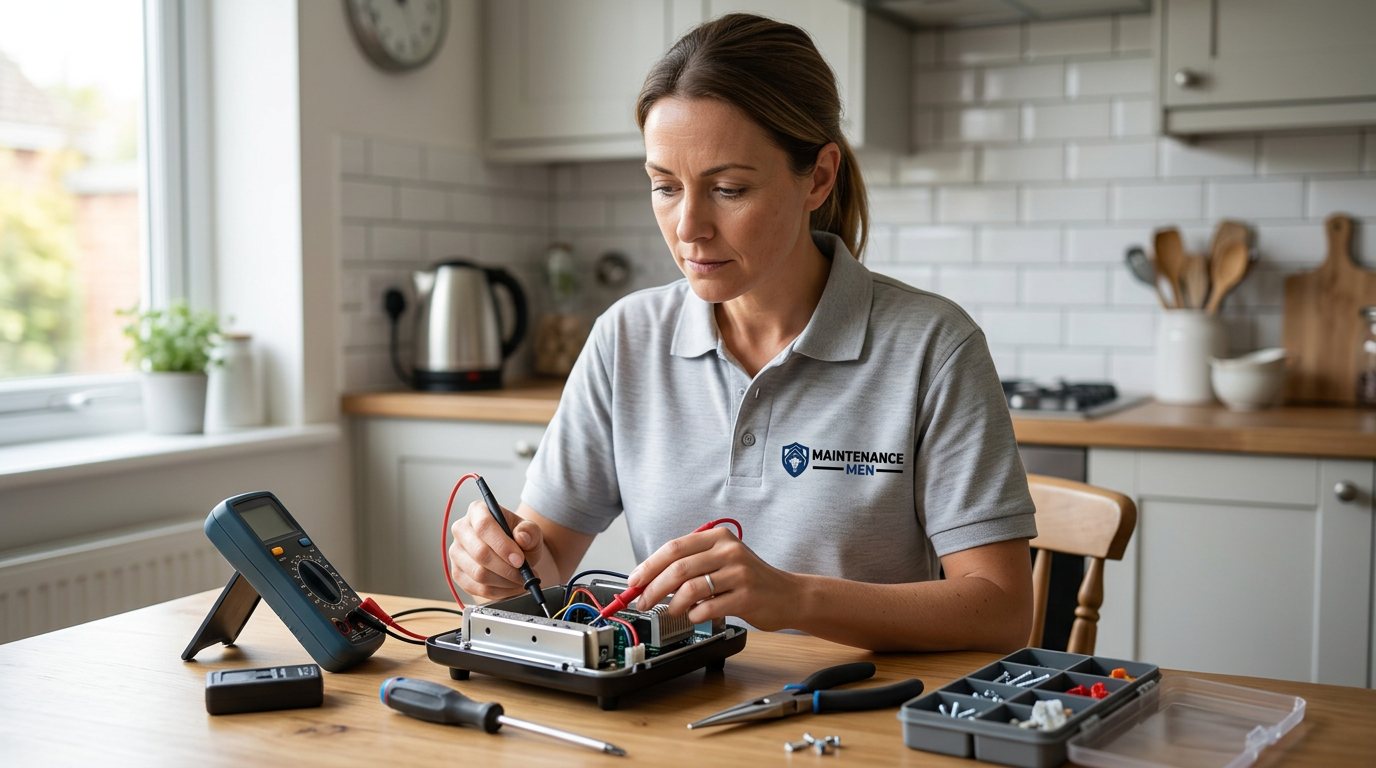
Appliance cutting in and out? We find the loose connection in Coventry
We isolate whether an intermittent supply fault sits in the plug, flex, switch or internal wiring, and test under load so the fault shows itself during the visit.
Booking fee plus hourly labour — the price is confirmed before any work starts.
What this costs
| Booked 14+ days ahead | £25 booking fee £85 per hour |
|---|---|
| Booked within 48 hours | £100 booking fee £65 per hour |
| Same-day call-out | £220 booking fee £45 per hour |
The booking fee secures the visit. Labour is then charged by the hour, so you only pay for the time the job actually takes.
Booking fee £25–£220
£25 + £85/hr booked 14+ days ahead, £100 + £65/hr inside 48 hours, £220 + £45/hr same day. Agreed before we arrive.
Covered under Small Appliances
Home Appliances › Small Appliances — one of 20 documented jobs in this section.
Same-day intermittent power fault
Urgent jobs can often be booked for today. Ask when you book and we will confirm the slot before you pay anything.
15 service areas
Birmingham, Coventry, Dorridge and 12 more across the West Midlands.
An appliance that cuts out mid-use, restarts when you wiggle the plug, or dies for a day and then behaves perfectly is showing you an intermittent fault. These are rarely random. A connection has worked loose, a switch contact has burned back, a thermal cut-out is tripping early, or a cable has been damaged inside its insulation where you cannot see it. The difficulty is that intermittent faults hide, so the visit is as much about provoking the fault as about finding it.
What intermittent usually means in practice
Three mechanisms account for most of what we see. The first is a high-resistance joint: a terminal screw that has loosened, a crimp that was never tight, or a solder joint that has cracked with repeated heating and cooling. It passes current most of the time, heats up under load, and eventually opens. The second is a protective device operating early: a thermal cut-out or thermal fuse tripping below its intended temperature because the appliance is running hotter than it should, often from blocked vents or a tired cooling fan. The third is mechanical: a flex that is broken inside the outer sheath near the strain relief, so it makes contact in one position and not another.
Testing under load rather than at rest
A multimeter on a dead appliance tells you very little about a fault that only appears when it is drawing current. Where it is safe and appropriate, we test with the appliance running and monitor voltage at the plug, at the switch and at the internal supply, looking for a drop that should not be there. We also flex the cable gently at the points where it bends, watching for the supply to flicker. Heat is a useful clue too: a warm plug pin, a discoloured terminal or a scorch mark on a switch body points straight at the joint that is failing.
The plug and flex get checked first
It is genuinely common to find the fault in the plug. Loose strands at a rewired plug, a fuse holder that has lost its spring tension, or a cable grip that was never tightened so the inner cores take the strain. We open the plug, inspect the terminations, check the fuse rating against the appliance load and remake anything doubtful. The flex is inspected along its length for crush damage, cable-tie pinching and heat marks, particularly where it passes through a cabinet or behind a worktop.
When the fault will not reproduce
Sometimes the appliance behaves impeccably for the whole visit. That is not a wasted appointment. We can still report what we measured, rule out the supply, flag any wear or heat damage we found, and advise on what to monitor. Photographs of the fault when it happens, a note of what the appliance was doing at the time, and whether the lights flickered or a breaker tripped all help narrow it down. If the pattern points to a particular stage, we can discuss replacing the likely component as a precaution and be clear that it is a judgement call rather than a certainty.
Where we stop
Intermittent faults on high-voltage sections, such as the internal circuit of a microwave, are not something we open up; the stored charge in a capacitor remains dangerous even with the plug out. Appliances with damaged fixed wiring circuits, scorched sockets or a breaker that trips when the appliance is used need the circuit investigated, and we will explain what is and is not within the visit. If the fault involves a gas appliance, we do not work on the gas side at all.
Preparing for the visit
Unplug the appliance, but do not dismantle it. Keep a note of exactly when it cuts out — after ten minutes, on a particular setting, only when the room is warm — because that detail often saves time. Have the make, model and age to hand, and mention anything you have already replaced. If a breaker has tripped, note which one and whether it reset without trouble.
How to book
Book online, describing the appliance and the pattern of the fault. The booking fee is paid when you book and the hourly labour rate depends on how soon you need the visit. The full cost is quoted and approved before work starts, with any parts identified and priced separately after diagnosis.
How the price works
We charge a booking fee to hold your slot, then an hourly rate for the work itself. The fee changes with how soon you need us; the hourly rate changes with the slot you choose. You approve the price before we start, so there is no surprise on the invoice.
Booked 14+ days ahead
£25 booking fee
then £85 per hour of labour
Best value. Book the slot now, pay the smallest booking fee.
Booked within 48 hours
£100 booking fee
then £65 per hour of labour
For jobs that can wait a day or two but not a fortnight.
Same-day call-out
£220 booking fee
then £45 per hour of labour
Urgent problems: standing water, no heat, no power, leaks.
Book the slot
Choose the window that suits you and pay the booking fee. That holds your place in the diary.
We diagnose on site
The engineer confirms the cause and tells you what the job involves and how long it should take.
You approve, we work
Nothing goes ahead until you agree the price. Labour is then charged per hour at your slot rate.
Intermittent faults are the hardest kind to live with, because the appliance works perfectly until the moment it does not. They are also the ones most often left alone until something overheats. We test the supply path under load, check joints and terminations for heat damage and movement, and explain what we find, even when the fault refuses to appear on the day.
What our customers say about our home appliances service
4.8 out of 5 from 14 reviews
Exactly what was quoted
What I appreciated was being told what was actually wrong before anyone started. Sorted in under 27 minutes and the invoice matched the quote to the penny.
Job: Tumble Dryer Not Starting Cycle
Good job, slightly late
Solid work. Hourly rate feels fair for the amount of work involved and everything was tested before they left. Would book again.
Job: Toaster Not Working
No mess left behind
Really straightforward. It had been bothering us for weeks; diagnosed properly, fixed the same visit, and the price was exactly what was explained when booking. Can not fault it.
Job: Microwave Button Repair
Book Intermittent Power Fault
Tell us what is happening and choose a slot. If you are not sure this is the right job, use the diagnosis panel — it narrows the problem down before you book.
- Booking fee confirmed up front
- Hourly labour, agreed before work starts
- Same-day slots for urgent problems









Questions people ask about intermittent power fault
Straight answers to the things customers ask most often before booking.
Can I sort an intermittent fault myself?
You can check the obvious things safely: that the plug is firmly in, the cable grip is tight, the fuse rating is correct and the vents are clear. Anything beyond that, particularly opening the appliance, is better left to someone who can test it properly.
What is checked during an intermittent fault visit?
The socket and supply, the plug terminations and fuse, the flex along its length, the switch and any thermal cut-out, plus a load test where it is safe to run the appliance. We also look for heat damage at terminals. The appliance is inspected cold, then run under load only where that is safe.
The appliance only cuts out occasionally. Is that dangerous?
It can be. A loose joint that heats up is a fire risk over time, and a thermal cut-out tripping early usually means something is running hotter than designed. It is worth having it looked at rather than waiting for it to fail completely.
What if the fault does not happen while you are here?
We will still test the supply path, report measurements and flag anything worn or heat-damaged. Notes on when it happens and any photos you have taken make a real difference to narrowing it down.
What will it cost?
You pay the booking fee when you book, and the hourly labour rate depends on how soon you need the visit. We confirm the full cost for your approval before any work begins, and parts are quoted separately once identified.
Need intermittent power fault sorted in Coventry?
Book a slot in the diary and pay only the booking fee up front. We confirm the rest before we start.