
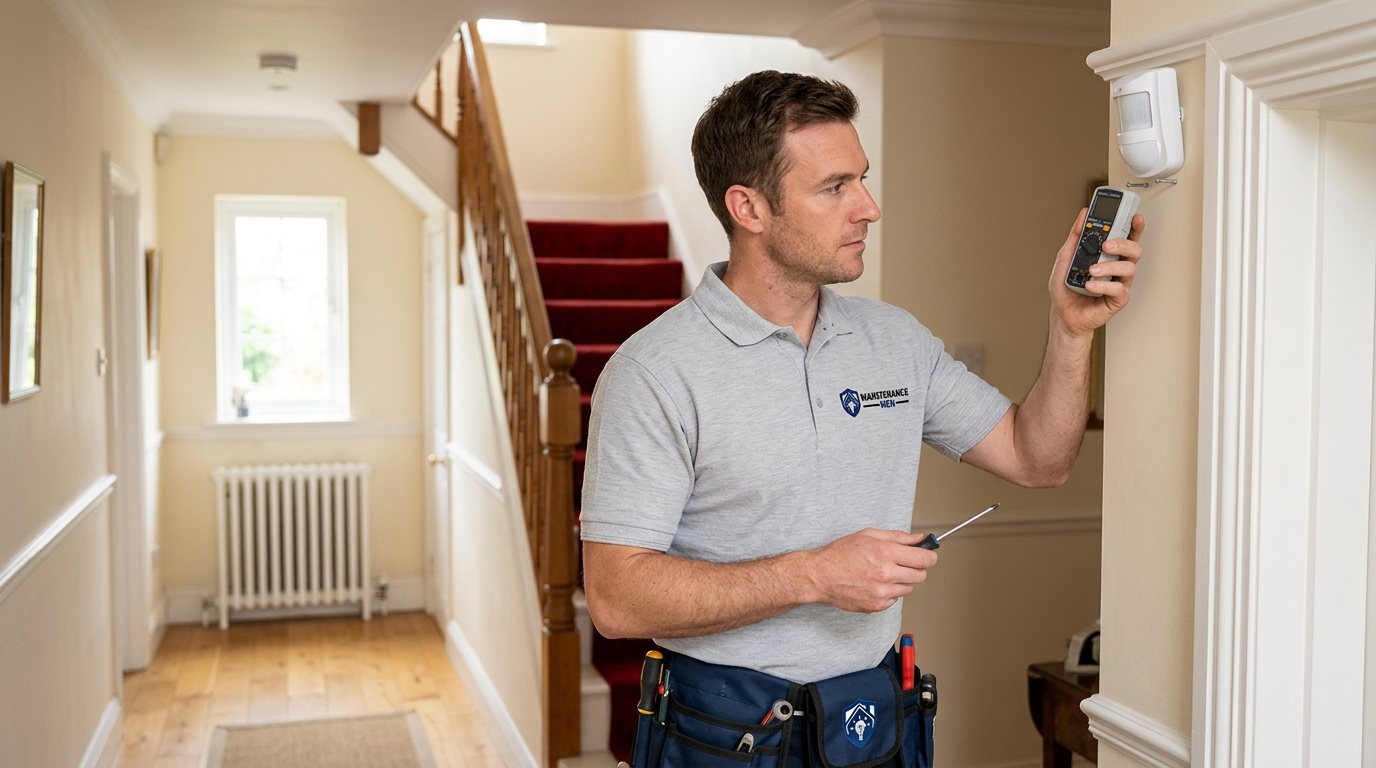
Sensor Signal Loss? Weak Links Found and Made Reliable Again in Birmingham
We trace why a sensor's signal keeps dropping — range, obstructions, battery, interference or hardware — and make the link solid, with the work quoted first.
Booking fee plus hourly labour — the price is confirmed before any work starts.
What this costs
| Booked 14+ days ahead | £25 booking fee £85 per hour |
|---|---|
| Booked within 48 hours | £100 booking fee £65 per hour |
| Same-day call-out | £220 booking fee £45 per hour |
The booking fee secures the visit. Labour is then charged by the hour, so you only pay for the time the job actually takes.
Booking fee £25–£220
£25 + £85/hr booked 14+ days ahead, £100 + £65/hr inside 48 hours, £220 + £45/hr same day. Agreed before we arrive.
Covered under Sensors & Detectors
Security & CCTV › Sensors & Detectors — one of 22 documented jobs in this section.
Same-day sensor signal loss
Urgent jobs can often be booked for today. Ask when you book and we will confirm the slot before you pay anything.
15 service areas
Birmingham, Coventry, Dorridge and 12 more across the West Midlands.
Signal loss shows up in characteristic ways: a sensor that is online in the morning and offline by evening; an alarm that works perfectly until it rains; a smart sensor that drops off the app and returns after a restart; zones that fault on the panel a few times a week. The intermittence is the diagnostic clue — the sensor's electronics are alive, so the problem sits in the link between it and whatever receives its signal. That link has a short list of failure modes, and a methodical diagnosis finds the one you have rather than the one you assume.
Why sensor signals drop
Distance and obstruction head the list. Radio signals weaken with every wall, and certain materials are disproportionately hostile: metal cladding and radiators, foil-backed insulation, large appliances, reinforced concrete and mirrors all cut signal strength far more than ordinary plasterboard. A sensor that worked when installed can fall below reliable range later, when the hub is moved, furniture changes, or the battery weakens — a fading battery reduces transmit power, which is why many signal-loss faults begin as nothing more than an ageing cell. Interference is another live cause: household WiFi, new wireless devices, or neighbouring equipment can occupy the same air, and a marginal link that was fine yesterday becomes unreliable when the airwaves get busier. Placement details matter too — a sensor strapped to a metal beam or tucked inside a metal cabinet loses signal in ways no software can compensate. On wired systems the equivalent fault is a marginal connection or damaged cable that fails intermittently with temperature, moisture or vibration. And sometimes the receiving end is the problem: a hub with a failing radio or a loose antenna, not the sensor at all.
How we diagnose it
We begin by mapping the pattern: when does the signal drop, how often, in what weather, and did anything change beforehand — a new router, a moved hub, a battery replaced elsewhere? Where the equipment reports signal strength, we read the actual numbers at the affected sensor and compare them with healthy ones. We test with a fresh battery, because that is cheap to eliminate and explains a remarkable share of cases. We examine what the sensor is mounted on and what sits between it and the hub, and we look at the hub's own placement and condition. Where the fault survives all of that, we test the sensor and hub hardware against each other. The result is a named cause — range, obstruction, battery, interference, wiring or hardware — explained before we propose the fix.
Making the link reliable
Range and obstruction problems are solved by re-siting the sensor or hub, or by adding a repeater or additional bridge where the system supports one — quoted separately so you can decide with the numbers in front of you. Batteries are replaced as a matter of course, marginal wired connections repaired, and interfering placement corrected. Where hardware is failing we will say so and quote replacement honestly. We will also be straight with you about limits: no wireless link is guaranteed against every future change in your home or your neighbours' equipment, but a link diagnosed and set up with proper margins should stay reliable through ordinary household change. Every fix is verified with live tests before we finish, and the full cost is approved before work begins.
Booking a signal diagnosis
Call or use the website and describe the pattern: which sensor drops, how often, and what changed beforehand. You pay a booking fee when you book, labour is charged hourly at a rate that depends on how soon you need the visit, and the full cost is quoted and approved before work starts, with any parts quoted separately.
How the price works
We charge a booking fee to hold your slot, then an hourly rate for the work itself. The fee changes with how soon you need us; the hourly rate changes with the slot you choose. You approve the price before we start, so there is no surprise on the invoice.
Booked 14+ days ahead
£25 booking fee
then £85 per hour of labour
Best value. Book the slot now, pay the smallest booking fee.
Booked within 48 hours
£100 booking fee
then £65 per hour of labour
For jobs that can wait a day or two but not a fortnight.
Same-day call-out
£220 booking fee
then £45 per hour of labour
Urgent problems: standing water, no heat, no power, leaks.
Book the slot
Choose the window that suits you and pay the booking fee. That holds your place in the diary.
We diagnose on site
The engineer confirms the cause and tells you what the job involves and how long it should take.
You approve, we work
Nothing goes ahead until you agree the price. Labour is then charged per hour at your slot rate.
A sensor that connects and then loses its signal unpredictably is worse than one that fails outright, because you can never quite trust the system it belongs to. Intermittent signal loss is one of the most solvable faults in the category — provided someone traces it methodically instead of shuffling devices at random.
What our customers say about our Security & CCTV service
5 out of 5 from 7 reviews
Would use again
Third time we have used Maintenance Men, and the same experience each time: agreed price, proper explanation, job done in one visit. The hourly rate is fair for the standard of work.
Job: CCTV Installation
Second time we have used them
I had put off sorting this for months because I expected a runaround. Quoted the booking fee plus hourly rate upfront, stuck to it, and actually found the underlying cause rather than just clearing the symptom. Worked neatly and hoovered up afterwards.
Job: Backup Battery Fault
Exactly what was quoted
What I appreciated was being told what was actually wrong before anyone started. Sorted in under 56 minutes and the invoice matched the quote to the penny.
Job: Alarm Repair Service
Book Sensor Signal Loss
Tell us what is happening and choose a slot. If you are not sure this is the right job, use the diagnosis panel — it narrows the problem down before you book.
- Booking fee confirmed up front
- Hourly labour, agreed before work starts
- Same-day slots for urgent problems




Questions people ask about sensor signal loss
Straight answers to the things customers ask most often before booking.
Can I fix intermittent sensor signal loss myself?
A fresh battery of the correct type is the one thing worth trying first — it is cheap, often the answer, and takes minutes. Beyond that, moving devices around at random rarely helps and can hide the real pattern. Signal-strength numbers and systematic testing find the cause faster than guesswork.
What do you check on the visit?
We map when and how often the signal drops, read signal strength where the equipment reports it, test with a fresh battery, examine the sensor's mounting and the obstructions in the path, check the hub's placement and condition, and test wiring on wired systems. You get the named cause before any quote.
Could signal loss mean my sensor is failing?
Sometimes, but hardware failure is usually the last conclusion, not the first — batteries, range and interference explain most cases. If testing does point to a failing sensor or hub, we will say so plainly and quote the replacement separately rather than stringing out repairs that will not hold.
Why did signal loss start after I moved my hub?
Moving a hub changes the radio path to every sensor, and a few metres or a new wall can push a marginal sensor out of reliable range. The sensor is usually fine — the geometry is not. We measure the actual link and either re-site the hub, add a repeater where supported, or find the placement that works.
How is a signal-loss diagnosis priced?
You pay a booking fee when you book, and labour is charged hourly at a rate that depends on how soon you need the visit. Once we have found the cause, the full cost of the work is quoted and approved before we start, and any parts, such as a repeater or battery, are quoted separately.
Need sensor signal loss sorted in Birmingham?
Book a slot in the diary and pay only the booking fee up front. We confirm the rest before we start.