
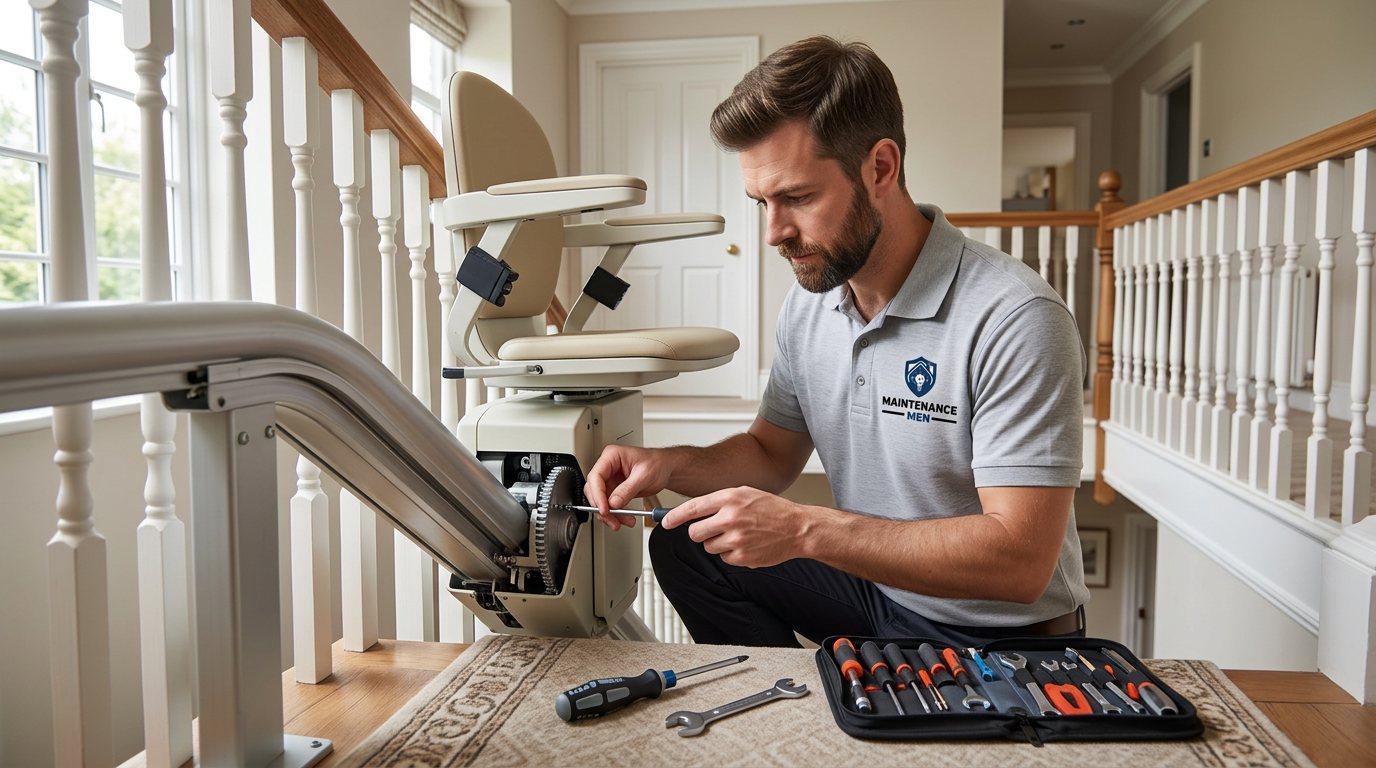
Electrical Fault in Your Stair Lift? Traced Properly and Safely in Birmingham
We test the supply, charging chain, loom and electronics systematically, find the fault, and quote the repair before work begins.
Booking fee plus hourly labour — the price is confirmed before any work starts.
What this costs
| Booked 14+ days ahead | £25 booking fee £85 per hour |
|---|---|
| Booked within 48 hours | £100 booking fee £65 per hour |
| Same-day call-out | £220 booking fee £45 per hour |
The booking fee secures the visit. Labour is then charged by the hour, so you only pay for the time the job actually takes.
Booking fee £25–£220
£25 + £85/hr booked 14+ days ahead, £100 + £65/hr inside 48 hours, £220 + £45/hr same day. Agreed before we arrive.
Covered under Stair Lifts
Mobility & Accessibility › Stair Lifts — one of 24 documented jobs in this section.
Same-day electrical fault in stair lift
Urgent jobs can often be booked for today. Ask when you book and we will confirm the slot before you pay anything.
15 service areas
Birmingham, Coventry, Dorridge and 12 more across the West Midlands.
Almost every mysterious stair lift symptom has an electrical candidate behind it: refuses to move, stops mid-journey, behaves erratically, trips the house electrics, or shows fault lights that come and go. What separates a professional diagnosis from guesswork is method — testing the electrical path in a logical order until the fault is found, rather than swapping parts and hoping.
The electrical path, end to end
It starts at the mains: the socket, any switched spur, the charger unit's supply and its fuse. Then the charging chain: charger output, the rail's charge contacts, and the carriage's pickup. Then the batteries themselves and their connections. From there the lift's own electrics: the main fuse or breaker on the carriage, the wiring loom that flexes with every journey, the connectors at every junction, the key and isolation switches, the control board and its electronics, and finally the motors, sensors and controls each circuit feeds. A fault anywhere along that path produces symptoms somewhere else — which is why the order matters and why a single symptom rarely points to a single component.
Symptoms and what they suggest
A completely dead lift suggests the supply or charging chain. A lift dead at one end of the rail but alive at the other suggests contacts or a break in the loom. Erratic behaviour — beeping without reason, moving briefly then stopping, lights flickering — suggests a loose connector, a failing board or a marginal battery sagging under load. Tripping the house electrics is a short circuit somewhere and needs urgent attention. Burning smells mean stop using the lift immediately and book urgently.
What you must not do
Do not open the lift's covers or attempt electrical testing — mains-voltage and battery-side electrics on a lift are engineer work, full stop. Do not keep resetting a lift that trips the house electrics; repeated tripping means the fault is active. Do not use a lift that has smelled of burning or behaved erratically until it has been checked. And if it stops with someone aboard, keep them safe, comfortable and calm, call 999 if they are in pain or distress, and use a manual release only strictly per the manufacturer's instructions by a confident person — never climb under, push or force a suspended lift.
How we find the fault
We work along the path with the right instruments: supply voltage at the socket and charger, charger output under load, contact continuity and condition, battery voltage and load behaviour, then the loom flexed and tested along its whole travel, every connector checked and re-seated, switches tested, and the board and motor circuits tested where the evidence points. We note what the lift's own fault indicators report and use it as a cross-check, not a verdict. Once the fault is proven, we quote the repair in full for your approval — a connector, loom section, charger, batteries or board, using manufacturer-approved parts, parts quoted separately — and complete it, then prove the lift through repeated full travel cycles.
Honest options on older lifts
Where a control board or charger is obsolete on an older lift, we will say so plainly and discuss the realistic options — including whether a replacement lift serves you better than a repair that cannot promise longevity. We never promise stock availability or repair durations before diagnosis.
Aftercare
Keep the charging area dry and clean, avoid trailing leads and extension reels near the charger supply, and report flickering lights or new beep patterns immediately — early electrical faults are nearly always cheaper than late ones. An annual service includes a full electrical check.
Booking
Get in touch with the make and model and a precise description of the symptoms, including anything about tripping or smells. You pay a booking fee when you book, the hourly labour rate depends on how soon you need us, and the full cost is quoted and approved before work begins, with parts quoted separately.
How the price works
We charge a booking fee to hold your slot, then an hourly rate for the work itself. The fee changes with how soon you need us; the hourly rate changes with the slot you choose. You approve the price before we start, so there is no surprise on the invoice.
Booked 14+ days ahead
£25 booking fee
then £85 per hour of labour
Best value. Book the slot now, pay the smallest booking fee.
Booked within 48 hours
£100 booking fee
then £65 per hour of labour
For jobs that can wait a day or two but not a fortnight.
Same-day call-out
£220 booking fee
then £45 per hour of labour
Urgent problems: standing water, no heat, no power, leaks.
Book the slot
Choose the window that suits you and pay the booking fee. That holds your place in the diary.
We diagnose on site
The engineer confirms the cause and tells you what the job involves and how long it should take.
You approve, we work
Nothing goes ahead until you agree the price. Labour is then charged per hour at your slot rate.
Electrical faults can hide anywhere between the wall socket and the lift's control board, and guessing is the worst way to find them. Our engineers test the whole electrical path in order until the fault is proven — then explain it and quote before touching anything.
What our customers say about our mobility & accessibility service
4.5 out of 5 from 8 reviews
Proper job, no upselling
Turned up in the window they promised, walked me through the options (turns out the old fitting was seized and needed careful removal), then cracked on. Everything was tested before they left. No mess, no drama, no surprise on the bill.
Job: Loose or Faulty Brakes
Fine in the end
The problem is fixed, which is the main thing, and the engineer clearly knew what they were doing. It took a fair bit longer than the estimate on the phone and I had to ask twice for a breakdown of the hours.
Job: Stair Lift Service
Would use again
What I appreciated was being told what was actually wrong before anyone started. Sorted in under 70 minutes and the invoice matched the quote to the penny.
Job: Control Panel Fault
Book Electrical Fault in Stair Lift
Tell us what is happening and choose a slot. If you are not sure this is the right job, use the diagnosis panel — it narrows the problem down before you book.
- Booking fee confirmed up front
- Hourly labour, agreed before work starts
- Same-day slots for urgent problems



Questions people ask about electrical fault in stair lift
Straight answers to the things customers ask most often before booking.
My lift keeps tripping the house electrics — should I keep resetting it?
No. A lift that trips the electrics has an active fault, and repeatedly resetting it risks damage or worse. Leave it switched off and book an urgent visit. If it has also smelled of burning, do not use it at all until an engineer has checked it.
What do you test during an electrical diagnosis?
The whole path in order: mains supply and charger output, the charging contacts, battery voltage under load, the wiring loom flexed along its travel, every connector, the switches, and the board and motor circuits where indicated. The fault is proven before any repair is quoted.
Can I check the fuse or plug myself?
Checking that the charger's plug is seated and its socket switch is on is reasonable, and the manual may show a user-accessible fuse. Beyond that — testing voltages, opening covers, touching the loom — is engineer work. Mains-side and internal electrics on a stair lift are not DIY territory.
The lift moves on its own sometimes without a button pressed — is that electrical?
It could be a failing control board, a damaged loom or moisture in the controls, and it is serious. Stop using the lift immediately and book urgently. If it ever stops with someone aboard, keep them safe and comfortable, call 999 if they are in distress, and use manual release only per the manufacturer's instructions.
What does an electrical fault diagnosis cost?
You pay a booking fee when you book, and labour is charged hourly at a rate that depends on how soon you need the visit. Once the fault is found we quote the full cost of the repair for your approval before starting, and parts are quoted separately.
Need electrical fault in stair lift sorted in Birmingham?
Book a slot in the diary and pay only the booking fee up front. We confirm the rest before we start.