
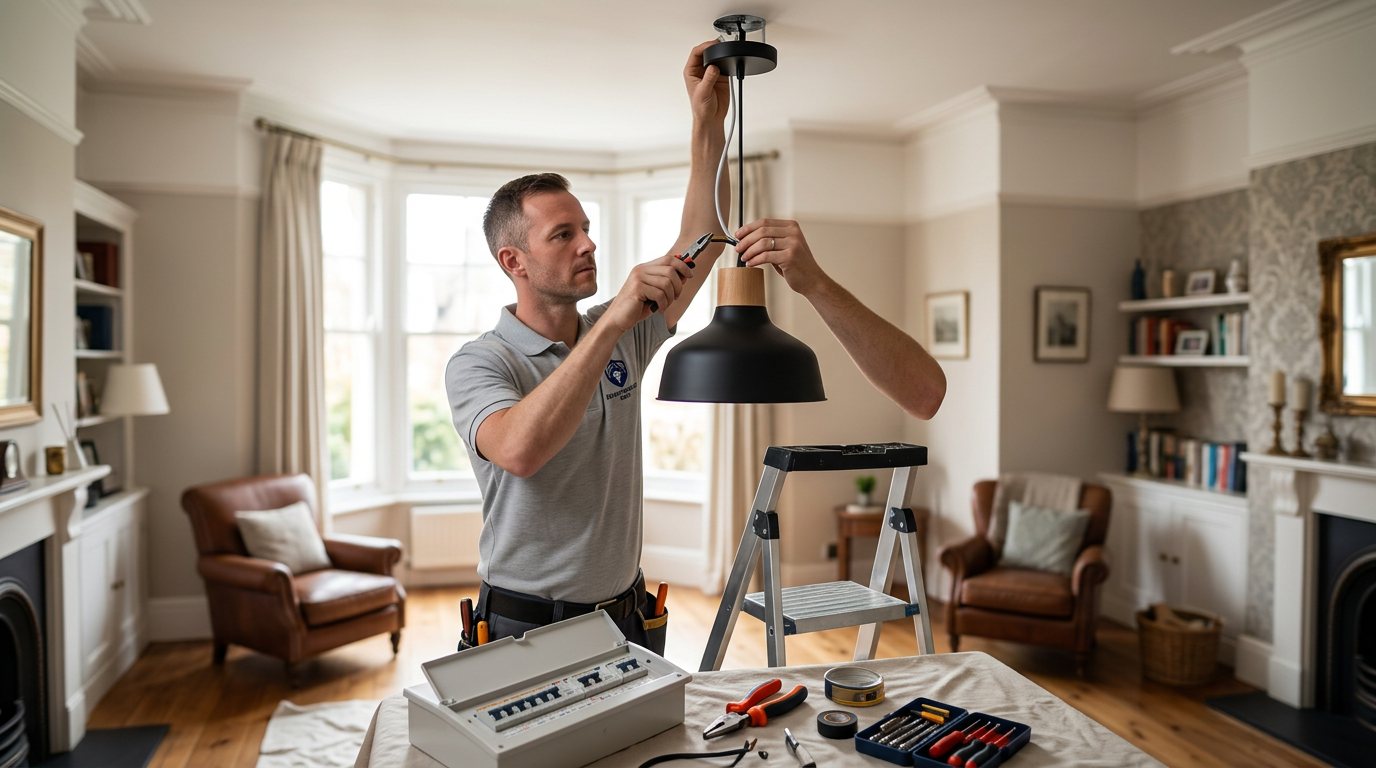
Lights That Cut In and Out? Intermittent Faults Are Our Speciality in Birmingham
Lighting that works one minute and dies the next is the hardest fault to pin down — and the one where methodical testing beats guesswork every time.
Booking fee plus hourly labour — the price is confirmed before any work starts.
What this costs
| Booked 14+ days ahead | £25 booking fee £85 per hour |
|---|---|
| Booked within 48 hours | £100 booking fee £65 per hour |
| Same-day call-out | £220 booking fee £45 per hour |
The booking fee secures the visit. Labour is then charged by the hour, so you only pay for the time the job actually takes.
Booking fee £25–£220
£25 + £85/hr booked 14+ days ahead, £100 + £65/hr inside 48 hours, £220 + £45/hr same day. Agreed before we arrive.
Covered under Lighting
Electrical › Lighting — one of 20 documented jobs in this section.
Same-day intermittent lighting control
Urgent jobs can often be booked for today. Ask when you book and we will confirm the slot before you pay anything.
15 service areas
Birmingham, Coventry, Dorridge and 12 more across the West Midlands.
Intermittent faults are the diplomatically difficult ones of the electrical world. A light that's permanently dead can be diagnosed in minutes. A light that works most of the time, cut out last Tuesday, came back by itself, and now behaves when you demonstrate it to anyone — that takes a different approach. This page explains why lights cut in and out, how we trap a fault that won't perform on demand, and what the usual fixes turn out to be.
Why Lights Behave Intermittently
The overwhelming majority of intermittent lighting faults come down to a connection that is making and breaking. A conductor backed slightly off its terminal touches, then vibrates away from contact — thermal expansion as the fitting warms up, or physical vibration, decides when. That's why the pattern so often follows heat: the light works when first switched on, cuts out after the fitting has been running a while, and comes back once it's cooled. People describe it as "the light gets tired" — it's actually a joint opening as the metal expands.
Other causes include a switch mechanism whose contacts have worn to the point of unreliability, a lamp holder that only makes contact when the bulb sits at a particular angle, a failing dimmer or transformer module that drops out under load, and — where control gear is involved — electronics that shut down when they overheat and reset when they cool.
Why the Fault Hides When We Visit
Intermittent faults are time-dependent and heat-dependent, and a diagnosis visit is brief and cool by comparison to an evening's use. Rather than hoping the fault appears on cue, we work the evidence: the pattern you've observed is data, and a good description of it narrows the search enormously.
How We Trap an Intermittent Fault
We start by interviewing the pattern. Does it cut out after running a while, or at random? One light or several? Does wiggling anything change it — the switch, the bulb? Did it start after any change in the house, however unrelated it seemed? Then we test the components in the light's chain with proper instruments, looking specifically for the marginal conditions an intermittent fault lives in: a connection with slight resistance, a switch contact that reads inconsistently, a lamp holder that grips poorly, a module that behaves differently warm than cold. Where nothing shows under static testing, we can load-test and thermal-check the circuit to provoke the fault deliberately rather than waiting for it.
The Usual Fixes
Because most intermittent faults are connection faults, the most common repair is remaking terminations — and remaking them properly, with conductor trimmed back to bright metal and terminals torqued down, not just "nipped up". A worn switch mechanism gets replaced; a tired lamp holder likewise. A control module that drops out under load is replaced with one correctly rated for the job. Whatever we find, the fix targets the make-and-break point itself, because anything less just schedules a return visit.
After the Repair
Intermittent faults deserve a follow-up mindset. We'll tell you exactly what we found, what we changed, and what to watch for in the following weeks. If the same symptom recurs — and honest engineers admit this is occasionally the case with faults that never showed themselves during testing — we return and continue the trace rather than charging you from scratch for a fresh diagnosis.
When to Call Us
Book a visit when any light cuts in and out, when a switch or fitting behaves differently warm than cold, when jiggling a switch or bulb changes the behaviour, or when several lights on the same circuit share the same intermittent habit. That last one suggests a shared connection, and shared faults affect everything downstream of them.
Book Your Intermittent Fault Diagnosis Today
Tell us the pattern — when it fails, how it recovers, what makes it worse — when you book, and you'll give the engineer a head start that can save real time on the visit. Call Maintenance Men or book online: qualified electricians, fully insured, patient with faults that don't perform on demand, covering the West Midlands.
How the price works
We charge a booking fee to hold your slot, then an hourly rate for the work itself. The fee changes with how soon you need us; the hourly rate changes with the slot you choose. You approve the price before we start, so there is no surprise on the invoice.
Booked 14+ days ahead
£25 booking fee
then £85 per hour of labour
Best value. Book the slot now, pay the smallest booking fee.
Booked within 48 hours
£100 booking fee
then £65 per hour of labour
For jobs that can wait a day or two but not a fortnight.
Same-day call-out
£220 booking fee
then £45 per hour of labour
Urgent problems: standing water, no heat, no power, leaks.
Book the slot
Choose the window that suits you and pay the booking fee. That holds your place in the diary.
We diagnose on site
The engineer confirms the cause and tells you what the job involves and how long it should take.
You approve, we work
Nothing goes ahead until you agree the price. Labour is then charged per hour at your slot rate.
An intermittent lighting fault is uniquely maddening: the engineer arrives and the lights behave perfectly. We work with the evidence rather than the moment — testing connections, loads and controls to find what's making and breaking, and fixing it at the point where it actually fails.
What our customers say about our electrical service
4.6 out of 5 from 11 reviews
Does what it says on the tin
No complaints about the work itself — clear explanation, sensible advice, fair price. Booking online was easy enough once I found the right job page.
Job: Smoke Alarm Replacement
Fixed it, but took longer than expected
Work itself was fine and tidy. Communication beforehand was patchy — I did not get the confirmation message and had to ring to check the slot. Would still use again.
Job: Flickering Outdoor Lights
Turned up when they said
Third time we have used Maintenance Men, and the same experience each time: agreed price, proper explanation, job done in one visit. The hourly rate is fair for the standard of work.
Job: Appliance Causing Power Trip
Book Intermittent Lighting Control
Tell us what is happening and choose a slot. If you are not sure this is the right job, use the diagnosis panel — it narrows the problem down before you book.
- Booking fee confirmed up front
- Hourly labour, agreed before work starts
- Same-day slots for urgent problems








Questions people ask about intermittent lighting control
Straight answers to the things customers ask most often before booking.
How do you charge for a fault that comes and goes?
The same way as any job: a booking fee when you book, hourly labour at a rate based on how quickly you attend to the visit, and a full quote that you approve before any repair work starts. If the fault doesn't reproduce on the first visit, we tell you what we tested and found rather than billing for a shrug.
Is there anything I can do before the engineer arrives?
Collect evidence. Note exactly when it cuts out, how long it's been running when it does, whether it recovers by itself or needs the switch cycled, and whether touching the switch or bulb changes anything. Don't open fittings or switches — but a written pattern is worth more to us than an hour of guessing.
How do you find a fault that won't show itself?
We test the whole chain — switch, terminations, lamp holder, any control gear — looking for marginal conditions: connections with slight resistance, contacts that read inconsistently, modules that behave differently warm than cold. Where static testing finds nothing, we can load and thermal-test to provoke the fault rather than waiting for it to volunteer.
Could an intermittent light be a safety issue?
It can be, because the most common cause — a connection that makes and breaks — is the same mechanism that produces arcing and heat. If the cut-outs come with flickering, buzzing, warmth or smell, treat it as urgent. A purely random cut-out with no other symptoms is more likely a tired component, but it still worsens over time rather than healing.
What if the fault doesn't happen on your visit?
That's the nature of intermittent faults, and we plan for it. We test everything in the chain anyway, remaking anything marginal we find, and we leave you with a clear record of what was checked and changed. If the symptom returns, call us and we'll continue the trace with that history in hand.
Need intermittent lighting control sorted in Birmingham?
Book a slot in the diary and pay only the booking fee up front. We confirm the rest before we start.